A project is an important part of software engineering and project management because it helps organizations achieve specific goals within a defined time and budget. In simple terms, a project is a planned set of activities that are carried out to create a product, service, or result. Every software system, mobile application, or website is developed through a project. Therefore, proper project planning and management are necessary for successful completion. Overall, a project helps teams organize tasks, manage resources, and deliver quality results on time.
These are widely used in software engineering, business, construction, and many other fields to organize and manage complex tasks effectively. In today’s competitive environment, organizations rely on projects to develop new products, improve services, and achieve strategic goals. A well-planned project helps teams complete work in a systematic and controlled manner. Moreover, it ensures proper coordination between team members and efficient use of resources. Therefore, understanding the concept of a project and its characteristics is essential for successful planning and execution of any task.
What is Project?
A project is a temporary and planned set of activities undertaken to achieve a specific goal or create a unique product, service, or result within a defined time, cost, and scope. It involves organized tasks, limited resources, and a clear objective to ensure successful completion. A project follows a structured process such as planning, execution, monitoring, and completion. In simple terms, a project is a systematic effort to accomplish a specific target within a fixed period and budget.
For example, A software company develops a college management system as a project. First, the team collects requirements such as student records, attendance, and fee management. Then, they design and develop the software within a fixed time and budget. After testing and verification, the system is delivered to the college for daily use. This example shows how a project is a planned effort with a clear goal, limited resources, and a defined timeline.
Diagram of Project Lifecycle
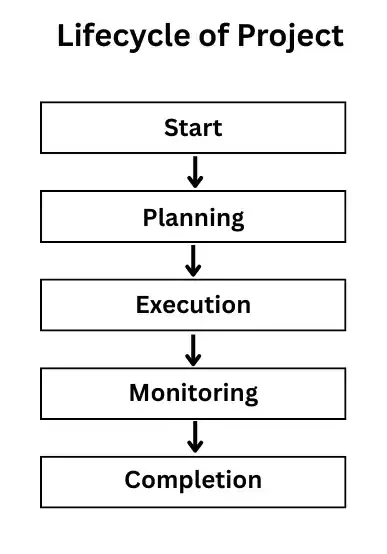
Fig: Basic Project Lifecycle
Explanation of the diagram of Lifecycle of Project
The project lifecycle shows the different stages through which a project passes from beginning to end. It helps teams plan, execute, and complete the project in a structured way. Each stage has specific tasks and responsibilities that ensure smooth progress. The lifecycle makes project management easier and more organized. Overall, the project lifecycle helps in achieving project goals efficiently and on time.
Following are the steps followed in lifecycle of a project:-
1. Start (Initiation Phase)
The start phase is the beginning of the project lifecycle. In this stage, the project idea is identified and evaluated for feasibility. Project goals, objectives, and scope are defined clearly. Stakeholders and project managers are selected to lead the project. This phase ensures that the project is necessary and beneficial before moving to planning.
Key Points:
- Identify project idea
- Define project objectives
- Select project team
- Check feasibility
- Get approval from stakeholders
2. Planning Phase
The planning phase focuses on preparing a detailed project plan. In this stage, tasks, timelines, resources, and budget are defined clearly. Risk analysis and quality planning are also done to avoid future problems. A proper plan helps the team work in a structured manner. Therefore, planning is the most important stage of the project lifecycle.
Key Points:
- Define project scope and requirements
- Create project schedule
- Allocate resources and budget
- Identify risks and solutions
- Prepare project documentation
3. Execution Phase
The execution phase is where the actual work of the project begins. In this stage, the project team develops the product or service according to the plan. Tasks are assigned to team members, and work is carried out step by step. Communication and coordination are important during execution. This phase ensures that the project progresses according to the plan.
Key Points:
- Develop product or service
- Assign tasks to team members
- Implement project plan
- Maintain communication
- Deliver project outputs
4. Monitoring Phase
The monitoring phase ensures that the project is running smoothly. In this stage, project progress is tracked and compared with the planned schedule. Managers check quality, performance, and cost regularly. If any problem occurs, corrective actions are taken immediately. Monitoring helps in controlling risks and improving project performance.
Key Points:
- Track project progress
- Check quality and performance
- Control time and cost
- Identify issues and risks
- Take corrective actions
5. Completion Phase
The completion phase is the final stage of the project lifecycle. In this stage, the project is finished and delivered to the customer. Final testing, documentation, and evaluation are completed. The team reviews project performance and records lessons learned. This phase ensures successful project closure and customer satisfaction.
Key Points:
- Deliver final product
- Complete documentation
- Evaluate project performance
- Get customer approval
- Close the project
Objectives of a Project
The objectives of a project define the goals and targets that need to be achieved during the project lifecycle. These objectives guide the project team in planning, executing, and completing tasks efficiently. Clear project objectives help in managing time, cost, and resources properly. They also ensure that the final product meets customer requirements and quality standards. Therefore, project objectives play an important role in successful project management.
There are several objectives of a project as follows:-
1. Achieve Specific Goals
The main objective of a project is to achieve a specific goal or target. Every project is started to create a product, service, or result. The team works according to defined goals and objectives. This helps in completing tasks in an organized way. As a result, the project delivers expected outcomes successfully.
2. Complete Project on Time
Another important objective is to complete the project within the given time. Proper scheduling and planning help in meeting deadlines. Time management ensures smooth project progress and reduces delays. Teams follow timelines and milestones during development. Therefore, timely completion increases project success.
3. Control Project Cost
Projects aim to complete work within the allocated budget. Proper cost planning and monitoring help in avoiding unnecessary expenses. Resource allocation is done carefully to reduce wastage. This ensures financial stability and efficiency. Hence, cost control is an important project objective.
4. Maintain Quality Standards
Projects focus on delivering high-quality products or services. Quality control and testing ensure that the final product meets requirements. Proper standards and guidelines are followed during development. This improves customer satisfaction and reliability. Therefore, maintaining quality is a key objective.
5. Efficient Resource Utilization
Projects use resources such as manpower, technology, and materials effectively. Proper resource management reduces wastage and improves productivity. Teams allocate resources according to project needs. This ensures smooth execution of tasks. As a result, project performance improves.
6. Improve Team Coordination
Projects aim to improve teamwork and communication among team members. Proper coordination helps in completing tasks efficiently. Team members share responsibilities and support each other. This reduces conflicts and misunderstandings. Therefore, coordination improves project success.
7. Ensure Customer Satisfaction
The final objective of a project is to satisfy customer needs and expectations. The product or service should meet user requirements and quality standards. Timely delivery and reliability increase customer trust. Satisfied customers improve business reputation. Hence, customer satisfaction is an essential objective.
Characteristics of Project
The characteristics of a project describe the key features that make a project different from regular work or daily operations. These characteristics help in understanding how a project is planned, executed, and completed within a specific time and budget. Every project has a clear goal, limited resources, and a defined timeline. It also involves teamwork, planning, and risk management to achieve success. Therefore, understanding project characteristics is important for effective project management and smooth execution.
Following are the various characteristics of a project:-
1. Unique in Nature
Every project is unique and has a specific objective or goal. No two projects are exactly the same because requirements, resources, and outcomes differ. For example, developing a mobile app is different from building a hospital management system. Each project follows a different approach and design. Therefore, uniqueness is an important characteristic of a project.
2. Temporary in Nature
A project is temporary and has a fixed start and end point. It begins with planning and ends after achieving its objective. Unlike routine work, a project does not continue forever. For example, building a website ends after deployment and delivery. Hence, projects are temporary in nature.
3. Defined Objectives
Every project has clear and well-defined objectives that guide the team. These objectives help in planning and executing tasks properly. Without clear goals, the project may fail or lose direction. Objectives ensure that the team works toward a common target. Therefore, defined objectives are a key characteristic.
4. Limited Resources
Projects operate with limited resources such as time, money, manpower, and technology. Teams must use these resources efficiently to achieve goals. Poor resource management can delay or fail the project. Proper planning helps in resource utilization. Hence, limited resources are an important characteristic.
5. Fixed Time and Budget
Every project must be completed within a specific time and budget. Deadlines and financial limits are defined during planning. Teams work according to schedules and cost constraints. This ensures proper control and management. Therefore, fixed time and budget are essential characteristics.
6. Interrelated Activities
A project consists of many related tasks and activities that depend on each other. Each activity must be completed in sequence for smooth progress. For example, design must be completed before coding starts. Proper coordination ensures success. Hence, interrelated activities are a key feature.
7. Risk and Uncertainty
Projects involve risks and uncertainties such as technical problems, delays, or resource shortages. Unexpected challenges may occur during development. Proper risk management helps in reducing these problems. Teams prepare backup plans to handle risks. Therefore, risk and uncertainty are common characteristics.
Types of Projects
Projects are carried out in different fields such as software engineering, construction, business, and research to achieve specific goals. Each project type is designed according to the nature of work, resources, and objectives. Understanding the types of projects helps organizations choose the right approach and management strategy. Moreover, different projects require different planning, execution, and monitoring methods. Therefore, studying project types is important for effective project management and successful completion.
Following are various types of projects:-
1. Software Development Project
A software development project focuses on designing, coding, testing, and deploying software applications. It involves activities such as requirement analysis, system design, programming, and maintenance. Examples include mobile apps, websites, and management systems. These projects require skilled developers and proper testing to ensure quality. Therefore, software development projects are widely used in IT industries.
For example, developing a mobile banking app or an e-commerce website is a software development project. Therefore, this type of project is widely used in IT industries.
2. Construction Project
A construction project involves building physical structures such as roads, bridges, buildings, and dams. It requires planning, design, materials, labor, and safety measures. Engineers and architects work together to complete the project within time and budget. Construction projects are usually large and resource-intensive. Hence, proper project management is essential for success.
For example, constructing a highway or a shopping mall is a construction project. Hence, proper planning and resource management are essential.
3. Research Project
A research project focuses on discovering new knowledge, ideas, or solutions to problems. It involves data collection, analysis, experiments, and reporting results. Universities, scientists, and organizations conduct research projects in various fields. These projects help in innovation and technological development. Therefore, research projects are important for progress and development.
For example, developing a new medicine or studying artificial intelligence algorithms is a research project. Therefore, research projects are important for technological progress.
4. Business Project
A business project is undertaken to improve business operations or launch new products and services. It includes marketing campaigns, product development, and business expansion activities. Proper planning and budgeting are required for success. These projects help organizations achieve growth and profitability. Hence, business projects are important in the corporate sector.
For example, launching a new smartphone or opening a new branch of a company is a business project. Hence, business projects support organizational growth.
5. IT Infrastructure Project
An IT infrastructure project focuses on developing networks, servers, databases, and hardware systems. It includes installing computer systems, network setup, and data management solutions. These projects improve organizational efficiency and communication. IT professionals manage and maintain these systems. Therefore, IT infrastructure projects are essential in modern organizations.
For example, setting up a company’s computer network or cloud storage system is an IT infrastructure project. Therefore, it is essential in modern organizations.
6. Government Project
Government projects are carried out to provide public services and infrastructure. Examples include smart city development, road construction, healthcare systems, and public transport systems. These projects aim to improve public welfare and economic growth. Government projects require proper planning and monitoring. Hence, they play an important role in national development.
For example, building metro rail systems or developing smart cities is a government project. Hence, these projects benefit society and the economy.
7. Engineering and Manufacturing Project
Engineering and manufacturing projects focus on designing and producing machines, vehicles, and industrial products. Engineers plan, design, and test products before manufacturing. These projects ensure quality and safety in production. Proper management improves efficiency and reduces cost. Therefore, engineering projects are important in industries.
For example, manufacturing cars or designing industrial machines is an engineering project. Therefore, it is important in industrial development.
Advantages of Project
1. Clear Goal Achievement
A project helps in achieving specific goals in a structured and organized manner. The team works according to defined objectives and plans. This ensures that all activities move in the right direction. As a result, the desired product or service is delivered successfully. Therefore, projects improve goal achievement.
2. Better Planning and Control
Projects involve proper planning, scheduling, and monitoring of activities. Managers can track progress and control resources effectively. This helps in reducing confusion and delays. Planning also improves decision-making. Hence, project management becomes more efficient.
3. Efficient Use of Resources
Projects ensure proper utilization of resources like time, money, and manpower. Resources are allocated based on project requirements. This reduces wastage and improves productivity. Teams work efficiently with limited resources. Therefore, resource management becomes better.
4. Improved Team Coordination
Projects encourage teamwork and communication among team members. Each member has defined roles and responsibilities. This improves coordination and understanding. As a result, tasks are completed smoothly and efficiently. Therefore, teamwork increases project success.
5. Timely Completion of Work
Projects follow a fixed schedule and deadlines. This helps in completing tasks within a specific time frame. Proper time management reduces delays and improves productivity. Teams focus on meeting milestones. Hence, projects ensure timely completion.
6. Quality Improvement
Projects focus on maintaining quality standards in development. Proper testing and monitoring ensure high-quality output. Quality control reduces defects and errors. This increases customer satisfaction. Therefore, project-based work improves product quality.
7. Customer Satisfaction
Projects deliver products or services according to customer requirements. Timely delivery and quality results build trust and confidence. Customers feel satisfied with the final product. This improves the organization’s reputation. Hence, customer satisfaction increases.
Disadvantages of Project
1. High Cost
Projects require financial investment for resources, tools, and manpower. Poor planning may increase expenses and budget issues. Large projects especially require more funding. This can create financial pressure on organizations. Therefore, high cost is a major disadvantage.
2. Time-Consuming
Project planning and execution take a lot of time and effort. Delays may occur due to technical or resource problems. Long development time may affect productivity. Teams must follow strict schedules. Hence, projects can be time-consuming.
3. Risk and Uncertainty
Projects involve various risks such as technical failure, delays, or budget issues. Unexpected problems may arise during development. Risk management is required to handle these challenges. Without proper planning, projects may fail. Therefore, risk is a major disadvantage.
4. Complex Management
Managing large projects is difficult and requires strong leadership. Coordination between different teams becomes challenging. Managers must handle multiple tasks and responsibilities. This increases workload and complexity. Hence, project management becomes complex.
5. Requires Skilled Professionals
Projects require experienced and skilled team members. Lack of skills can reduce project quality and efficiency. Training and expertise are necessary for successful execution. Skilled professionals may also increase project cost. Therefore, skilled manpower is required.
6. Resource Limitations
Projects operate with limited resources such as time, money, and manpower. Poor allocation may delay project completion. Limited resources create pressure on the team. Proper planning is needed to manage them. Hence, resource limitation is a disadvantage.
7. Dependency on Proper Planning
Project success depends heavily on planning and management. Weak planning may lead to failure and delays. Improper scheduling affects the entire project lifecycle. Teams must follow a clear plan for success. Therefore, planning dependency is a limitation.
Applications of Project
1. Software Development Projects
Projects are widely used in developing software, mobile apps, and websites. Teams plan, design, code, and test the system step by step. This ensures quality and timely delivery. Therefore, projects are essential in software engineering.
2. Construction Projects
Projects are used in building roads, bridges, and buildings. Engineers plan and manage resources for construction work. Proper project management ensures safety and quality. Hence, projects are important in construction.
3. Business and Marketing Projects
Companies use projects to launch new products and marketing campaigns. Planning and execution help in achieving business goals. This improves market growth and customer reach. Therefore, projects support business development.
4. IT Infrastructure Projects
Projects are used in developing networks, databases, and IT systems. Proper planning ensures smooth installation and maintenance. This improves organizational performance. Hence, IT projects are widely used.
5. Research and Development Projects
Research projects help in developing new technologies and innovations. Scientists and engineers work on experiments and analysis. This leads to new discoveries and improvements. Therefore, projects support research activities.
6. Government and Public Projects
Government uses projects for public services like roads, hospitals, and smart cities. Proper project management ensures timely completion. This improves public infrastructure and services. Hence, projects are useful in government sectors.
7. Engineering and Manufacturing Projects
Projects are used in designing machines, vehicles, and industrial products. Engineers plan and develop systems carefully. This ensures efficiency and safety. Therefore, projects are important in engineering fields.
Conclusion
Projects are essential for achieving specific goals in different fields such as software, construction, business, and government sectors. Each type of project has its own purpose, process, and resources, which help organizations complete tasks efficiently. Understanding the types of projects and their characteristics improves planning, management, and execution.
For example, software projects focus on application development, while construction projects focus on building infrastructure. Proper project management ensures timely completion and better results. Overall, projects play a vital role in organizational growth, innovation, and national development.