Software Development Life Cycle (SDLC) is a structured process used to develop software in a systematic way. Moreover, it helps in planning, designing, developing, testing, and maintaining software. It also ensures that the software meets user requirements and quality standards. Therefore, SDLC improves project management and software development efficiency.
SDLC improves software development by providing a structured and systematic process. Moreover, it helps in better planning and resource management. It also ensures software quality and timely delivery. Therefore, SDLC increases project success and customer satisfaction.
For example, a mobile banking application follows SDLC to ensure proper development. Moreover, planning defines features like login and balance check. Development builds the application and testing removes bugs. Therefore, SDLC helps in delivering a secure and reliable banking app.
What is Software Development Life Cycle (SDLC)
The Software Development Life Cycle (SDLC) is a structured process used by software developers to design, develop, test, and maintain software efficiently. It provides a systematic approach to manage software projects from initial planning to final deployment and maintenance. SDLC ensures that software is delivered on time, within budget, and meets user requirements. It also helps in improving software quality, reducing errors, and optimizing resources throughout the development process.
Phases of Software Development Life Cycle (SDLC)
The Software Development Life Cycle (SDLC) consists of several phases that help in developing software in a structured and systematic way. First, planning defines project goals, scope, cost, and resources to provide a clear direction. Next, requirement analysis collects and documents user needs so that the system can be developed correctly.
Then, design creates system architecture, database structure, and user interface to form a blueprint of the software. After that, development converts design into working software through coding, while testing checks errors and improves software quality and reliability.
Finally, deployment installs the software in a real environment and maintenance updates and improves the system to ensure long-term performance and user satisfaction.
Flowchart diagram of SDLC Phases
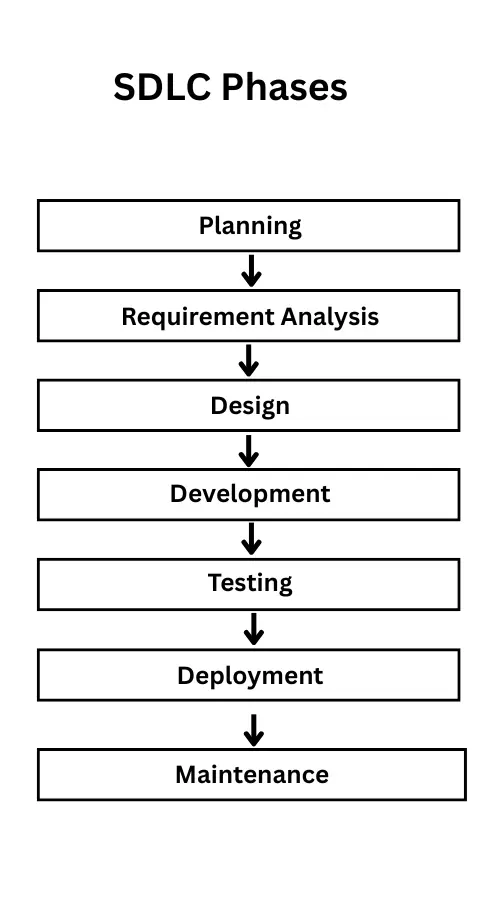
Figure: Phases of SDLC
Let’s see the detailed explanation for the phases of SDLC:-
1. Planning
Planning is the first phase of SDLC where project goals, scope, and resources are defined. Moreover, the team identifies project requirements and prepares a feasibility study to check whether the project is possible or not. It also includes cost estimation, risk analysis, and timeline planning. Therefore, planning provides a clear direction for the software project. As a result, the team can start the project in an organized and systematic way.
2. Requirement Analysis
Requirement analysis is the phase where developers collect and understand user requirements. Moreover, the team interacts with clients and stakeholders to gather system needs and expectations. It also prepares Software Requirement Specification (SRS) documents for better understanding. Therefore, this phase ensures that the software is developed according to user needs. As a result, it reduces confusion and development errors.
3. Design
Design is the phase where system architecture and structure are created. Moreover, developers design database structure, user interface, and system modules. It also includes technical and logical design of the software. Therefore, design provides a clear blueprint for development. As a result, developers can build the software easily and efficiently.
4. Development
Development is the phase where actual coding of software takes place. Moreover, developers convert design into working software using programming languages and tools. It also includes module development and feature implementation. Therefore, this phase builds the complete system step by step. As a result, the software starts taking its final shape.
5. Testing
Testing is the phase where software is checked for errors and bugs. Moreover, testers verify system performance, security, and functionality. It also ensures that the software works correctly according to requirements. Therefore, testing improves software quality and reliability. As a result, users receive error-free software.
6. Deployment
Deployment is the phase where software is installed in a real environment. Moreover, the system becomes available to users and clients. It also includes user training and system configuration. Therefore, deployment completes the software delivery process. As a result, users can start using the software.
7. Maintenance
Maintenance is the final phase of SDLC where software is updated and improved. Moreover, developers fix bugs and add new features based on user feedback. It also improves system performance and security. Therefore, maintenance ensures long-term software usability. As a result, the software remains efficient and reliable.
Objectives of SDLC
The main objective of SDLC is to develop high-quality software in a structured and organized way. Moreover, it helps in proper planning and resource management. It also ensures timely project completion and error-free software. Therefore, SDLC improves software performance and customer satisfaction.
Following are the objectives of SDLC:-
1. Develop High-Quality Software
The primary objective of SDLC is to develop software that is reliable, efficient, and meets user requirements. It ensures that the software functions properly and performs optimally. SDLC focuses on reducing errors, identifying defects early, and improving overall performance. By following structured development processes, organizations can deliver software that satisfies both technical and business needs.
2. Improve Project Planning and Management
SDLC provides a framework for proper planning and management of software projects. It clearly defines project goals, timelines, and available resources. This structure improves coordination between team members and allows for systematic tracking of progress. As a result, SDLC supports organized execution, better decision-making, and timely completion of project tasks.
3. Reduce Development Cost and Time
One of the main objectives of SDLC is to control the cost and time of software development. By reducing unnecessary work, avoiding rework, and optimizing resource usage, SDLC minimizes project expenses. Efficient planning and structured workflows ensure that software is developed faster, saving both time and money while maintaining quality standards.
4. Ensure Proper Testing and Quality
SDLC integrates testing into every phase of software development. This allows errors and bugs to be identified and fixed early in the process. Continuous testing ensures that the software is reliable, secure, and meets functional requirements. This objective emphasizes high-quality software delivery, reducing post-deployment issues and improving customer satisfaction.
5. Improve Team Coordination
SDLC clearly defines roles and responsibilities for developers, testers, and managers. This improves communication, collaboration, and teamwork throughout the project. Better coordination reduces misunderstandings, enhances efficiency, and ensures that tasks are executed smoothly according to the project plan.
6. Support Maintenance and Updates
SDLC provides guidelines for software maintenance after deployment. It allows for bug fixes, updates, and performance improvements over time. By supporting ongoing maintenance, SDLC ensures that the software remains functional, secure, and useful for long-term operations.
7. Deliver Software on Time
A key objective of SDLC is to ensure that software is delivered within the scheduled timeline. Proper scheduling, monitoring, and task management help prevent delays. Timely delivery enhances customer satisfaction, builds trust, and ensures that project commitments are met efficiently.
Characteristics of Software Development Life Cycle (SDLC)
The Software Development Life Cycle (SDLC) has distinct characteristics that make it an effective framework for managing software projects. These characteristics ensure systematic planning, execution, testing, and maintenance of software. Understanding these traits helps organizations maintain quality, reduce risks, and achieve project objectives efficiently.
Following are the various characteristics of Software Development Life Cycle (SDLC):-
1. Structured and Systematic
SDLC follows a structured and organized approach to software development. Each phase has defined tasks, deliverables, and goals. This systematic process ensures clarity, reduces confusion, and improves project management efficiency.
2. Phase-Oriented
SDLC is divided into multiple phases such as requirement analysis, design, coding, testing, deployment, and maintenance. Each phase has specific objectives and outputs, allowing the team to focus on one stage at a time while ensuring proper sequencing.
3. Goal-Focused
Each phase of SDLC has clear goals, such as understanding user requirements, ensuring proper design, or testing software quality. This goal orientation helps achieve project objectives efficiently and reduces errors during development.
4. Iterative or Sequential Process
Depending on the model used (e.g., Waterfall, Agile), SDLC can be sequential or iterative. Sequential models complete one phase before moving to the next, while iterative models allow revisiting earlier phases for improvements. This flexibility enhances software quality.
5. Quality and Testing Emphasis
SDLC emphasizes continuous testing and quality assurance at every phase. Errors are identified early, reducing rework and improving reliability. This ensures that the final software meets user expectations and functional requirements.
6. Resource-Oriented
SDLC requires careful allocation of resources, including manpower, tools, and time. Efficient resource management ensures that tasks are completed on schedule without wastage, contributing to cost-effective software development.
7. Maintenance Support
SDLC considers software maintenance as an essential part of the life cycle. It provides guidelines for updates, bug fixes, and performance improvements post-deployment. This ensures long-term software usability and stability.
8. Risk Management
SDLC allows identification, assessment, and mitigation of risks during development. Early risk detection helps in taking preventive measures, ensuring smoother project execution and fewer failures.
9. Documentation and Traceability
Each SDLC phase requires proper documentation of requirements, designs, test cases, and processes. Documentation ensures traceability, improves communication, and supports future software updates or audits.
10. Customer/User Involvement
Many SDLC models, especially Agile, encourage customer feedback throughout development. This ensures that the software meets user requirements and expectations, increasing satisfaction and product success.
Advantages of Software Development Life Cycle (SDLC)
1. Improved Project Planning
SDLC provides a structured framework for planning and managing software projects. It defines clear objectives, timelines, and deliverables, which helps teams organize tasks efficiently and reduce confusion.
2. High-Quality Software
By integrating testing and validation at each phase, SDLC ensures that errors are detected early. This improves software reliability, performance, and overall quality, meeting user requirements effectively.
3. Efficient Resource Utilization
SDLC ensures optimal use of manpower, tools, and time. Resources are allocated effectively across phases, reducing wastage and improving project efficiency.
4. Better Risk Management
SDLC allows early identification and mitigation of risks during development. This reduces the chances of project failure and helps in smooth execution.
5. Timely Project Delivery
Structured scheduling and monitoring in SDLC help in completing the project within the defined timeline. This enhances customer satisfaction and ensures commitments are met.
6. Enhanced Team Coordination
Roles and responsibilities are clearly defined, improving communication and collaboration among developers, testers, and managers. This ensures smooth workflow and reduces errors.
7. Supports Maintenance and Upgrades
SDLC includes post-deployment maintenance and updates, ensuring long-term software usability, reliability, and adaptability to changing requirements.
Disadvantages of Software Development Life Cycle (SDLC)
1. Time-Consuming
The structured nature of SDLC, especially in models like Waterfall, can make the process lengthy. Each phase requires detailed planning and documentation, delaying initial delivery.
2. High Cost
Implementing SDLC involves investment in tools, documentation, testing, and skilled personnel. This can increase the overall development cost.
3. Requires Skilled Personnel
Effective SDLC implementation needs experienced project managers and developers. Lack of skilled professionals can lead to project delays or poor-quality software.
4. Limited Flexibility
Sequential SDLC models make it difficult to accommodate changes once a phase is completed. This reduces adaptability to evolving user requirements.
5. Complexity in Large Projects
Managing multiple phases and deliverables in large-scale projects can be complicated. It requires advanced planning, coordination, and monitoring.
6. Continuous Monitoring Needed
SDLC demands regular supervision and progress tracking, which can be resource-intensive and add management overhead.
7. Risk of Delays
Delays in one phase can affect subsequent phases, potentially impacting the overall project timeline. Proper monitoring is essential to avoid cascading delays.
Applications of Software Development Life Cycle (SDLC)
1. Software Development Projects
SDLC is widely used in planning, designing, coding, testing, and deploying software applications efficiently.
2. Web and Mobile Applications
Websites, mobile apps, and online platforms follow SDLC to ensure high-quality, reliable, and secure software delivery.
3. Business and Enterprise Software
SDLC is used in developing ERP, CRM, and other enterprise solutions, providing structured project management and maintenance.
4. Embedded Systems and IoT
SDLC guides the development of embedded systems and IoT devices, ensuring proper design, testing, and deployment.
5. Government and Large-Scale Projects
Public sector and infrastructure-related software projects use SDLC for systematic execution, compliance, and quality assurance.
6. Research and Development Projects
SDLC helps in organizing R&D projects that require prototyping, testing, and iterative improvements.
7. Cloud-Based Software Solutions
Cloud platforms and SaaS applications use SDLC models to ensure scalability, reliability, and continuous maintenance of software systems.
Conclusion
In conclusion, the Software Development Life Cycle (SDLC) provides a structured and systematic approach to develop high-quality software. Moreover, it helps in proper planning, designing, testing, and maintenance of software systems. It also improves team coordination, reduces risks, and ensures timely project completion. Therefore, SDLC plays an important role in successful software development and helps organizations deliver reliable and efficient software to users.