The V-Process Model is a software development model that follows a sequential approach like the Waterfall model but focuses strongly on testing at each stage. In this model, development and testing activities run in parallel. Moreover, every development phase has a corresponding testing phase. Therefore, it helps in early detection of errors and improves software quality. As a result, it is widely used in projects where high accuracy and validation are required.
For example, ATM banking software development. First, requirements like cash withdrawal and balance checking are defined. Then, each function is designed and tested step by step. Finally, system testing and acceptance testing ensure that the ATM works correctly and securely.
What is V-Process Model?
The V-Process Model, also known as the V-Model (Verification and Validation Model), is a software development methodology in which each phase of development is directly associated with a corresponding testing phase. It follows a sequential structure similar to the Waterfall Model, but emphasizes early testing and validation at every stage.
The model is called “V-Model” because its structure forms a V shape, where the left side represents development activities (requirement, design, coding) and the right side represents testing activities (unit testing, integration testing, system testing, acceptance testing).
Objectives of V-Process Model
The V-Process Model focuses on achieving high software quality through proper verification and validation at every stage of development. It aims to create a structured and systematic development process with parallel testing activities. Moreover, the objectives of this model help in reducing errors, improving reliability, and ensuring clear project planning. Therefore, understanding these objectives is important to develop secure, accurate, and well-tested software systems.
Following are the objectives of V-Process Model:-
1. Improve Software Quality
The main objective of the V-Process Model is to improve software quality through proper testing. Each development phase is connected with a testing phase. Therefore, errors are detected early in the process. As a result, the final product becomes more reliable and efficient.
2. Ensure Early Testing
Another objective is to start testing from the beginning of the project. Testing is planned during the requirement and design phases. Moreover, this reduces the chances of major errors later. Hence, it saves time and cost in software development.
3. Provide Clear Structure
The V-Process Model gives a clear and structured development process. Each phase is well defined and easy to understand. Furthermore, developers and testers work together at every stage. Therefore, project management becomes simple and organized.
4. Reduce Development Risks
This model helps in reducing project risks through proper verification and validation. Every stage is checked before moving to the next phase. As a result, the chances of failure decrease. Thus, the project becomes more stable and secure.
Characteristics of V-Process Model
1. Verification and Validation Focus
The V-Process Model strongly emphasizes both verification (checking documents and design) and validation (testing the final product) at every stage of development. Each development activity is matched with a testing activity to ensure correctness and quality. This structured testing approach reduces defects and improves reliability. As a result, the software becomes more accurate and stable.
2. Sequential Development Approach
The V-Model follows a linear and sequential development process similar to the Waterfall Model. Each phase must be completed before moving to the next stage of development and testing. This ensures proper planning and disciplined execution of project activities. It also helps in maintaining a clear workflow and structured progress.
3. Corresponding Testing Phases
Each development phase in the V-Model has a corresponding testing phase such as requirement analysis with acceptance testing, system design with system testing, and coding with unit testing. This ensures that every stage is verified and validated properly. It helps in early identification of errors and improves overall system quality.
4. Early Test Planning
Testing is planned from the beginning of the project rather than after development. Test cases, test strategies, and testing requirements are prepared during the initial phases. This reduces confusion and ensures proper testing execution later. Early test planning improves efficiency and minimizes project risks.
5. Clear Phase Structure
The V-Process Model has clearly defined phases such as requirement analysis, system design, architectural design, coding, unit testing, integration testing, system testing, and acceptance testing. Each phase has specific objectives and deliverables. This clarity helps in better project management and monitoring.
6. Strong Documentation
Detailed documentation is prepared at every stage of development and testing. Documents include requirement specifications, design documents, test plans, and reports. Proper documentation helps in maintaining records and supports future maintenance and upgrades. It also improves communication among team members.
7. Quality-Oriented Development
The V-Model focuses heavily on software quality by integrating testing with development. Continuous verification and validation ensure that the system meets user requirements and standards. This results in reliable and high-performance software systems.
8. Risk Reduction Approach
The model helps in reducing risks by identifying errors at early stages. Since testing is performed throughout the development process, defects are detected before they become major issues. This improves project stability and reduces development cost.
9. Suitable for Well-Defined Requirements
The V-Process Model works best when requirements are clear and stable from the beginning. It ensures structured development and proper testing for such projects. This makes it ideal for critical and high-reliability systems.
10. Strong Quality Control Mechanism
The V-Model ensures strict quality control through continuous monitoring and testing. Each phase is checked before moving to the next, ensuring that the final product meets high standards of quality and performance.
Uniqueness of V-Process Model
1. Parallel Development and Testing
The V-Model uniquely connects each development phase with a testing phase. Unlike the Waterfall Model, testing is not performed only at the end but throughout the process. This ensures better quality control.
2. Strong Verification and Validation Mechanism
The V-Process Model focuses heavily on verification and validation at every stage. This makes it more quality-oriented compared to other traditional models.
3. Early Test Planning Approach
Testing strategies and test cases are prepared at the beginning of the project. This early testing approach is a unique feature of the V-Model.
4. Clear Relationship Between Phases
Each development phase has a direct link with a testing phase, forming a V-shaped structure. This provides better clarity and organization in development.
5. Higher Quality Assurance
The V-Model ensures strict quality control through continuous monitoring and testing. This makes it more reliable for critical systems compared to other models.
6. Suitable for High-Risk Projects
The model is specially designed for high-risk and safety-critical projects where failure is not acceptable. This makes it unique in handling sensitive systems.
7. Structured and Disciplined Approach
The V-Model provides a disciplined and systematic development approach, ensuring organized project execution and high reliability of software systems.
V-Process Model Flow Diagram
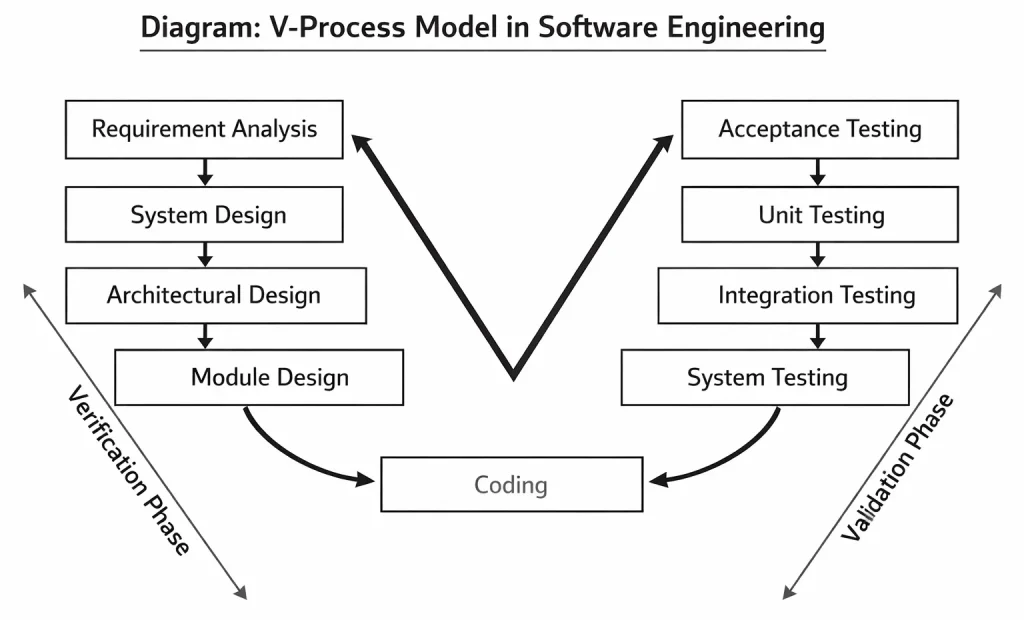
Figure: V-Process Model
Following are the phases of V-Process Model:-
1. Requirement Analysis
In this phase, the main focus is on clearly identifying the needs and expectations of users and stakeholders. Developers and analysts carefully study the problem and gather detailed information about what the system should perform in real-world situations. They interact with clients through discussions, interviews, and requirement sessions to understand business goals, system features, and operational needs. At the same time, testing requirements are also prepared to ensure that each requirement can be verified later in the development process. This early planning helps in reducing risks and avoiding confusion during later stages of development.
Furthermore, requirement analysis also includes documenting system constraints, performance expectations, and security needs. Developers create structured documents that guide the entire project from beginning to end. A well-defined requirement phase ensures that both development and testing teams work with a clear understanding of system objectives.
For example, A banking system should support account creation, secure login, fast transactions, and accurate balance updates.
2. System Design
In this phase, developers transform the collected requirements into a structured system plan that explains how the software will be built. The team prepares a detailed outline of system components, database structure, user interface, and overall workflow. The main aim is to organize the system in such a way that it becomes easy to develop, test, and maintain. Designers also plan system-level testing strategies to ensure that the final product meets user expectations and performs efficiently.
Additionally, system design focuses on selecting appropriate technologies, tools, and platforms for development. It also defines how different system components will communicate with each other. This phase creates a strong roadmap that guides developers and testers throughout the project.
For example, Designing the structure of banking software with database tables for customers, accounts, and transactions.
3. Architectural Design
In this phase, the internal framework of the system is carefully planned by dividing it into major modules and subsystems. Developers define how each module will function and how they will interact with each other. The system architecture acts like a blueprint that ensures smooth coordination between different components. Integration testing strategies are also prepared at this stage to verify communication between modules later in the development process.
Moreover, architectural design helps in improving system performance, scalability, and reliability. It allows developers to identify technical challenges and solve them before coding begins. A well-designed architecture ensures that the system remains stable even when new features are added in the future.
For example, Dividing banking software into login module, account module, transaction module, and reporting module.
4. Module Design
In this phase, each module is designed in detail with proper logic and internal structure. Developers define inputs, outputs, processing steps, and functional behavior of each module. This stage focuses on breaking complex system components into smaller manageable units that can be easily developed and tested. Unit testing strategies are also planned to ensure that each module performs its task correctly.
Furthermore, module design includes preparing algorithms, flowcharts, and technical documentation for coding. This helps developers understand the exact working of each function before implementation. A clear module design reduces coding errors and improves software quality.
For example, Designing deposit and withdrawal functions with proper input validation and transaction processing logic.
5. Coding
In this phase, developers convert the system and module design into actual program code using programming languages and development tools. Each module is implemented according to the planned structure and technical specifications. Developers focus on writing efficient, secure, and well-organized code that follows industry standards. This phase turns the theoretical design into a working software system.
Additionally, coding includes continuous debugging and code review to maintain quality and performance. Developers also ensure that the code is easy to maintain and update in the future. Proper coding practices help in building a stable and reliable system.
For example, Writing program code for login authentication, account management, and money transfer operations.
6. Unit Testing
In this phase, each individual module is tested separately to ensure it works correctly and meets design expectations. Developers check the functionality of small units of the system and identify errors or bugs at an early stage. This helps in improving software quality and reducing the chances of system failure later. Unit testing ensures that each component performs its assigned task accurately.
Moreover, this phase helps in verifying logic, calculations, and input-output operations within each module. Developers fix detected errors immediately to improve system performance and reliability. Early testing saves time and cost in later stages of development.
For example, Testing login module to ensure correct password validation and secure access.
7. Integration Testing
In this phase, different modules are combined and tested together to verify their interaction and communication. Developers check whether data flows correctly between modules and whether the system behaves as expected when components work together. This phase ensures that there are no connection or compatibility issues between modules.
Furthermore, integration testing helps in identifying errors that may occur due to module interaction. It improves system coordination and ensures smooth operation of the software. Proper integration testing prepares the system for complete system testing.
For example, Connecting login module with transaction module to check data flow and system response.
8. System Testing
In this phase, the complete software system is tested as a whole to evaluate its overall performance and functionality. Developers and testers check whether the system meets all requirements and works properly under different conditions. This includes testing system speed, security, reliability, and user experience.
Additionally, system testing ensures that the software can handle real-world situations and large amounts of data. Different testing methods are used to confirm that the system is stable and ready for deployment. This phase ensures the overall quality of the product.
For example,Testing full banking system for secure transactions, fast processing, and accurate account updates.
9. Acceptance Testing
In this final phase, the system is tested and reviewed by users and stakeholders to confirm that it meets their expectations. Users verify system functionality and check whether it solves their real-world problems effectively. Once they are satisfied, they provide approval for system deployment.
Moreover, acceptance testing builds trust between developers and clients by ensuring that the system works according to agreed requirements. After approval, the software is ready to be implemented in the real environment for daily use.
For example, Bank staff test the software and approve it for use in real banking operations.
Advantages of V-Process Model
1. Early Detection of Errors
The V-Process Model ensures that testing is performed at every stage of development, which helps in identifying errors early. Early error detection reduces the cost and effort required to fix defects later. This improves system reliability and stability. As a result, the final software becomes more accurate and efficient.
2. High Software Quality
Continuous verification and validation at each phase ensure that the software meets quality standards. Each stage is checked carefully before moving forward, reducing the chances of defects. This structured testing approach improves overall software performance and reliability. Therefore, the V-Model delivers high-quality software.
3. Easy Project Management
The V-Model has clearly defined phases and milestones, making project management easier. Managers can track progress and monitor development activities effectively. This helps in better planning, scheduling, and resource allocation. It also ensures that the project stays on track.
4. Clear Testing Strategy
Each development phase has a corresponding testing phase, which creates a clear testing plan. Test cases and test strategies are prepared early in the project. This reduces confusion and ensures systematic testing. As a result, the software is thoroughly verified and validated.
5. Suitable for Critical Systems
The V-Process Model is ideal for safety-critical and high-risk systems such as banking, medical, and defense software. These systems require strict quality control and accuracy. The structured testing approach ensures reliability and safety. Therefore, it is widely used in critical applications.
6. Strong Documentation Support
The model emphasizes detailed documentation at every stage of development and testing. This helps in maintaining proper records and supports future maintenance and upgrades. Documentation also improves communication among team members. It ensures transparency in project activities.
7. Better Risk Management
Since testing and verification are performed throughout the development process, risks are identified early. This allows developers to take corrective actions quickly. It reduces project uncertainty and ensures smooth execution. Therefore, the V-Model provides better risk control.
Disadvantages of V-Process Model
1. Lack of Flexibility
The V-Model follows a strict sequential process, making it difficult to accommodate changes in requirements. Once a phase is completed, going back to make changes becomes costly and time-consuming. This reduces flexibility in development. Therefore, it is not suitable for dynamic projects.
2. Time-Consuming Process
Each phase requires detailed planning, development, and testing before moving to the next stage. This increases the overall project duration. The structured approach may delay the delivery of software. Therefore, it is not ideal for fast-paced projects.
3. High Development Cost
The V-Model requires extensive testing, documentation, and skilled professionals, which increases project cost. Maintaining quality at every stage requires additional resources. This makes the model expensive compared to other development approaches.
4. Not Suitable for Changing Requirements
The model works best when requirements are fixed and clearly defined. If requirements change frequently, it becomes difficult to modify the system. This may lead to project delays and increased cost.
5. Complex Testing Structure
Managing multiple testing phases such as unit testing, integration testing, system testing, and acceptance testing can be complex. It requires careful planning and coordination. This increases management effort and complexity.
6. Limited Customer Involvement
Customer involvement is mainly during requirement and acceptance testing phases. Continuous feedback is not emphasized as in Agile models. This may lead to misunderstandings in user expectations.
7. Difficult to Handle Large Changes
Major changes in early phases affect the entire development and testing structure. This increases rework and delays. Therefore, the model is not suitable for highly evolving systems.
Applications of V-Process Model
1. Banking and Financial Systems
The V-Process Model is widely used in banking and financial software where security and reliability are important. Strict testing ensures accurate transactions and data protection. This improves system trust and performance.
2. Healthcare and Medical Software
Medical and healthcare systems require high accuracy and safety. The V-Model ensures proper verification and validation, reducing risks in patient management and medical systems. This improves system reliability and safety.
3. Embedded Systems Development
Embedded systems require precise testing and stable functionality. The V-Process Model ensures structured development and quality control. This makes it suitable for hardware and embedded software systems.
4. Government and Defense Projects
Government and defense systems require strict quality standards and proper documentation. The V-Model provides a structured approach for secure and reliable software development. This ensures system stability and compliance.
5. Aviation and Aerospace Systems
Aviation software requires high reliability and error-free performance. The V-Model ensures proper testing and validation at every stage. This reduces risks and improves safety in aerospace systems.
6. Enterprise and Large-Scale Systems
Large enterprise systems require proper planning and structured development. The V-Model helps in managing complex software with systematic testing and documentation.
7. Safety-Critical Software Systems
Software used in safety-critical environments such as nuclear plants and industrial control systems requires strict quality control. The V-Model ensures accurate and reliable software development.
Conclusion
The V-Process Model is a structured software development approach that focuses on verification and validation at every stage. It ensures high software quality through early testing and proper planning. Moreover, it helps in reducing errors and improving system reliability. Therefore, this model is best suited for projects that require accuracy, security, and well-defined requirements.