Project management is an important concept in software engineering and business management because it helps organizations plan and complete projects successfully. Every project requires proper planning, scheduling, and control to achieve its goals within time and budget. Project management provides a structured approach to manage resources, tasks, and risks effectively. Therefore, it plays a vital role in delivering quality results and ensuring project success.
In today’s competitive environment, organizations use project management techniques to handle complex projects efficiently. It helps teams coordinate their work, monitor progress, and solve problems during development. Moreover, project management improves communication between team members and stakeholders. As a result, projects are completed on time with better quality and reduced risks.
For example, A software company developing a mobile banking application uses project management to plan tasks, assign developers, set deadlines, and monitor progress. The project manager ensures that coding, testing, and deployment are completed on time and within budget. For example, the manager schedules weekly meetings, tracks development progress, and solves technical issues. This helps the team deliver the application successfully and maintain software quality.
What is Project Management?
Project management is the process of planning, organizing, directing, and controlling project activities to achieve specific goals within a defined time, cost, and scope. It involves managing resources, schedules, risks, and quality to ensure successful project completion. Project management ensures that project objectives are met efficiently and effectively. Therefore, it helps organizations deliver high-quality results and meet customer expectations.
For example, A company decides to create an online shopping website to sell its products. First, the project manager collects requirements such as product pages, user login, shopping cart, and payment options. Next, designers create the website layout, and developers start coding the frontend and backend. Meanwhile, the project manager monitors the progress, assigns tasks, and ensures that the work is completed on time. Finally, the team tests the website and launches it for customers.
Objectives of Project Management
The objectives of project management define the main goals that guide a project toward successful completion. These objectives help project managers plan, organize, and control project activities in a structured manner. Moreover, clear objectives ensure that time, cost, quality, and resources are properly managed throughout the project lifecycle. They also help teams stay focused on delivering the expected results without confusion or delays. Therefore, understanding the objectives of project management is important for achieving project success and improving organizational performance.
Following are the objectives of Project Management:-
1. Complete Project on Time
Project management ensures that all project activities are completed within the given schedule. It helps in planning tasks and setting deadlines for each phase of development. Teams follow proper timelines to avoid delays and improve efficiency. Therefore, timely completion becomes possible with proper project management.
2. Control Project Cost
It helps in managing the project budget and reducing unnecessary expenses. Proper cost estimation and resource allocation prevent financial losses. Project managers monitor spending and control costs effectively. As a result, the project stays within the planned budget.
3. Ensure Quality
Project management focuses on maintaining high-quality standards in project deliverables. Quality checks and testing are performed at each stage of development. This reduces errors and improves reliability. Therefore, customers receive better and more reliable products.
4. Manage Resources Efficiently
It helps in proper use of human resources, tools, and materials. Project managers assign tasks based on skills and availability. Efficient resource management improves productivity and performance. Hence, project goals are achieved smoothly.
5. Reduce Project Risks
Project management identifies possible risks and prepares solutions in advance. Risk management helps in avoiding delays and failures. Teams take preventive measures to handle problems. Therefore, project success becomes more certain.
6. Improve Communication
It ensures clear communication between team members and stakeholders. Regular meetings and reports keep everyone informed about progress. Good communication reduces misunderstandings and conflicts. As a result, teamwork improves.
7. Achieve Project Goals
The main objective of project management is to achieve project goals successfully. It ensures proper planning, execution, and monitoring of tasks. All activities are aligned with project objectives. Therefore, organizations achieve desired results efficiently.
Characteristics of Project Management
Project management has several important characteristics that help in planning, executing, and controlling project activities effectively. These characteristics ensure that the project is completed within time, cost, and quality constraints. Moreover, they provide a structured approach to manage resources and achieve project goals. Therefore, understanding the characteristics of project management helps organizations deliver successful and high-quality projects.
1. Goal-Oriented
Project management is always focused on achieving specific goals and objectives. Every activity in the project is planned to meet the desired outcome within a given time and budget. Clear goals help the team stay focused and avoid unnecessary work. It also improves productivity and efficiency.
For example, developing a mobile application within 4 months with required features is a clear project goal.
2. Time-Bound Process
Project management works within a fixed timeline and schedule. Each phase of the project has a defined start and end date to ensure timely completion. Proper scheduling helps in avoiding delays and managing tasks efficiently. Time management improves overall project performance.
For example, a website project may have deadlines for design, coding, and testing phases.
3. Structured Planning and Control
Project management follows a structured approach that includes planning, organizing, execution, and monitoring. This structure helps in controlling project activities and maintaining quality. Managers track progress and make necessary adjustments when needed. It ensures smooth project execution. For example, preparing a project schedule and monitoring weekly progress reports ensures proper control.
4. Resource Management
Project management involves proper utilization of human resources, tools, and materials. It ensures that the right resources are available at the right time for project activities. Efficient resource management improves productivity and reduces wastage. It also helps in achieving project goals effectively.
For example, assigning developers, testers, and project managers based on their skills.
5. Risk Management
Project management identifies possible risks and prepares solutions in advance. This helps in reducing project failures and handling unexpected problems. Risk management ensures smooth project execution and better decision-making. It improves project stability and success rate.
For example, preparing backup plans in case of technical or financial issues.
6. Quality Focus
Project management ensures that the final product meets quality standards and customer expectations. Quality checks and testing are performed at each stage of development. This reduces errors and improves reliability. It also increases customer satisfaction.
For example, testing software before release to ensure error-free performance.
7. Continuous Monitoring and Improvement
Project management involves regular monitoring and evaluation of project progress. Managers review performance and make improvements when needed. Continuous monitoring helps in identifying issues early and solving them quickly. It ensures better project outcomes.
For example, conducting weekly meetings to review project status and improve performance.
Process of Project Management
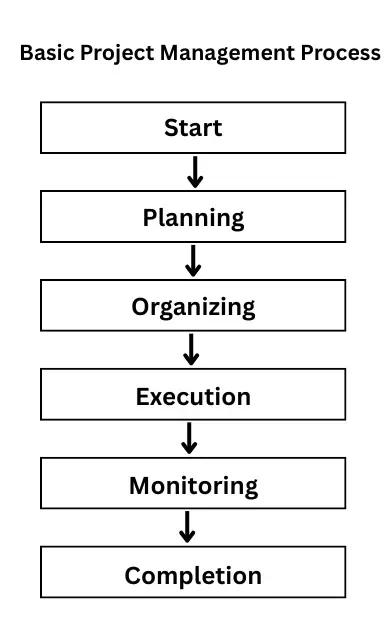
Figure: Basic Project Management Process
How Basic Project Management Process Works?
The basic project management process explains how a project moves from an idea to completion in a structured and organized way. It includes different stages such as starting, planning, organizing, execution, monitoring, and completion. Each stage plays an important role in achieving project goals successfully. Moreover, proper coordination between team members and managers ensures smooth project development. Therefore, understanding this process helps in managing projects efficiently and delivering quality results.
Following are processes of basic Project Management :-
1. Start
The project begins when an idea, requirement, or problem is identified. At this stage, the organization decides the purpose and scope of the project. The project manager understands the needs of stakeholders and defines the project objectives. This stage helps in deciding whether the project is feasible or not.
For example, a company decides to develop a mobile shopping application after identifying customer demand for online shopping.
2. Planning
Planning is the most important stage of project management because it defines goals, tasks, schedule, and resources. The project manager prepares a project plan, timeline, and budget to guide the team. Risks and possible challenges are also identified in this stage. Proper planning reduces confusion and delays in the project.
For example, the manager creates a schedule for designing the app, coding, testing, and launching within six months.
3. Organizing
In this stage, the project manager assigns tasks to team members and arranges necessary resources. The team structure, tools, and responsibilities are clearly defined. Proper organization improves coordination and teamwork. It also ensures that each member knows their role in the project.
For example, developers are assigned coding tasks, testers are assigned testing work, and designers handle the user interface.
4. Execution
Execution is the stage where the actual work of the project is performed. The team follows the project plan and completes assigned tasks step by step. Communication and teamwork are very important in this phase. The project manager guides the team and ensures work is done correctly.
For example, developers write code for the shopping app, designers create screens, and testers check the software for errors.
5. Monitoring
Monitoring ensures that the project is progressing according to the plan. The project manager tracks performance, checks deadlines, and solves problems if they occur. Regular reports and meetings help in identifying issues early. Monitoring improves quality and reduces risks.
For example, the manager reviews weekly progress reports and fixes delays in coding or testing activities.
6. Completion
Completion is the final stage where the project is finished and delivered to the customer. The project manager checks whether all objectives are achieved and prepares final reports. The team hands over the final product and closes the project. Feedback is also collected for future improvement.
For example, the mobile shopping application is launched on the app store and delivered to users successfully.
Components of Project Management
Project management consists of several important components that help in planning, executing, and controlling a project effectively. These components ensure that the project is completed within scope, time, cost, and quality requirements. Moreover, each component plays a specific role in managing project activities and resources. Therefore, understanding these components helps project managers deliver successful and high-quality results.
Following are the various components of Project Management:-
1. Scope Management
Scope management defines what work must be done in the project and what is not included. It helps in identifying project goals, tasks, and deliverables clearly. Proper scope management prevents unnecessary work and avoids confusion among team members. It also ensures that the project stays focused on its objectives.
For example, in a website development project, scope management defines features like login page, product page, and payment system while excluding extra features not required by the client.
2. Time Management
Time management ensures that project tasks are completed within the given deadline. It includes scheduling, task planning, and progress tracking to avoid delays. Proper time management improves productivity and ensures timely delivery of the project. Project managers use timelines and schedules to monitor progress.
For example, a mobile app project may have a 3-month timeline with 1 month for design, 1 month for coding, and 1 month for testing.
3. Cost Management
Cost management controls the project budget and ensures that expenses do not exceed the planned amount. It includes cost estimation, budgeting, and monitoring of financial resources. Proper cost management reduces financial risks and improves project efficiency. It also helps in avoiding unnecessary spending.
For example, a software project may allocate a fixed budget for developer salaries, tools, and testing to keep expenses under control.
4. Quality Management
Quality management ensures that the final project output meets required standards and customer expectations. It involves testing, quality checks, and continuous improvement during development. Proper quality management reduces errors and improves reliability. It also increases customer satisfaction.
For example, in an e-commerce application, testing is done to ensure secure payment, fast loading speed, and error-free functionality.
5. Resource Management
Resource management focuses on managing people, tools, and materials needed for the project. It ensures that the right resources are available at the right time. Proper resource management improves team performance and productivity. It also helps in avoiding resource shortages.
For example, assigning developers for coding, testers for testing, and providing computers and software tools for project work ensures smooth project execution.
Advantages of Project Management
1. Better Planning and Organization
Project management provides a clear structure for planning and organizing project activities. It helps managers define goals, tasks, timelines, and resources in advance. As a result, the team understands their roles and responsibilities clearly. This reduces confusion and improves coordination among team members. Proper planning ensures smooth execution of the project and better control over activities.
2. Timely Completion of Projects
Project management ensures that projects are completed within the given deadline through proper scheduling and monitoring. Managers track progress regularly and take corrective actions when delays occur. This improves productivity and efficiency in the organization. Deadlines help teams stay focused on their tasks and responsibilities. Therefore, project management supports timely delivery of work.
3. Effective Resource Utilization
Project management helps in the proper use of human resources, tools, and materials required for the project. It ensures that resources are allocated based on project needs and priorities. Efficient resource management reduces wastage and improves productivity. It also helps in maintaining a balanced workload among team members. As a result, project performance improves significantly.
4. Improved Quality of Work
Project management focuses on maintaining quality standards at every stage of the project. Regular reviews, testing, and monitoring help in identifying errors early. This improves the reliability and performance of the final output. Quality control ensures that project deliverables meet customer expectations. Therefore, organizations can deliver high-quality results consistently.
5. Better Risk Management
Project management helps in identifying and managing risks before they become serious problems. Managers analyze possible risks and prepare preventive measures in advance. This reduces uncertainty and improves project stability. Risk management also supports quick decision-making during critical situations. As a result, project success becomes more predictable and reliable.
6. Improved Communication and Coordination
Project management promotes clear communication among team members and stakeholders. Regular meetings and progress reports ensure that everyone is informed about project activities. This reduces misunderstandings and conflicts within the team. Good communication improves teamwork and collaboration. Therefore, coordination becomes easier and more effective.
7. Increased Customer Satisfaction
Project management ensures that customer requirements are properly understood and fulfilled. Timely delivery and high-quality output improve customer trust and satisfaction. Organizations can maintain long-term relationships with clients through effective project management. It also enhances the reputation of the company. As a result, customer loyalty increases.
Disadvantages of Project Management
1. High Implementation Cost
Project management requires skilled professionals, tools, and software, which increases overall cost. Organizations need to invest in training and management systems. Small companies may find it difficult to afford these expenses. The cost of maintaining project management tools can also be high. Therefore, implementation becomes expensive.
2. Time-Consuming Process
Project management involves planning, documentation, monitoring, and reporting activities. These processes require a significant amount of time and effort. Managers need to conduct meetings and prepare reports regularly. This may slow down the development process. As a result, project execution may take longer.
3. Requires Skilled Professionals
Effective project management depends on experienced managers and trained team members. Lack of skilled professionals can lead to poor planning and execution. Organizations must invest in training and development programs. This increases operational effort and cost. Therefore, skilled personnel are essential for success.
4. Complex Management Structure
Project management includes multiple processes such as planning, scheduling, risk management, and monitoring. Managing all these activities can be complex and challenging. Large projects require proper coordination and control. Complexity may create confusion among team members. As a result, project management becomes difficult.
5. Resistance to Change
Employees may resist new project management tools and processes. They may feel uncomfortable with structured methods and reporting systems. This reduces productivity and creates conflicts within the organization. Proper training and guidance are required to overcome resistance. Therefore, adaptation becomes a challenge.
6. Communication Overload
Project management involves regular meetings, reports, and updates. Too much communication may create pressure on team members. Employees may spend more time in meetings than in actual work. This reduces efficiency and productivity. As a result, communication overload becomes a problem.
7. Risk of Over-Management
Sometimes project managers focus too much on monitoring and control. This reduces flexibility and creativity within the team. Strict rules and procedures may slow down decision-making. Over-management can create stress among employees. Therefore, balance in management is necessary.
Applications of Project Management
1. Software Development Industry
Project management is widely used in software development to manage coding, testing, and deployment activities. It helps teams follow structured processes and meet deadlines. Proper planning ensures high-quality software delivery. Monitoring improves performance and reliability. Therefore, it is essential in IT organizations.
2. Construction Industry
Project management is used to manage building, road, and infrastructure projects. It helps control materials, labor, and timelines effectively. Proper planning ensures safety and quality in construction work. Monitoring reduces delays and risks. As a result, construction projects are completed successfully.
3. Business and Marketing Projects
Organizations use project management for product launches and marketing campaigns. It helps in planning promotional activities and managing budgets. Proper coordination improves business performance. Monitoring ensures timely completion of tasks. Therefore, it supports business growth.
4. IT Infrastructure Projects
Project management is used to manage networks, servers, and databases in organizations. It ensures proper installation and maintenance of systems. Managers monitor performance and solve technical issues. This improves efficiency and communication. As a result, IT infrastructure becomes reliable.
5. Healthcare Sector
Hospitals and healthcare organizations use project management to manage medical systems and services. It helps in organizing staff, equipment, and patient care processes. Proper planning improves service quality and efficiency. Monitoring ensures smooth operations. Therefore, healthcare management becomes more effective.
6. Government and Public Projects
Government organizations use project management for public infrastructure and development programs. It helps in managing large-scale projects effectively. Proper monitoring ensures timely completion and quality results. It also improves public services. Therefore, it supports national development.
7. Research and Development Projects
Project management is used in research and development to manage experiments and studies. It helps in organizing resources, timelines, and data analysis. Proper planning improves innovation and accuracy. Monitoring ensures successful completion of research activities. As a result, research outcomes become more reliable.
Conclusion
Project management plays a vital role in planning, organizing, and controlling project activities to achieve specific goals within time and budget. It provides a structured approach that improves coordination, quality, and resource utilization in every project. Moreover, the components, characteristics, and processes of project management help organizations complete projects efficiently and successfully.
Although it has some limitations such as cost and complexity, its benefits are much greater in ensuring proper planning and execution. Project management is widely used in software, construction, business, and government sectors to improve performance and productivity. Overall, effective project management ensures successful project completion and supports organizational growth and development.