Software project planning is the process of deciding how to complete a software project successfully. It involves defining goals, scope, time, cost, and resources. Moreover, it provides a clear roadmap for the entire development process. It also helps teams organize tasks and avoid confusion. Therefore, proper planning ensures smooth execution and successful project completion.
For example, while developing a mobile application, the team first plans features, timeline, and budget. Then, tasks are assigned and resources are allocated. Moreover, risks are identified in advance. Therefore, planning helps complete the project on time and within budget.
What is Project Planning?
Project planning is the process of defining project goals, scope, tasks, resources, schedule, and budget in advance to ensure the successful completion of a project. It involves creating a structured roadmap that guides the project team on what work needs to be done, how it will be done, and when it will be completed. Project planning helps in organizing activities, reducing risks, and ensuring efficient use of resources to achieve project objectives within the given time and cost constraints.
Diagram for components involved in Project Planning
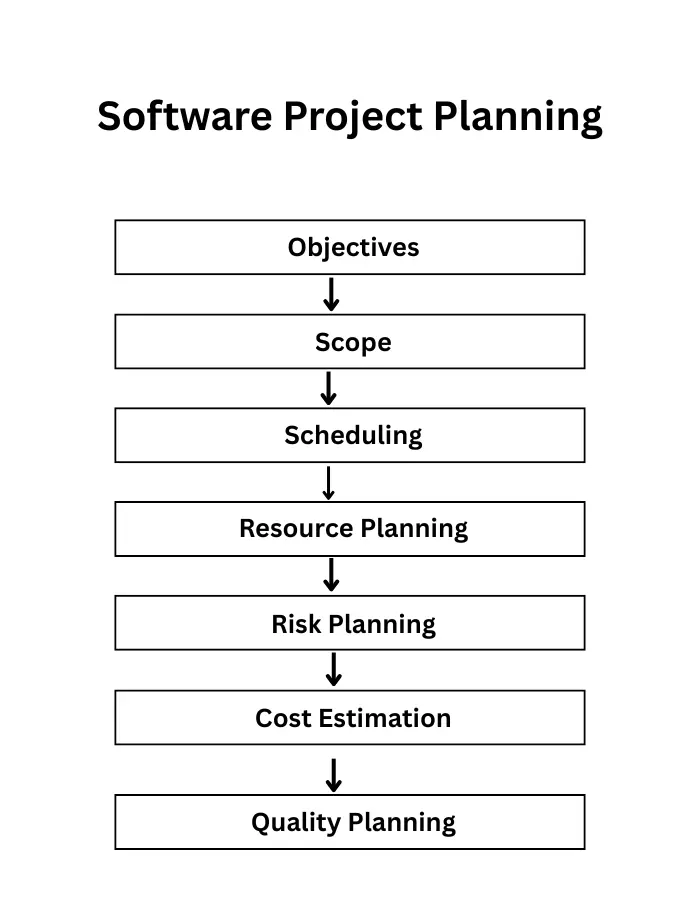
Figure: Software Project Planning Components
A detailed explanation of software project planning components
1. Defining Objectives
The team clearly defines what the project aims to achieve. Moreover, clear objectives guide development and support decision-making. Therefore, they keep the project focused and goal-oriented.
For example: Planning to develop a food delivery app. The team decides the main goal of providing quick and easy food ordering. Then, they focus on features that support this goal. As a result, the project stays clear and well-directed.
2. Scope Planning
The team identifies the features and limitations of the project. Moreover, it avoids unnecessary work and keeps development focused. Therefore, scope planning ensures clarity in project boundaries.
For example: Including ordering and payment features in an app. The team decides what features to include and what to exclude. Then, they avoid adding extra features. As a result, the project remains controlled and efficient.
3. Scheduling
The team creates a timeline for completing project tasks. Moreover, it helps track progress and manage deadlines. Therefore, scheduling ensures timely completion of the project.
For example: Setting deadlines for coding and testing. The team divides work into phases with fixed timelines. Then, they monitor progress regularly. As a result, tasks are completed on time.
4. Resource Planning
The team allocates resources like people, tools, and budget. Moreover, it ensures efficient use of available resources. Therefore, resource planning improves productivity.
For example: Assigning developers and testers. The manager assigns tasks based on skills. Then, each member works on specific roles. As a result, work is completed efficiently.
5. Risk Planning
The team identifies possible risks and prepares solutions. Moreover, it reduces uncertainty during project execution. Therefore, risk planning ensures smooth workflow.
For example: Planning backup for system failures. The team predicts possible technical issues. Then, they prepare backup solutions. As a result, problems are handled quickly.
6. Cost Estimation
The team estimates the total budget required for the project. Moreover, it helps control expenses and manage finances. Therefore, cost estimation ensures the project stays within budget.
For example: Estimating development cost of ₹5 lakh. The team calculates expenses for resources and tools. Then, they plan spending carefully. As a result, the project avoids overspending.
7. Quality Planning
The team ensures that the software meets required quality standards. Moreover, it includes proper testing and quality checks. Therefore, quality planning improves reliability.
For example: Planning testing phases before release. The team schedules testing at different stages. Then, they fix errors before final delivery. As a result, the software becomes reliable and user-friendly.
Advantages of Software Project Planning
1. Improves Project Organization
Software project planning provides a clear structure for managing project activities and tasks. It defines roles, responsibilities, and workflows in a systematic way. Moreover, it helps team members understand their duties clearly. Proper organization reduces confusion and improves coordination. Therefore, the project runs smoothly and efficiently.
2. Ensures Timely Completion
Planning helps in setting schedules, deadlines, and milestones for each task. It ensures that work is completed within the given time frame. Moreover, regular monitoring helps identify delays early. Corrective actions can be taken to maintain progress. Therefore, timely project completion becomes possible.
3. Reduces Risks and Uncertainty
Project planning helps identify possible risks and challenges at an early stage. It prepares strategies to handle technical, financial, and operational risks. Moreover, risk planning ensures smoother project execution. This reduces uncertainty and unexpected problems. Therefore, planning increases project stability and reliability.
4. Enhances Product Quality
Planning ensures that quality standards and testing procedures are defined in advance. It includes quality checks at every stage of development. Moreover, errors and defects are detected and corrected early. This improves the final software product. Therefore, high-quality output is achieved.
5. Improves Resource Utilization
Planning helps allocate resources like time, money, and manpower effectively. It ensures that resources are used wisely without wastage. Moreover, tasks are assigned based on skills and expertise. This increases productivity and efficiency. Therefore, resource utilization improves significantly.
6. Supports Better Decision-Making
Project planning provides detailed information about tasks, resources, and timelines. Managers can analyze this information before making decisions. Moreover, it reduces errors in judgment. This leads to better project management. Therefore, planning supports effective decision-making.
7. Increases Project Success Rate
Proper planning improves coordination, reduces risks, and ensures quality work. It helps achieve project goals efficiently. Moreover, timely completion and cost control increase customer satisfaction. This leads to successful project outcomes. Therefore, planning increases the overall project success rate.
Disadvantages of Poor Planning
1. Poor Project Execution
Lack of proper planning leads to confusion in project activities and responsibilities. Team members may not understand their tasks clearly. Moreover, workflow becomes disorganized and inefficient. This affects overall performance. Therefore, poor planning results in weak project execution.
2. Project Delays
Without proper planning, tasks may take more time than expected. Deadlines may not be defined clearly, leading to slow progress. Moreover, delays in one task affect the entire project. This reduces efficiency. Therefore, poor planning causes project delays.
3. Increased Costs
Poor planning leads to improper use of financial resources. Extra work, rework, and delays increase expenses. Moreover, lack of budgeting causes financial problems. This puts pressure on the organization. Therefore, project costs increase significantly.
4. Low Quality Output
Without planning, quality standards and testing processes may not be defined. Errors and defects remain undetected. Moreover, the final product may not meet user requirements. This reduces customer satisfaction. Therefore, poor planning leads to low-quality output.
5. Inefficient Resource Use
Resources like time, manpower, and tools may not be used properly. Some team members may be overloaded while others remain idle. Moreover, resource wastage affects productivity. This reduces project efficiency. Therefore, poor planning leads to inefficient resource use.
6. Higher Risks
Poor planning fails to identify potential risks early. Unexpected problems may occur during project execution. Moreover, lack of risk management increases uncertainty. This may lead to project failure. Therefore, risks become higher in poorly planned projects.
7. Reduced Project Success
Lack of planning affects time, cost, quality, and coordination. All these issues reduce the chances of project success. Moreover, customer satisfaction decreases due to delays and poor performance. This impacts the organization’s reputation. Therefore, poor planning reduces overall project success.
Applications of Software Project Planning
1. Software Development Projects
Software project planning is widely used in web, desktop, and mobile application development. It helps plan coding, testing, and deployment activities. Moreover, it ensures timely delivery and proper coordination. This improves overall software quality. Therefore, planning is essential in development projects.
2. IT Project Management
IT projects require proper planning for system implementation and maintenance. Planning helps manage hardware, software, and network resources. Moreover, it ensures smooth execution of IT operations. This reduces system failures. Therefore, IT project management depends on planning.
3. Business Application Development
Planning is used in banking, e-commerce, and ERP system development. It helps define requirements, timelines, and resources. Moreover, it ensures reliable and secure software solutions. This improves business operations. Therefore, planning supports business applications.
4. Team and Resource Management
Project planning helps assign tasks and manage team members effectively. It ensures proper use of skills and expertise. Moreover, it improves teamwork and coordination. This increases productivity. Therefore, planning supports efficient resource management.
5. Risk and Quality Management
Planning helps identify risks and define quality standards in advance. It ensures proper testing and monitoring. Moreover, it reduces errors and improves system reliability. This ensures successful project execution. Therefore, planning supports risk and quality management.
6. Project Scheduling and Tracking
Planning helps create schedules and track project progress regularly. It ensures that deadlines and milestones are achieved. Moreover, monitoring improves performance. This keeps the project on track. Therefore, scheduling and tracking become easier.
7. Decision-Making Processes
Planning provides useful data and reports for decision-making. Managers can analyze project progress and risks before taking action. Moreover, informed decisions improve project outcomes. This increases efficiency. Therefore, planning supports strategic decision-making.
Conclusion
Software project planning is an essential part of successful software development as it provides a clear roadmap for managing tasks, resources, time, and cost effectively. It helps in organizing project activities, reducing risks, improving quality, and ensuring timely completion of work. Moreover, proper planning supports better decision-making and efficient use of available resources, which increases the chances of project success.
Although poor planning can lead to delays, increased costs, and low-quality output, effective software project planning ensures smooth execution and better coordination among team members. It is widely used in software development, IT management, business applications, and project scheduling to achieve reliable and efficient results. Therefore, software project planning plays a crucial role in delivering high-quality software and achieving overall project success.