Pragmatic planning is a practical and flexible approach to project planning that focuses on real-world situations. It helps teams plan based on available resources, time, and constraints. Moreover, it avoids unnecessary complexity and focuses on achievable goals. It also allows changes during the project when needed. Therefore, pragmatic planning ensures realistic and effective project execution.
It focuses on practicality and flexibility. First, it sets realistic goals based on available resources. Next, it allows changes during development. Meanwhile, it adapts to real-world challenges and constraints. Finally, it ensures efficient execution without overcomplication. Therefore, this approach improves project success in dynamic environments.
For example: While developing an e-commerce website, the team first focuses on essential features like product listing, cart, and payment system. Then, they launch a basic version and collect user feedback. Moreover, they improve design and add new features step by step based on real needs. Therefore, by following a practical approach, the team completes the project efficiently and delivers better results over time.
What is Pragmatic Planning?
Pragmatic planning is a practical and flexible approach to project planning that focuses on real-world conditions, available resources, and achievable goals instead of theoretical or ideal assumptions. It emphasizes realistic decision-making, continuous adjustment, and effective problem-solving to ensure that the project progresses smoothly and successfully. Pragmatic planning aims to balance time, cost, quality, and resources while adapting to changing project requirements and constraints.
Objectives of Pragmatic Planning
Pragmatic planning focuses on creating practical and realistic plans that can be easily implemented in real-world software projects. It helps project managers and teams make achievable goals based on available resources, time, and budget. Moreover, this approach emphasizes flexibility, continuous monitoring, and problem-solving to ensure smooth project execution. The main objective of pragmatic planning is to reduce uncertainty and improve decision-making during the project.
It also aims to balance project constraints such as cost, time, scope, and quality while adapting to changing requirements. It encourages efficient use of resources and proper coordination among team members. Therefore, the objectives of pragmatic planning help in achieving successful and reliable software project outcomes.
Following are the objectives of Pragmatic Planning:-
1. Achieve Realistic Project Goals
Pragmatic planning aims to set practical and achievable project goals based on available resources and time. It avoids unrealistic expectations and focuses on what can be done effectively. Moreover, realistic goals improve project performance and reduce pressure on the team. This ensures better planning and execution. Therefore, achievable goals increase the chances of project success.
2. Improve Decision-Making
Pragmatic planning helps managers make better and informed decisions during the project. It provides clear information about resources, risks, and timelines. Moreover, practical planning supports quick and effective problem-solving. This improves overall project management. Therefore, decision-making becomes more accurate and reliable.
3. Ensure Efficient Resource Utilization
Pragmatic planning focuses on proper use of resources such as time, manpower, and tools. It helps assign tasks based on skills and availability. Moreover, efficient resource utilization reduces wastage and improves productivity. This ensures smooth project execution. Therefore, resources are used effectively.
4. Reduce Risks and Uncertainty
Pragmatic planning identifies possible risks and challenges at an early stage. It prepares practical solutions and backup plans to handle unexpected problems. Moreover, risk management improves project stability and control. This reduces uncertainty in development. Therefore, projects become more secure and reliable.
5. Maintain Project Flexibility
Pragmatic planning allows changes and adjustments according to project needs. It helps the team adapt to new requirements and market conditions. Moreover, flexibility improves project performance and efficiency. This ensures continuous improvement. Therefore, the project remains adaptable and manageable.
6. Ensure Timely Completion
Pragmatic planning focuses on proper scheduling and time management. It helps complete tasks within deadlines by following realistic timelines. Moreover, regular monitoring improves progress tracking. This avoids unnecessary delays. Therefore, the project is completed on time.
7. Improve Quality of Output
Pragmatic planning ensures that quality standards are maintained throughout the project. It includes proper testing, monitoring, and performance evaluation. Moreover, continuous improvement helps deliver reliable software. This increases customer satisfaction. Therefore, high-quality output is achieved.
Characteristics of Pragmatic Planning
1. Practical and Realistic Approach
Pragmatic planning focuses on real-world conditions and practical solutions instead of theoretical ideas. It helps project managers create achievable goals based on available resources and time. Moreover, it avoids unrealistic expectations in project development. This improves project feasibility and execution. Therefore, planning becomes more practical and effective.
2. Focus on Achievable Goals
Pragmatic planning emphasizes setting realistic and achievable project objectives. It ensures that goals are based on team capabilities and project requirements. Moreover, achievable goals improve productivity and performance. This reduces pressure on team members. Therefore, the project moves in a clear and focused direction.
3. Flexibility in Planning
Pragmatic planning allows changes and adjustments according to project needs. It helps teams adapt to new requirements and unexpected situations. Moreover, flexibility improves project efficiency and control. This ensures smooth progress of work. Therefore, planning becomes more adaptable and manageable.
4. Continuous Monitoring and Evaluation
Pragmatic planning requires regular monitoring of project progress. It helps managers evaluate performance and make necessary improvements. Moreover, continuous monitoring reduces errors and delays. This improves project control and quality. Therefore, progress is maintained effectively.
5. Efficient Resource Utilization
Pragmatic planning ensures proper use of resources such as time, manpower, and tools. It helps assign tasks based on skills and availability. Moreover, efficient resource utilization increases productivity. This reduces wastage and improves performance. Therefore, resources are used effectively.
6. Risk Awareness and Management
Pragmatic planning focuses on identifying and managing risks at an early stage. It prepares practical solutions to handle unexpected problems. Moreover, risk management improves project stability and reliability. This reduces uncertainty in project execution. Therefore, risks are minimized.
7. Focus on Results and Performance
Pragmatic planning emphasizes achieving desired results and improving project performance. It focuses on delivering quality output within time and budget. Moreover, result-oriented planning increases project success. This ensures customer satisfaction. Therefore, the project achieves its objectives effectively.
Diagram of Pragmatic Planning Process
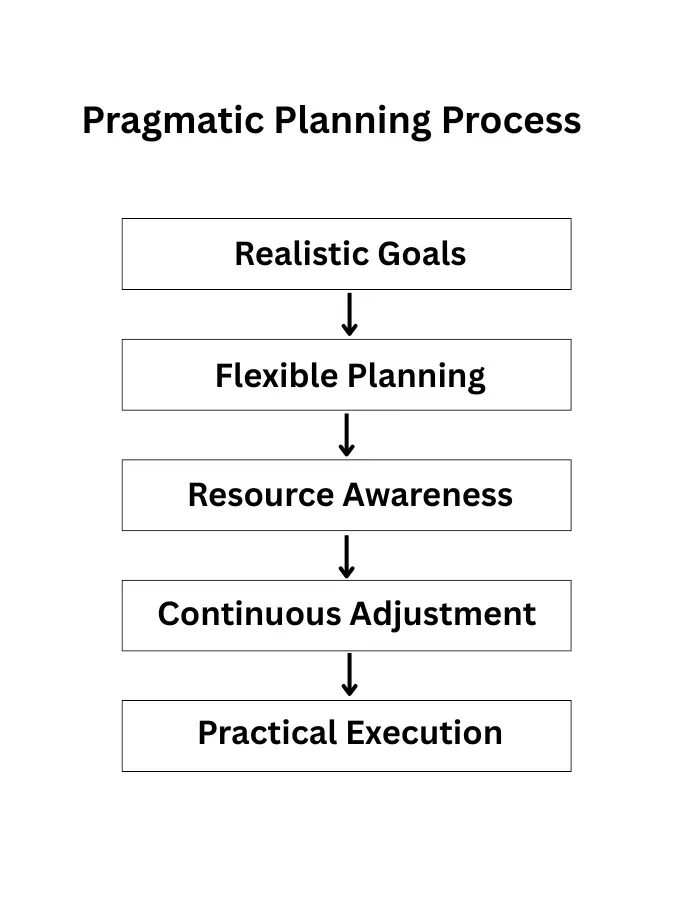
Figure: Pragmatic Planning Process
Let’s see the detailed explanation for Pragmatic Planning Process,
1. Realistic Goal Setting
The team sets goals that are practical and achievable. Moreover, it considers available resources and constraints. It also avoids unrealistic expectations. Therefore, realistic goals improve success rate.
For example: In a project, the team plans basic app features first. Then, they avoid adding complex features initially. Moreover, they focus on achievable targets. As a result, the project progresses smoothly.
2. Flexibility in Planning
The plan allows changes based on project needs. Moreover, it adapts to new requirements and challenges. It also helps manage uncertainties effectively. Therefore, flexibility improves project adaptability.
For example: In a project, new features are added based on user feedback. Then, the plan is updated accordingly. Moreover, timelines are adjusted. As a result, the project stays relevant.
3. Efficient Resource Utilization
The team uses resources effectively without wastage. Moreover, it assigns tasks based on skills. It also improves productivity. Therefore, resource efficiency ensures better output.
For example: Developers are assigned tasks based on expertise. Then, tools are used efficiently. Moreover, time is managed properly. As a result, work is completed faster.
4. Continuous Improvement
The plan is updated based on feedback and progress. Moreover, it helps improve quality and performance. It also ensures better decision-making. Therefore, continuous improvement enhances success.
For example: After each phase, the team reviews performance. Then, improvements are made. Moreover, errors are corrected quickly. As a result, the project quality improves.
5. Risk Handling
The team identifies and manages risks effectively. Moreover, it prepares solutions for unexpected issues. It also reduces uncertainty. Therefore, risk handling ensures smooth execution.
For example: The team predicts possible delays and prepares backup plans. Then, they monitor risks regularly. Moreover, issues are resolved quickly. As a result, the project continues without major problems.
Advantages of Pragmatic Planning
1. Provides Realistic Project Approach
Pragmatic planning focuses on practical and achievable project goals based on real-world conditions. It avoids unrealistic assumptions and theoretical ideas. Moreover, it helps teams work according to available resources and time. This improves project stability and execution. Therefore, projects become more practical and manageable.
2. Improves Decision-Making
Pragmatic planning provides clear and useful information for making decisions. It helps managers analyze problems and choose the best possible solutions. Moreover, practical planning supports quick and effective decision-making. This improves project performance and control. Therefore, decisions become more accurate and reliable.
3. Enhances Flexibility in Planning
Pragmatic planning allows changes and adjustments according to project needs. It helps teams adapt to new requirements and unexpected situations. Moreover, flexibility improves project efficiency and progress. This ensures smooth execution of tasks. Therefore, planning becomes more adaptable.
4. Reduces Risks and Uncertainty
Pragmatic planning identifies risks early and prepares solutions to handle them. It focuses on practical risk management strategies. Moreover, it reduces uncertainty and unexpected problems. This improves project safety and reliability. Therefore, risks are minimized effectively.
5. Improves Resource Utilization
Pragmatic planning ensures proper use of time, manpower, and tools. It helps assign tasks based on team skills and availability. Moreover, efficient resource utilization increases productivity. This reduces wastage and improves performance. Therefore, resources are used effectively.
6. Ensures Timely Project Completion
Pragmatic planning focuses on realistic scheduling and time management. It helps complete tasks within the given deadlines. Moreover, regular monitoring ensures proper progress tracking. This reduces delays and improves efficiency. Therefore, projects are delivered on time.
7. Enhances Quality of Output
Pragmatic planning ensures continuous quality monitoring and improvement. It focuses on delivering reliable and error-free software. Moreover, proper testing and evaluation improve product performance. This increases customer satisfaction. Therefore, high-quality output is achieved.
Disadvantages of Pragmatic Planning
1. Requires Experienced Managers
Pragmatic planning needs skilled and experienced project managers to make practical decisions. Inexperienced managers may fail to handle real-world problems effectively. Moreover, lack of expertise can affect project planning. This reduces efficiency and performance. Therefore, skilled professionals are required.
2. Time-Consuming Process
Pragmatic planning involves careful analysis of resources, risks, and project conditions. This requires time and effort in planning and monitoring. Moreover, continuous adjustments may slow down initial progress. This can delay project planning stages. Therefore, it may take more time.
3. Difficult to Implement in Large Projects
In large and complex projects, pragmatic planning becomes difficult to manage. Many tasks, resources, and risks need to be handled simultaneously. Moreover, coordination becomes challenging. This increases project complexity. Therefore, implementation becomes difficult in large projects.
4. Frequent Changes May Create Confusion
Pragmatic planning allows flexibility and continuous adjustments. However, frequent changes in plans may create confusion among team members. Moreover, unclear changes may affect project stability. This reduces coordination and focus. Therefore, proper communication is required.
5. High Dependence on Real-Time Data
Pragmatic planning depends on real-time project data and information. If data is inaccurate or outdated, planning may fail. Moreover, wrong information can lead to poor decisions. This affects project performance. Therefore, accurate data is essential.
6. Requires Continuous Monitoring
Pragmatic planning requires regular monitoring and evaluation of project progress. Managers must continuously track performance and make adjustments. Moreover, this increases workload and responsibility. This may create pressure on the management team. Therefore, continuous monitoring is necessary.
7. May Increase Initial Planning Cost
Pragmatic planning requires proper analysis, tools, and skilled professionals. This may increase initial planning and management costs. Moreover, organizations need to invest in planning resources. This increases project expenses at the beginning. Therefore, initial cost may be higher.
Applications of Pragmatic Planning
1. Software Development Projects
Pragmatic planning is widely used in software development to create realistic project plans. It helps manage coding, testing, and deployment activities effectively. Moreover, it ensures timely delivery and quality output. This improves project success. Therefore, it is useful in software projects.
2. IT Project Management
Pragmatic planning helps in managing IT systems and infrastructure efficiently. It focuses on practical solutions for technical problems. Moreover, it ensures smooth system implementation and maintenance. This reduces system failures and downtime. Therefore, it is important in IT management.
3. Business Application Development
Pragmatic planning is used in banking, e-commerce, and ERP system development. It helps in managing requirements, resources, and timelines effectively. Moreover, it ensures reliable and secure applications. This improves business operations. Therefore, it supports business development.
4. Resource and Team Management
Pragmatic planning helps assign tasks and manage team members efficiently. It ensures proper use of manpower and tools. Moreover, it improves coordination and teamwork. This increases productivity and efficiency. Therefore, it is useful in resource management.
5. Risk and Quality Management
Pragmatic planning helps identify risks and maintain quality standards. It ensures proper testing and monitoring of project activities. Moreover, it reduces errors and improves reliability. This ensures successful project execution. Therefore, it supports risk and quality management.
6. Project Scheduling and Monitoring
Pragmatic planning helps create realistic schedules and track project progress regularly. It ensures deadlines and milestones are achieved on time. Moreover, monitoring improves project control. This keeps the project on track. Therefore, scheduling becomes easier.
7. Decision-Making and Strategic Planning
Pragmatic planning provides useful data for decision-making and strategic planning. Managers can analyze project conditions and choose practical solutions. Moreover, it improves planning and performance. This increases project success rate. Therefore, it supports decision-making.
Conclusion
Pragmatic planning is an important approach in software project management that focuses on practical and realistic planning based on real-world conditions. It helps in setting achievable goals, utilizing resources efficiently, managing risks, and maintaining flexibility in project execution. Moreover, its characteristics such as continuous monitoring, result-oriented approach, and adaptability make project management more effective and reliable. As a result, pragmatic planning improves decision-making and ensures smooth project progress.
Although pragmatic planning requires skilled management and continuous monitoring, its benefits in improving project performance and reducing uncertainty are significant. Therefore, pragmatic planning is widely used in software development, IT management, and business applications to achieve successful and high-quality project outcomes.