Bottom-Up estimating is a software project estimation technique in which each small task of the project is estimated separately and then combined to calculate the total project time, cost, and effort. It focuses on detailed analysis of every activity before making the final estimate. Moreover, it improves accuracy and planning because each component is studied carefully. It also helps in better resource allocation and scheduling. Therefore, bottom-up estimating is considered one of the most reliable estimation techniques in software project management.
Bottom-up estimating works by breaking the project into smaller tasks and estimating each task individually. First, the team identifies all activities such as design, coding, testing, and deployment. Next, they estimate time, cost, and effort for each activity separately. Meanwhile, these estimates are added together to get the total project estimate. Finally, the manager reviews and adjusts the plan. Therefore, bottom-up estimating ensures accurate and detailed project planning.
For example, while developing an e-commerce website, the team first divides the project into tasks like login system, product page, payment gateway, and testing. Then, each task is estimated separately for time and cost. Moreover, all estimates are combined to get the final project schedule and budget. Therefore, bottom-up estimating helps complete the project accurately and efficiently.
What is Bottom-Up estimating?
Bottom-Up estimating is a software project estimation technique in which the project is divided into smaller tasks or components, and the cost, time, and effort for each task are estimated individually. These small estimates are then combined to calculate the total project estimate.
Moreover, this method focuses on detailed analysis and accurate calculation of resources. It provides a more reliable and precise estimation compared to other techniques. Therefore, bottom-up estimating is widely used in software project planning to improve accuracy and control over project activities.
Workflow diagram of Bottom-Up Estimation Process
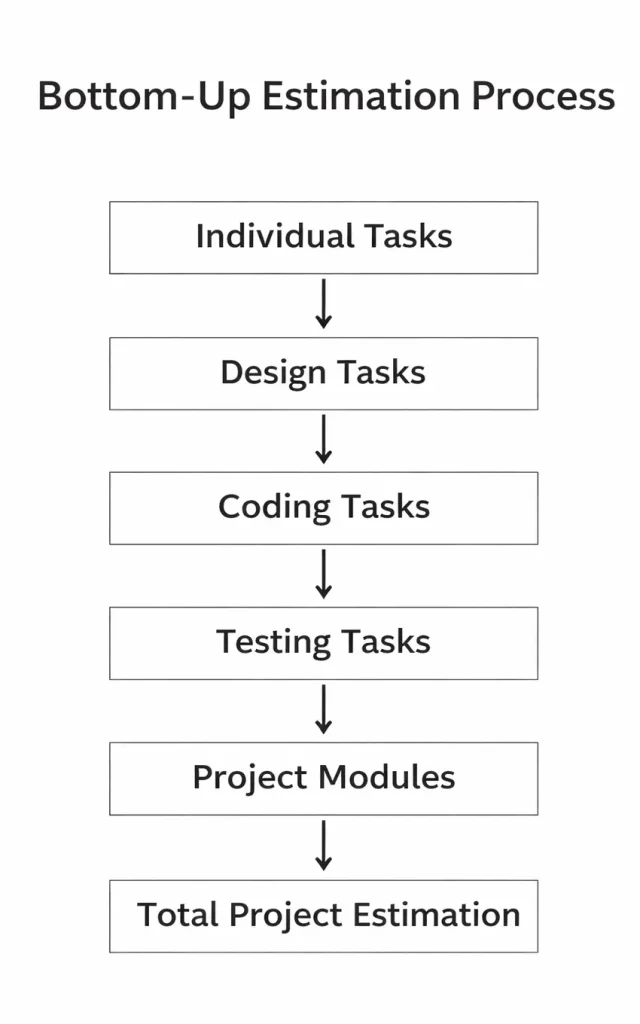
Figure: Bottom-Up Estimation Process
Following are the detailed explanation for the Bottom-Up Estimation Process:-
1. Individual Tasks
In the bottom-up estimation process, the project starts from small individual tasks. First, the team identifies all activities required to complete the project, such as coding, testing, and documentation. Then, each task is analyzed carefully to estimate time and effort. Therefore, this step provides a detailed and accurate understanding of the work.
2. Coding Phase
Next, all coding-related tasks are grouped under the coding phase. Developers estimate how much time and effort are needed to write program code for each feature. Moreover, they consider programming language, tools, and complexity of the module. As a result, the coding effort becomes more realistic and manageable.
3. Testing Phase
After coding estimation, testing tasks are estimated separately. Testers calculate the time required for unit testing, integration testing, and bug fixing. Additionally, they plan quality checks to ensure the software works correctly. Therefore, this phase improves the accuracy of the overall estimation.
4. Design Phase
In this step, the design-related tasks such as system architecture, UI design, and database design are estimated. The team plans how the system will be structured and how different modules will interact. Furthermore, they estimate the resources required for design work. Thus, this phase helps in building a strong technical foundation.
5. Project Modules
After estimating individual phases, tasks are grouped into project modules like login module, payment module, and dashboard module. Each module’s total effort and cost are calculated by adding all task estimates. This makes the project structure clear and organized. Therefore, the team can easily track progress of each module.
6. Total Project Estimation
Finally, all module estimates are combined to calculate the total project estimation. The manager adds effort, cost, and time of all modules to get the final project estimate. Moreover, this approach provides high accuracy because it is based on detailed task analysis. As a result, bottom-up estimation is reliable and useful for complex software projects.
Objectives of Bottom-Up Estimating
Bottom-up estimating aims to provide accurate and detailed estimation of project tasks and resources. Moreover, it helps in proper planning and scheduling of activities. It also improves cost and time control during project development. Therefore, the main objective is to ensure reliable estimation and successful project completion.
Following are the objectives of Bottom-Up Estimating:-
1. Identify Project Tasks
The team first identifies all project activities and tasks in detail. Moreover, it helps in understanding project requirements clearly. It also ensures that no task is missed during estimation. Therefore, task identification is the first step.
For example, in a mobile app project, the team identifies tasks like UI design, coding, testing, and deployment. Then, each task is listed separately. Moreover, responsibilities are assigned to team members. As a result, planning becomes clear and organized.
2. Estimate Time and Effort
The team estimates time and effort required for each task. Moreover, it helps in scheduling project activities properly. It also improves work management. Therefore, time estimation is essential.
For example, coding may take 10 days and testing may take 5 days. Then, deadlines are planned accordingly. Moreover, progress is monitored regularly. As a result, tasks are completed on time.
3. Estimate Cost
The team calculates the cost of each activity and resource. Moreover, it helps in budget planning and cost control. It also avoids overspending. Therefore, cost estimation is necessary.
For example, developer salary and software tools are estimated. Then, total cost is calculated. Moreover, expenses are managed properly. As a result, the project stays within budget.
4. Combine All Estimates
The team combines all task estimates to get the final project estimate. Moreover, it provides a complete project plan. It also improves accuracy and decision-making. Therefore, combining estimates is the final step.
For example, time and cost of design, coding, and testing are added together. Then, the total project duration is calculated. Moreover, resources are finalized. As a result, the project plan becomes ready.
Characteristics of Bottom-Up Estimating
1. Task-Level Estimation
Bottom-up estimating focuses on estimating each small task or component of the project separately. Every module, activity, and function is analyzed in detail before estimation. Moreover, this approach improves accuracy and clarity in planning. It helps in understanding project requirements properly. Therefore, task-level estimation is a key characteristic.
2. Detailed and Accurate Approach
This technique provides detailed estimation of time, cost, and effort for each activity. It reduces errors by analyzing each part of the project carefully. Moreover, detailed estimation improves project planning and control. This increases reliability of results. Therefore, bottom-up estimating is highly accurate.
3. Time-Consuming Process
Bottom-up estimating requires detailed analysis of all project components. It takes time to estimate each task and combine results. Moreover, careful planning and evaluation are needed. This increases the planning effort. Therefore, it is a time-consuming process.
4. Requires Clear Project Structure
Bottom-up estimating works best when the project is divided into well-defined tasks and modules. A clear work breakdown structure is necessary for proper estimation. Moreover, structured planning improves accuracy. This helps in better resource allocation. Therefore, clear project structure is essential.
5. Involves Team Participation
This technique involves developers, testers, and project managers in the estimation process. Each team member estimates their own task based on expertise. Moreover, team participation improves accuracy and coordination. This ensures better understanding of project requirements. Therefore, teamwork is important.
6. Suitable for Complex Projects
Bottom-up estimating is useful for large and complex software projects. It helps in managing detailed tasks and activities effectively. Moreover, it provides better control over project execution. This reduces risks and errors. Therefore, it is suitable for complex projects.
7. Improves Resource Allocation
Bottom-up estimating helps assign resources based on detailed task analysis. It ensures proper use of manpower, tools, and budget. Moreover, efficient allocation improves productivity. This reduces resource wastage. Therefore, resource utilization becomes better.
Techniques of Bottom-Up Estimating
Bottom-up estimating uses different techniques to calculate the time, cost, and effort of each small task in a software project. These techniques help in breaking down the project into smaller components and estimating them accurately. Moreover, each technique focuses on detailed analysis and structured planning. Therefore, bottom-up estimating techniques improve accuracy and project control.
1. Work Breakdown Structure (WBS) Technique
In this technique, the project is divided into smaller tasks and sub-tasks. Moreover, each component is analyzed separately to estimate time and cost. It helps in understanding the complete project structure clearly. Therefore, WBS makes estimation more accurate and organized.
2. Task-Based Estimation Technique
This technique focuses on estimating each individual task of the project. Moreover, every task is evaluated based on effort, time, and resources required. It helps in detailed planning and better scheduling. Therefore, task-based estimation improves accuracy in bottom-up estimating.
3. Resource-Based Estimation Technique
In this technique, estimation is done based on available resources like developers, testers, and tools. Moreover, the effort required for each resource is calculated carefully. It helps in proper resource allocation and cost estimation. Therefore, this technique ensures efficient use of resources.
4. Expert Judgment Technique
This technique uses the knowledge and experience of experts to estimate project tasks. Moreover, experienced project managers and developers analyze each component carefully. It helps in reducing estimation errors and improving reliability. Therefore, expert judgment is widely used in bottom-up estimating.
5. Historical Data Technique
In this technique, previous project data is used to estimate current project tasks. Moreover, past records help in predicting time and cost accurately. It reduces uncertainty and improves planning. Therefore, historical data makes estimation more realistic.
6. Activity-Based Estimation Technique
This technique estimates each project activity separately based on effort and duration. Moreover, activities are analyzed in detail to avoid confusion. It helps in better scheduling and monitoring of tasks. Therefore, activity-based estimation improves project management.
7. Detailed Cost Estimation Technique
In this technique, cost is calculated for each small component of the project. Moreover, expenses related to resources, tools, and development are analyzed carefully. It helps in controlling project budget effectively. Therefore, detailed cost estimation ensures financial stability in the project.
When to Use Bottom-Up Estimating
Bottom-up estimating is used in situations where detailed planning and accurate cost and time estimation are required for a software project. It is most suitable when the project is well-defined and all tasks can be broken down into smaller components. Moreover, this method helps project managers make better decisions by analyzing each activity separately. Therefore, bottom-up estimating is mainly used in structured, large, and long-term software development projects where precision and control are important.
For example, in a government software development project, all system modules such as database, user interface, security, and reporting are defined clearly before development starts. Then, each module is estimated separately in terms of time, cost, and resources. Moreover, project managers analyze every task carefully and prepare a detailed plan. As a result, the project becomes easier to manage and the chances of errors and delays are reduced.
1. When Project Requirements are Clear and Defined
Bottom-up estimating is suitable when project requirements are clearly understood and documented. Moreover, each task and module should be well-defined before estimation begins. This helps in accurate calculation of time, cost, and effort. Therefore, clear requirements make bottom-up estimating more effective and reliable.
2. When Detailed Estimation is Required
This method is used when detailed and accurate estimation is needed for project planning. Moreover, each small activity is analyzed separately to avoid mistakes in estimation. It helps in improving planning and scheduling. Therefore, bottom-up estimating is useful in projects where precision is very important.
3. In Large and Complex Software Projects
Bottom-up estimating is widely used in large and complex projects that involve multiple modules and teams. Moreover, breaking the project into smaller parts makes it easier to manage and control. It reduces confusion and improves coordination among team members. Therefore, this method is ideal for complex software systems.
4. When Accuracy is More Important than Speed
This method is used when accurate estimation is more important than quick estimation. Moreover, it focuses on detailed analysis rather than fast calculation. Although it takes more time, it provides reliable results. Therefore, bottom-up estimating is preferred in projects where accuracy is a priority.
5. When Enough Project Data is Available
Bottom-up estimating requires sufficient project data such as task details, resource information, and previous project records. Moreover, availability of data helps in making realistic estimates. It reduces uncertainty and improves decision-making. Therefore, this method works best when proper data is available.
6. In Long-Term and Structured Projects
This estimating technique is suitable for long-term and structured projects that follow proper planning and execution processes. Moreover, it helps in monitoring project progress over time. It ensures systematic development and better control. Therefore, bottom-up estimating is useful in long-duration software projects.
7. When Proper Resource Planning is Needed
Bottom-up estimating is used when proper allocation of resources like developers, testers, and tools is required. Moreover, it helps in assigning tasks based on skills and availability. It improves productivity and reduces resource wastage. Therefore, this method supports efficient resource management in software projects.
Advantages of Bottom-Up Estimating
1. High Accuracy
Bottom-up estimating provides highly accurate results because each task is analyzed in detail. It reduces estimation errors and improves reliability. Moreover, accurate estimation supports better planning and execution. This increases project success rate. Therefore, accuracy is a major advantage.
2. Better Project Control
This technique allows managers to monitor each task separately. It helps track progress and identify delays easily. Moreover, better control improves project management and coordination. This ensures smooth execution. Therefore, project control becomes easier.
3. Efficient Resource Management
Bottom-up estimating helps in proper allocation of resources to each task. It ensures efficient use of manpower, tools, and budget. Moreover, efficient resource management improves productivity. This reduces wastage. Therefore, resources are used effectively.
4. Suitable for Large Projects
This technique is useful for large and complex projects that require detailed planning. It helps manage multiple tasks and activities efficiently. Moreover, detailed estimation reduces risks and uncertainty. This improves project performance. Therefore, it is suitable for large projects.
5. Improves Team Involvement
Bottom-up estimating involves team members in the estimation process. Developers and testers provide their own estimates based on experience. Moreover, team involvement improves coordination and communication. This increases responsibility and accountability. Therefore, teamwork is improved.
6. Reduces Project Risks
Detailed estimation helps identify potential risks at an early stage. It prepares solutions and backup plans for unexpected problems. Moreover, risk management improves project stability. This ensures smooth execution. Therefore, risks are minimized.
7. Enhances Planning and Scheduling
Bottom-up estimating supports proper planning and scheduling of project activities. It helps create realistic timelines and milestones. Moreover, accurate scheduling improves project efficiency. This ensures timely completion. Therefore, planning becomes more effective.
Disadvantages of Bottom-Up Estimating
1. Time-Consuming Process
Bottom-up estimating requires detailed analysis of each task and activity. It takes a lot of time to estimate and combine results. Moreover, planning becomes slow in the initial stages. This delays project start. Therefore, it is time-consuming.
2. Requires Detailed Information
This technique needs complete and clear project requirements. Without proper information, estimation may become difficult. Moreover, lack of data affects accuracy. This creates planning problems. Therefore, detailed information is necessary.
3. High Planning Effort
Bottom-up estimating requires effort from project managers and team members. Each task must be analyzed and estimated carefully. Moreover, this increases workload and complexity. This affects efficiency. Therefore, planning effort is high.
4. Difficult for Small Projects
For small projects, bottom-up estimating may not be necessary. Detailed estimation may increase planning time and effort unnecessarily. Moreover, simple projects do not require such detailed analysis. This reduces efficiency. Therefore, it is not suitable for small projects.
5. Requires Skilled Team
Bottom-up estimating depends on the experience and knowledge of team members. Inexperienced teams may give incorrect estimates. Moreover, lack of expertise affects planning accuracy. This reduces project performance. Therefore, skilled professionals are required.
6. Complex to Manage
Managing multiple task estimates and combining them into a final estimate is complex. It requires proper coordination and documentation. Moreover, errors in calculation may occur. This affects project planning. Therefore, management becomes difficult.
7. Frequent Updates Required
Bottom-up estimates need regular updates as project requirements change. It requires re-estimation and modification of plans. Moreover, this increases workload and time. This affects efficiency. Therefore, continuous updates are required.
Applications of Bottom-Up Estimating
1. Software Development Projects
Bottom-up estimating is widely used in software development projects to estimate coding, testing, and deployment tasks. It helps in detailed planning and resource allocation. Moreover, it improves accuracy and control. This ensures successful project completion. Therefore, it is useful in development.
2. Large IT Projects
This technique is used in large IT projects that involve multiple modules and components. It helps in managing complex tasks and activities. Moreover, detailed estimation improves project stability. This reduces risks and errors. Therefore, it is suitable for IT projects.
3. Project Scheduling and Planning
Bottom-up estimating helps create realistic schedules and timelines for project activities. It ensures proper planning and monitoring of tasks. Moreover, scheduling improves project efficiency. This keeps the project on track. Therefore, it supports planning.
4. Resource and Cost Management
This technique helps in managing manpower, tools, and budget efficiently. It ensures proper allocation of resources to each task. Moreover, cost estimation improves financial control. This reduces wastage. Therefore, it supports resource management.
5. Risk and Quality Management
Bottom-up estimating helps identify risks and maintain quality standards. It ensures proper testing and monitoring of project activities. Moreover, detailed estimation improves reliability. This ensures smooth execution. Therefore, it supports risk and quality management.
6. Engineering and Construction Projects
Bottom-up estimating is also used in engineering and construction projects. It helps estimate materials, labor, and time required for each task. Moreover, detailed planning improves project control. This ensures timely completion. Therefore, it is useful in engineering.
7. Business and Research Projects
This technique is used in business and research projects for detailed planning and cost estimation. It helps in managing project activities effectively. Moreover, accurate estimation improves decision-making. This increases project success. Therefore, it supports business and research projects.
Conclusion
Bottom-Up estimating is a detailed and accurate software project estimation technique that focuses on estimating each small task or component of a project separately and then combining them to calculate the total project effort, time, and cost. It helps in improving project planning, resource allocation, risk management, and scheduling by providing reliable and precise estimates. Moreover, team involvement and detailed analysis make this technique highly effective for complex and large software projects.
Although bottom-up estimating is time-consuming and requires skilled professionals and detailed information, its benefits in improving accuracy and project control are significant. Therefore, it is widely used in software development, IT projects, engineering, and business applications to ensure successful project completion and efficient project management.