Software project estimation is an important part of software project management because it helps in predicting the time, cost, and effort required to complete a project. Different estimation approaches are used to plan and control software development effectively. Among these, the top-down approach and parametric models are widely used for estimating project size, effort, and cost in the early stages of development. These methods help project managers make quick and structured decisions.
The top-down approach focuses on estimating the overall project first and then dividing it into smaller parts, while parametric models use mathematical formulas and historical data to calculate effort and cost. Moreover, both approaches help in planning resources, managing schedules, and reducing uncertainty in software projects. Therefore, these estimation techniques play a significant role in successful software project planning and management.
What is Top-Down Approach?
The Top-Down Approach is a software project estimation method in which the total project effort, cost, and time are estimated at a higher level first and then divided into smaller components or modules. It mainly focuses on overall project estimation based on experience, historical data, and expert judgment. Moreover, this approach is useful in the early stages of project planning when detailed information is not available. Therefore, the top-down approach provides a quick and general estimate of the software project.
For example, In a software company, a project manager is assigned to develop an online shopping website. At the beginning of the project, detailed information about each module is not available. Therefore, the manager estimates the total project cost as ₹10 lakh and the time required as 4 months based on previous similar projects and experience. After that, the total cost and time are divided into smaller parts such as design, coding, testing, and deployment.
Moreover, each team is given a portion of the total budget and timeline to complete their tasks. This helps in quick planning and early decision-making. As a result, the project gets a general estimation in the early stage and planning becomes easier.
Objectives of Top-Down Approach
The objectives of the Top-Down Approach focus on providing a clear and quick estimation of a software project at the initial stage of development. This approach helps project managers understand the overall project scope, cost, time, and resources before breaking the project into smaller components. Moreover, it supports early planning and decision-making by giving a high-level view of the project. Therefore, the objectives of the top-down approach aim to simplify project estimation and improve management efficiency.
The main purpose of defining objectives in the top-down approach is to ensure proper planning, better resource allocation, and effective project control. It helps organizations manage large and complex software projects with less effort and time. Moreover, it reduces planning complexity and supports strategic decision-making in the early phase
Following are the objectives of Top-Down Approach:-
1. Quick Project Estimation
The main objective of the top-down approach is to provide a quick estimation of the overall project effort, time, and cost. Moreover, it helps project managers make early decisions in the initial stage of development. It reduces the need for detailed analysis at the beginning. Therefore, it supports fast and efficient project planning.
2. Early Project Planning
This approach helps in planning the project at an early stage when detailed requirements are not available. Moreover, it gives a general idea about project size and scope. It supports initial scheduling and budgeting. Therefore, it helps in starting the project smoothly.
3. Efficient Resource Allocation
The top-down approach aims to allocate resources effectively across different project modules. Moreover, it helps in distributing time, cost, and manpower properly. It improves coordination among teams. Therefore, it ensures better resource management.
4. Reducing Planning Complexity
This method reduces the complexity of project planning by focusing on overall estimation first. Moreover, it avoids detailed calculations in the initial phase. It makes planning simple and manageable. Therefore, it helps in handling large projects easily.
5. Supporting Decision-Making
The approach helps project managers take important decisions related to budget, schedule, and resources. Moreover, it provides a general overview of the project. It supports strategic planning and management. Therefore, it improves decision-making.
6. Improving Project Control
Top-down estimation helps in controlling project activities by providing a structured plan. Moreover, it helps in monitoring progress at a higher level. It ensures smooth project execution. Therefore, it improves project control.
7. Providing Overall Project View
The objective of this approach is to provide a complete view of the project at the beginning. Moreover, it helps stakeholders understand project goals and scope. It improves communication and planning. Therefore, it ensures better project understanding.
Characteristics of Top-Down Approach
1. High-Level Estimation
Top-down approach focuses on estimating the project at a higher level rather than analyzing small tasks. Moreover, it provides an overall estimate of effort and cost. It helps in quick planning. Therefore, it simplifies project estimation.
2. Based on Experience and Historical Data
This approach mainly depends on expert judgment and previous project data. Moreover, experienced managers estimate project requirements based on past knowledge. It improves estimation accuracy. Therefore, experience plays an important role.
3. Suitable for Early Project Stage
Top-down estimation is mostly used in the early phase of project development. Moreover, it works well when detailed requirements are not available. It helps in initial planning. Therefore, it supports early decision-making.
4. Less Detailed Analysis
This method does not focus on detailed task-level analysis. Moreover, it provides a general estimate of the project. It saves time and effort. Therefore, it is faster than bottom-up estimation.
5. Quick and Simple Estimation
The approach is simple and easy to apply in software projects. Moreover, it reduces planning complexity. It supports quick estimation. Therefore, it is widely used in small and medium projects.
6. Centralized Decision-Making
Top-down approach involves project managers and senior experts in estimation. Moreover, decisions are taken at a higher level. It ensures better control and planning. Therefore, it supports centralized management.
7. Suitable for Large Projects
This approach is useful in large projects where overall estimation is required first. Moreover, it helps in managing project scope and cost. It improves project planning. Therefore, it is useful for complex software projects.
Workflow diagram of Top-Down Approach
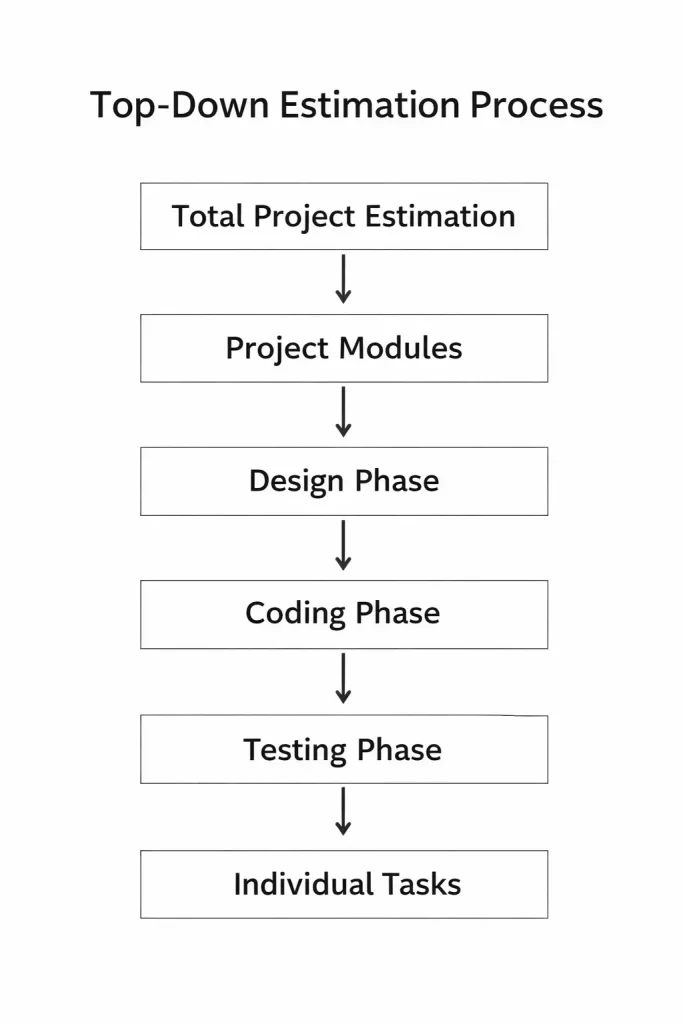
Figure: Top-Down Estimation Process
Following are the explanation of process of Top-Down:-
1. Total Project Estimation
In this step, the project manager estimates the overall cost, time, and effort of the complete software project. First, they analyze past project data and available resources to get a rough idea of the project size. Then, they set a general budget and timeline for the entire project. Therefore, this step provides a high-level estimation before breaking the project into smaller parts.
2. Project Modules
Next, the total project is divided into different modules or components. For example, a mobile application can be divided into login module, payment module, and dashboard module. This helps the team understand the structure of the project clearly. As a result, the estimation becomes more organized and easier to manage.
3. Design Phase
After dividing the project into modules, the design phase begins. In this stage, the system architecture, database structure, and user interface design are planned. Moreover, developers decide how the system will work and interact with users. Therefore, this phase ensures that the project has a clear technical structure before coding starts.
4. Coding Phase
In this step, developers start writing the actual program code for each module. They use programming languages and tools to implement the design into working software. Additionally, coding is done according to the project plan and timeline. Thus, this phase converts design ideas into a real software product.
5. Testing Phase
Once coding is completed, the testing phase begins to check errors and bugs in the software. Testers verify whether each module works correctly and meets the project requirements. Furthermore, they fix issues and improve software quality. Therefore, this step ensures that the final product is reliable and error-free.
6. Individual Tasks
Finally, the project is broken into small individual tasks and assigned to team members. Each developer or tester gets specific responsibilities and deadlines. This helps in tracking progress and completing the project on time. As a result, the team can work efficiently and achieve project goals successfully.
Techniques of Top-Down Approach – Introduction
The techniques of the Top-Down Approach are used to estimate the overall software project effort, cost, and time at a higher level before dividing it into smaller components. These techniques help project managers make quick and structured estimates based on experience, historical data, and expert judgment. Moreover, they focus on providing a general overview of the project in the early stages when detailed information is not available. Therefore, top-down techniques support efficient project planning and early decision-making.
The main purpose of using top-down estimation techniques is to simplify the estimation process and reduce planning complexity. These techniques help in predicting project size, budget, and schedule without analyzing each small task in detail. Moreover, they improve strategic planning, resource allocation, and feasibility analysis in software projects. Therefore, top-down approach techniques play an important role in effective software project estimation and management.
Following are techniques used in Top-Down Approach:-
1. Expert Judgment Technique
In this technique, experienced project managers estimate project effort and cost based on their knowledge and experience. Moreover, past project experience helps in making quick decisions. It reduces estimation time. Therefore, expert judgment is widely used in top-down estimation.
2. Analogous Estimation Technique
This technique uses data from similar previous projects to estimate the current project. Moreover, comparisons help in predicting time and cost. It improves estimation reliability. Therefore, analogous estimation supports quick planning.
3. Delphi Technique
The Delphi technique involves a group of experts who provide estimation separately and then discuss the results to reach a final estimate. Moreover, it reduces bias and improves accuracy. It ensures better decision-making. Therefore, it is useful in project estimation.
4. Historical Data Analysis
This technique uses past project records and data to estimate new projects. Moreover, previous results help in predicting effort and cost. It reduces uncertainty. Therefore, historical data improves estimation accuracy.
5. Ratio-Based Estimation
In this technique, estimation is done using ratios such as cost per module or effort per feature. Moreover, ratios help in calculating overall project estimation quickly. It simplifies planning. Therefore, it is useful in top-down estimation.
6. Management Experience Technique
This technique depends on the experience of senior management for project estimation. Moreover, decision-makers analyze project requirements at a higher level. It helps in strategic planning. Therefore, it supports effective estimation.
7. Comparative Estimation Technique
In this technique, different project estimates are compared to select the best one. Moreover, comparison helps in identifying realistic estimates. It improves planning and control. Therefore, it supports better project management.
Advantages of Top-Down Approach
1. Quick and Easy Estimation
Top-down approach provides quick estimation of project time and cost. Moreover, it reduces the need for detailed analysis. It helps in fast planning and decision-making. Therefore, it saves time and effort in the early stage.
2. Suitable for Early Planning
This approach works well when project requirements are not fully defined. Moreover, it helps in initial budgeting and scheduling. It supports early project planning. Therefore, it is useful in the initial phase of development.
3. Reduces Planning Complexity
Top-down estimation simplifies project planning by focusing on overall project estimation. Moreover, it avoids complex calculations. It makes project management easier. Therefore, it reduces planning complexity.
4. Supports Strategic Decision-Making
This approach helps managers make strategic decisions related to cost, time, and resources. Moreover, it provides a general overview of the project. It improves management control. Therefore, it supports better decision-making.
5. Requires Less Time and Effort
Top-down estimation takes less time compared to bottom-up estimation. Moreover, it requires fewer resources for planning. It improves efficiency. Therefore, it is suitable for quick estimation.
6. Useful for Large Projects
This approach helps in estimating large and complex projects at a higher level. Moreover, it provides an overall project view. It improves planning and control. Therefore, it is widely used in large projects.
7. Improves Project Coordination
Top-down estimation helps in coordinating different project activities and teams. Moreover, it provides a clear structure for planning. It ensures smooth project execution. Therefore, it improves teamwork and coordination.
Disadvantages of Top-Down Approach
1. Less Accurate Estimation
Top-down estimation may not provide accurate results because it focuses on overall estimation. Moreover, detailed task analysis is not done. It may lead to estimation errors. Therefore, accuracy may be low.
2. Depends on Expert Judgment
This approach mainly depends on the experience of project managers and experts. Moreover, wrong judgment can affect estimation. It may lead to incorrect planning. Therefore, it requires skilled professionals.
3. Ignores Small Project Details
Top-down estimation does not focus on small project tasks and components. Moreover, important details may be missed. It can affect project quality. Therefore, detailed planning becomes difficult.
4. Risk of Cost Overestimation or Underestimation
This approach may lead to wrong cost and time estimation. Moreover, incorrect assumptions can affect the project. It increases project risks. Therefore, careful analysis is required.
5. Not Suitable for Complex Detailed Projects
Top-down estimation is not ideal for projects that require detailed planning. Moreover, complex projects need more accurate estimation. It may cause planning issues. Therefore, it is less suitable for detailed development.
6. Limited Flexibility
This approach may not allow easy changes in estimation once the overall plan is defined. Moreover, modifications become difficult. It reduces adaptability. Therefore, flexibility is limited.
7. May Lead to Poor Resource Allocation
Incorrect estimation may result in improper resource distribution. Moreover, some tasks may get more or fewer resources than required. It affects project performance. Therefore, resource management may suffer.
Applications of Top-Down Approach
1. Software Development Projects
Top-down approach is used in software development for early project estimation. Moreover, it helps in planning coding, testing, and deployment activities. It supports project management. Therefore, it is widely used in software projects.
2. IT Project Management
This approach is applied in IT projects for estimating time, cost, and resources. Moreover, it helps in managing system development and maintenance. It improves planning and execution. Therefore, it is useful in IT project management.
3. Business Application Development
Top-down estimation is used in banking, e-commerce, and ERP systems. Moreover, it helps in planning business software projects. It improves project efficiency. Therefore, it supports business application development.
4. Government Software Projects
This approach is used in government and large-scale software projects. Moreover, it helps in planning large budgets and timelines. It improves project control. Therefore, it is useful in public sector projects.
5. Project Feasibility Analysis
Top-down approach helps in analyzing project feasibility at the early stage. Moreover, it provides a general estimate of cost and effort. It supports decision-making. Therefore, it is useful in feasibility studies.
6. Resource and Budget Planning
This approach helps in planning project budget and resource allocation. Moreover, it supports financial and manpower planning. It improves project management. Therefore, it is widely used in planning activities.
7. Strategic Project Planning
Top-down estimation is used in strategic planning and management decisions. Moreover, it helps organizations plan long-term projects. It improves business growth. Therefore, it is useful in strategic planning.
What is Parametric Models?
Parametric models are estimation techniques that use mathematical formulas and statistical data to calculate project cost, time, and effort. These models depend on project size, complexity, and historical data. Moreover, they provide accurate and scientific estimation. They also reduce human errors in planning. Therefore, parametric models are widely used in large software projects.
For example, In a software development project, the team uses a parametric estimation model to calculate effort and cost. The project size is estimated as 20,000 lines of code, and the model applies a mathematical formula to calculate effort in person-months. Based on the formula and historical data, the system estimates that the project will require 8 developers for 5 months and cost around ₹12 lakh.
Moreover, the estimation is based on productivity rate, project size, and complexity. This provides a more accurate and scientific estimate compared to manual methods. As a result, the project manager can plan resources and budget more effectively.
Objectives of Parametric Models
The objectives of parametric models focus on providing accurate and scientific estimation of software project effort, cost, and development time using mathematical formulas and historical data. These models help project managers estimate project requirements based on parameters such as project size, complexity, productivity rate, and available resources. Moreover, parametric models reduce estimation errors and improve project planning by using structured and data-driven methods. Therefore, the main objective of parametric models is to provide reliable and efficient project estimation.
Parametric models are mainly used to support better decision-making, proper resource allocation, and effective project control. They help organizations plan software projects in a systematic way and reduce uncertainty in estimation. Moreover, these models improve budgeting, scheduling, and risk management in software development. Therefore, the objectives of parametric models ensure accurate estimation and successful project management.
Following are the objectives of Parametric Models:-
1. Accurate Project Estimation
Parametric models aim to provide accurate estimation of project effort, cost, and time using mathematical formulas and historical data. Moreover, they reduce estimation errors and improve planning. Therefore, they ensure reliable project estimation.
2. Scientific and Data-Driven Planning
These models focus on using statistical data and parameters for estimation. Moreover, data-driven planning improves decision-making and project control. Therefore, parametric models support scientific estimation methods.
3. Efficient Resource Allocation
Parametric models help in allocating resources such as developers, tools, and budget effectively. Moreover, proper estimation ensures balanced resource distribution. Therefore, they improve resource management.
4. Reducing Estimation Uncertainty
These models aim to reduce uncertainty in project estimation by using historical data and formulas. Moreover, accurate predictions help in avoiding risks. Therefore, they improve project reliability.
5. Supporting Budget and Schedule Planning
Parametric models help in planning project budget and schedule properly. Moreover, they provide clear estimates for project timelines and costs. Therefore, they support effective project planning.
6. Improving Project Control
These models provide structured estimation that helps in monitoring and controlling project progress. Moreover, managers can track performance easily. Therefore, parametric models improve project control.
7. Enhancing Project Success Rate
Parametric models aim to increase the success rate of software projects by providing reliable and accurate estimates. Moreover, proper planning reduces project failure. Therefore, they support successful project completion.
Characteristics of Parametric Models
1. Mathematical Formula-Based
Parametric models use mathematical formulas to estimate project effort, cost, and time. Moreover, calculations are based on project parameters and data. Therefore, estimation becomes scientific and structured.
2. Uses Historical Data
These models depend on previous project data and statistical information. Moreover, historical records help in making accurate predictions. Therefore, past data plays an important role.
3. Focus on Project Parameters
Parametric models consider parameters such as project size, complexity, and productivity rate. Moreover, these parameters help in accurate estimation. Therefore, the model provides reliable results.
4. High Accuracy in Estimation
These models provide more accurate estimation compared to manual methods. Moreover, formulas reduce human errors. Therefore, project planning becomes more reliable.
5. Suitable for Large Projects
Parametric models are useful in large and complex software projects. Moreover, they help in managing big project data. Therefore, they support large-scale project estimation.
6. Structured and Systematic Approach
These models follow a systematic and organized estimation process. Moreover, structured planning improves project management. Therefore, estimation becomes easier.
7. Supports Automation
Parametric models can be implemented using software tools and automated systems. Moreover, automation improves efficiency and reduces manual effort. Therefore, estimation becomes faster.
Techniques of Parametric Models
The techniques of parametric models are used to estimate software project effort, cost, and development time using mathematical equations and statistical analysis. These techniques help project managers calculate project requirements based on parameters such as project size, lines of code, and complexity level. Moreover, parametric techniques improve accuracy and reduce estimation errors by using structured formulas and historical data. Therefore, they are widely used in software project estimation.
The main purpose of using parametric techniques is to provide reliable and scientific estimation for software projects. These techniques help in budgeting, scheduling, resource planning, and risk management. Moreover, they support decision-making and improve project performance. Therefore, parametric model techniques play an important role in software project management.
Following are the techniques used in Parametric Models:-
1. COCOMO Model
COCOMO (Constructive Cost Model) is a widely used parametric estimation technique that calculates effort and cost based on lines of code and project complexity. Moreover, it provides accurate estimation for software projects. Therefore, it is commonly used in software engineering.
2. Putnam Model
The Putnam model uses mathematical equations and productivity data to estimate project effort and development time. Moreover, it focuses on project size and manpower distribution. Therefore, it helps in effective planning.
3. Function Point Analysis
Function point analysis estimates software size based on system functions such as inputs, outputs, and files. Moreover, it measures software complexity without using lines of code. Therefore, it improves estimation accuracy.
4. SLIM Model
SLIM (Software Life Cycle Management) model is based on statistical and mathematical equations to estimate project effort and schedule. Moreover, it uses historical data for prediction. Therefore, it supports reliable estimation.
5. Regression Analysis Technique
Regression analysis uses statistical methods to estimate project cost and time based on past project data. Moreover, it helps in predicting project performance. Therefore, it improves estimation accuracy.
6. Algorithmic Cost Modeling
This technique uses algorithms and mathematical formulas to calculate effort and cost. Moreover, it provides structured estimation. Therefore, it is widely used in parametric models.
7. Productivity-Based Estimation
This technique estimates project effort based on productivity rate and available resources. Moreover, it helps in efficient resource planning. Therefore, it supports project estimation.
Workflow diagram of Parametric Estimation Process
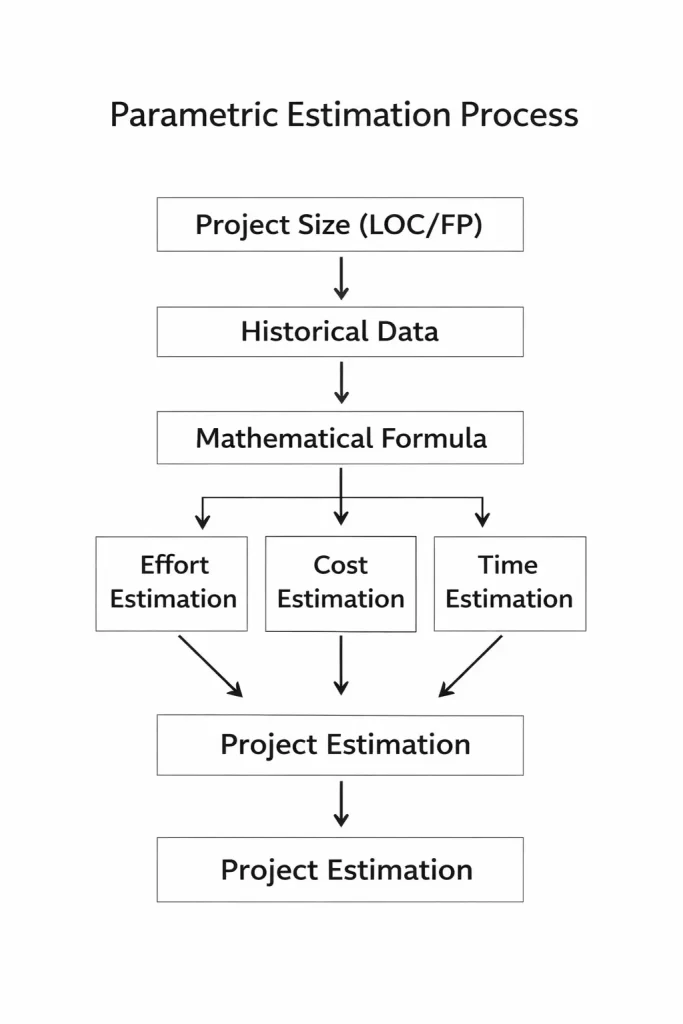
Figure: Parametric Estimation Process
Following are the explanation for the Parametric Estimation Process:-
1. Project Size (LOC/FP)
In this step, the size of the software project is measured using Lines of Code (LOC) or Function Points (FP). First, the team estimates how large the project will be based on features and requirements. Then, they calculate the number of modules and functions in the system. Therefore, this step helps in understanding the overall scope of the project clearly.
2. Historical Data
Next, the team collects historical data from previous similar projects. They analyze past project records such as time taken, cost, and effort required. Moreover, this data helps in making better and more accurate predictions. As a result, estimation becomes more reliable and realistic.
3. Mathematical Formula
After collecting project size and historical data, mathematical formulas are applied. For example, models like COCOMO or regression formulas are used to calculate effort and cost. Additionally, formulas convert project size into estimated values. Therefore, this step provides a scientific and structured estimation.
4. Effort Estimation
In this step, the amount of human effort required to complete the project is calculated. The team estimates how many developers and working hours are needed. Furthermore, they consider project complexity and team skills. Thus, this helps in proper manpower planning.
5. Cost Estimation
Next, the total cost of the project is calculated based on effort and resources. The team includes developer salaries, tools, infrastructure, and maintenance costs. Moreover, budget planning becomes easier with this estimation. Therefore, this step helps in financial planning of the project.
6. Time Estimation
After cost estimation, the project timeline is calculated. The team estimates how many days or months are needed to complete the project. Additionally, deadlines and milestones are set for each phase. As a result, the project schedule becomes clear and manageable.
7. Final Project Estimation
Finally, effort, cost, and time estimations are combined to get the final project estimation. The manager reviews all calculations and prepares the final project plan. Moreover, adjustments can be made if required. Therefore, parametric estimation provides an accurate and data-driven project estimation.
Advantages of Parametric Models
1. High Accuracy in Estimation
Parametric models provide accurate estimation using mathematical formulas and historical data. Moreover, they reduce human errors in estimation. Therefore, project planning becomes more reliable.
2. Scientific and Structured Approach
These models follow a systematic and scientific estimation method. Moreover, structured formulas improve planning and control. Therefore, they support efficient project management.
3. Saves Time in Estimation
Parametric models calculate project estimates quickly using formulas. Moreover, automation reduces manual effort. Therefore, estimation becomes faster and easier.
4. Supports Better Decision-Making
These models provide reliable data for project planning and budgeting. Moreover, managers can make informed decisions. Therefore, they improve decision-making.
5. Useful for Large Software Projects
Parametric models are suitable for large and complex software projects. Moreover, they handle big project data effectively. Therefore, they are widely used in large organizations.
6. Reduces Estimation Uncertainty
These models use statistical data to reduce uncertainty in project estimation. Moreover, predictions become more reliable. Therefore, project risks are minimized.
7. Improves Resource and Cost Planning
Parametric models help in planning resources and project budget properly. Moreover, they ensure balanced resource allocation. Therefore, project efficiency increases.
Disadvantages of Parametric Models
1. Requires Accurate Historical Data
Parametric models depend on previous project data for estimation. Moreover, incorrect data can affect results. Therefore, reliable data is necessary.
2. Complex Mathematical Calculations
These models involve complex formulas and statistical analysis. Moreover, it requires skilled professionals to apply them. Therefore, implementation becomes difficult.
3. Not Suitable for Small Projects
Parametric models are mainly designed for large software projects. Moreover, small projects may not need such detailed estimation. Therefore, they are less useful for small projects.
4. High Implementation Cost
Using parametric models may require special tools and trained experts. Moreover, this increases project cost. Therefore, it may not be affordable for small organizations.
5. Depends on Project Parameters
Parametric models rely on parameters like size and productivity. Moreover, wrong parameters can lead to incorrect estimation. Therefore, careful parameter selection is needed.
6. Less Flexibility
These models follow fixed formulas and rules. Moreover, making changes in estimation becomes difficult. Therefore, flexibility is limited.
7. Requires Skilled Professionals
Parametric models need experienced analysts and project managers. Moreover, lack of expertise can reduce accuracy. Therefore, skilled professionals are required.
Applications of Parametric Models
1. Software Development Projects
Parametric models are used to estimate effort and cost in software development projects. Moreover, they help in planning coding, testing, and deployment activities. Therefore, they support project management.
2. IT Project Management
These models are applied in IT projects for budgeting and scheduling. Moreover, they improve planning and execution. Therefore, they are useful in IT management.
3. Business Application Development
Parametric models are used in banking, e-commerce, and ERP systems. Moreover, they help in estimating project requirements. Therefore, they support business software development.
4. Government and Large Projects
These models are widely used in government and large-scale software projects. Moreover, they help in managing large budgets and timelines. Therefore, they improve project control.
5. Project Cost and Time Estimation
Parametric models help in calculating project cost and development time accurately. Moreover, they support financial planning. Therefore, they are useful in estimation.
6. Resource and Budget Planning
These models help in planning manpower and budget effectively. Moreover, they ensure balanced resource allocation. Therefore, they improve project efficiency.
7. Research and Software Engineering Studies
Parametric models are used in research and academic studies for analyzing software project estimation techniques. Moreover, they support learning and development. Therefore, they are useful in software engineering research.
Comparison Table: Top-Down Approach vs Parametric Models
| S.No | Top-Down Approach | Parametric Models |
|---|---|---|
| 1 | Estimation starts from the overall project and breaks into smaller tasks. | Estimation is calculated using mathematical formulas and historical data. |
| 2 | Uses high-level estimation based on experience and expert judgment. | Uses statistical and mathematical models for estimation. |
| 3 | Less accurate because it is based on assumptions. | More accurate due to data-driven calculations. |
| 4 | Takes less time for estimation. | Takes more time due to data analysis and calculations. |
| 5 | Simple and easy to understand. | More complex and technical. |
| 6 | Requires less historical data. | Requires detailed historical data and project size. |
| 7 | Manager estimates total project cost first, then divides into modules. | COCOMO model calculates effort based on LOC or FP. |
| 8 | Suitable for small and early-stage projects. | Suitable for large and complex projects. |
| 9 | Higher risk due to rough estimation. | Lower risk due to scientific estimation. |
| 10 | Provides quick overall estimation. | Provides accurate effort, cost, and time estimation. |
Conclusion
Top-down approach and parametric models are important software project estimation techniques. Moreover, the top-down approach provides quick estimation, while parametric models provide accurate results. Both methods help in planning and managing software projects effectively. Therefore, selecting the right estimation technique ensures successful project completion.