The elements of a project are the basic components that help in planning, managing, and completing a project successfully. These elements define how a project is organized and executed from start to finish. Moreover, they help in controlling time, cost, and quality in software development. Therefore, understanding project elements is important for effective software project management.
The elements of a project are the basic components that help in planning, managing, and completing a project successfully. These elements define how a project is organized and executed from start to finish. Moreover, they help in controlling time, cost, and quality in software development. Therefore, understanding project elements is important for effective software project management.
For example, while developing an online shopping website, the project manager defines project scope, assigns developers, sets deadlines, and estimates cost. The team follows proper planning and uses resources efficiently. Moreover, progress is monitored regularly to ensure quality and timely delivery. Therefore, project elements help in completing the project successfully.
What are elements of Project?
Elements of a project are the basic components or key factors that are required for planning, organizing, and successfully completing a project. These elements include objective, scope, time, cost, resources, quality, risk, and stakeholders, which together help in managing and controlling the project effectively. They provide a structured framework that ensures the project is completed within the defined goals, budget, and schedule while maintaining quality and efficiency.
Diagram of Key Elements of Project Structure
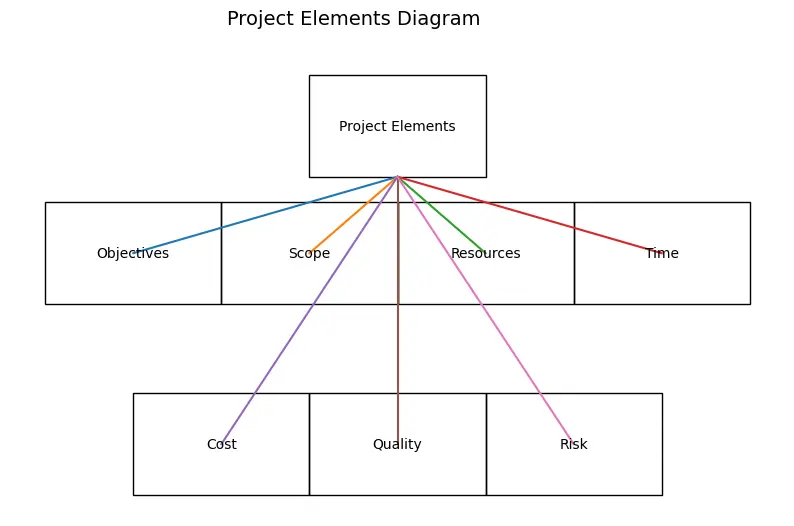
Figure: Elements of Project Structure
Following are the explanation of Elements of Project Structure:-
1. Project Objectives
Project objectives define the goals and expected results of the project. They help the team understand what needs to be achieved. Moreover, clear objectives guide project planning and decision-making. Therefore, objectives are the foundation of a project.
For example, the objective of a banking app project is to provide secure online transactions. The team focuses on safety and fast performance. Moreover, this helps in meeting customer needs. Therefore, clear objectives guide the project.
2. Project Scope
Project scope defines the boundaries and features of the project. It helps in identifying what is included and excluded. Moreover, scope planning avoids unnecessary work and confusion. Therefore, project scope keeps the project focused.
For example, a food delivery app includes ordering and payment features but excludes chat features. The team focuses only on required functions. Moreover, this saves time and cost. Therefore, scope controls project work.
3. Project Resources
Project resources include team members, tools, and budget required for development. They help in completing project tasks efficiently. Moreover, proper resource allocation improves productivity. Therefore, resources are essential for project success.
For example, developers, testers, and software tools are assigned to a project. Each team member performs specific tasks. Moreover, proper resource use improves performance. Therefore, resources support project completion.
4. Project Time
Project time refers to the schedule and deadlines for completing tasks. It helps in tracking project progress. Moreover, proper scheduling ensures timely delivery. Therefore, time management is important.
For example, a mobile app project is planned for 4 months. Each phase has a deadline. Moreover, timely work ensures project completion. Therefore, time control is necessary.
5. Project Cost
Project cost includes the total budget required for development. It helps in financial planning and expense control. Moreover, cost estimation ensures proper use of money. Therefore, cost management is important.
For example, a software project has a budget of ₹10 lakh. The manager controls expenses carefully. Moreover, proper budgeting avoids financial loss. Therefore, cost planning is essential.
6. Project Quality
Project quality ensures that the software meets standards and requirements. It includes testing and performance checking. Moreover, quality planning improves reliability and user satisfaction. Therefore, quality is important.
For example, the testing team checks software for errors before release. Bugs are fixed to improve performance. Moreover, this ensures user satisfaction. Therefore, quality improves the product.
7. Project Risk
Project risk refers to possible problems that may affect the project. It helps in identifying and managing uncertainties. Moreover, risk planning reduces project failure. Therefore, risk management is necessary.
For example, system failure may delay a project. The team prepares backup plans. Moreover, this reduces project risk. Therefore, risk planning ensures safety.
Objectives of Project Elements
The main objective of project elements is to provide a clear structure for project planning and execution. Moreover, they help in managing resources and controlling project activities. They also support proper coordination and communication among team members. Therefore, project elements ensure successful and timely project completion.
Following are the objectives of Project Elements:-
1. To Define Project Goals
The main objective of project elements is to clearly define the goals and purpose of the project. It helps the team understand what needs to be achieved and how to achieve it. Clear goals provide proper direction and reduce confusion during project execution. It ensures that all activities are focused on achieving the desired result. This improves overall project performance and success.
2. To Ensure Proper Planning
Project elements help in systematic planning of tasks and activities. They provide a structured approach to organize work, resources, and schedules. Proper planning reduces uncertainty and improves efficiency in project execution. It helps in setting timelines and allocating responsibilities. This leads to smooth and organized project management.
3. To Manage Time and Cost
Another objective is to control project time and budget effectively. Project elements help in scheduling activities and estimating costs properly. This ensures that the project is completed within the given time and financial limits. It also helps in avoiding delays and unnecessary expenses. Effective time and cost management improves project stability.
4. To Improve Resource Utilization
Project elements aim to use available resources efficiently. They help in assigning the right people, tools, and materials to the project. Proper resource utilization increases productivity and reduces wastage. It also ensures that work is completed smoothly without shortages. Efficient resource management leads to better project outcomes.
5. To Maintain Quality Standards
One important objective is to ensure high-quality project output. Project elements focus on maintaining standards and reducing errors in the final product. Quality control helps in meeting customer requirements and expectations. It improves reliability and performance of the project. Maintaining quality increases customer satisfaction and trust.
6. To Reduce Project Risks
Project elements help in identifying and managing risks in advance. They ensure that potential problems are handled properly before they affect the project. Risk management improves project safety and stability. It helps in making better decisions during difficult situations. This leads to successful project completion.
7. To Ensure Stakeholder Satisfaction
Project elements aim to meet the needs and expectations of stakeholders. They help in proper communication and coordination with clients, team members, and managers. Understanding stakeholder requirements improves project acceptance. It also helps in building trust and cooperation. This ensures overall project success.
Characteristics of Elements of Project
1. Clearly Defined
Elements of a project are clearly defined and structured to guide the project properly. Each element such as objective, scope, time, and cost has a specific role in project management. Clear definition helps in understanding responsibilities and tasks easily. It reduces confusion among team members. This ensures smooth and systematic project execution.
2. Interrelated in Nature
All project elements are interconnected and depend on each other. A change in one element, like time or cost, can affect other elements. Proper coordination between elements is necessary for project success. It helps in maintaining balance in project planning and execution. This interrelation improves overall project efficiency.
3. Goal-Oriented
Project elements are focused on achieving specific goals and objectives. They guide all activities toward the final project outcome. Each element supports the project in reaching its target effectively. This ensures that the project remains focused and productive. Goal orientation improves performance and results.
4. Time-Bound
Project elements work within a specific time frame or schedule. Every project has a start and end date that must be followed. Time-bound elements help in proper scheduling and timely completion of tasks. They reduce delays and improve work efficiency. This ensures the project is completed on time.
5. Resource-Based
Project elements require proper use of resources such as manpower, tools, and materials. Efficient resource utilization helps in completing the project successfully. It ensures that resources are not wasted or misused. Proper management of resources improves productivity. This leads to better project performance.
6. Quality-Focused
Project elements focus on maintaining quality standards in the final output. They ensure that the project meets customer requirements and expectations. Quality control helps in reducing errors and defects. It improves reliability and performance of the project. This increases customer satisfaction.
7. Risk-Sensitive
Project elements consider possible risks and uncertainties in the project. They help in identifying and managing potential problems in advance. Risk-sensitive elements ensure project safety and stability. Proper risk management reduces chances of project failure. This supports successful project completion.
Advantages of Elements of Project
1. Provides Clear Project Structure
Project elements provide a clear structure for planning and executing the project. They define objectives, scope, time, cost, and resources in an organized manner. This helps the team understand their roles and responsibilities clearly. It reduces confusion and improves coordination among team members. A structured approach increases the chances of project success.
2. Improves Project Planning
Elements of a project help in systematic planning of tasks and activities. They allow managers to organize resources, schedule work, and set deadlines properly. Proper planning reduces errors and delays during execution. It ensures that all activities are carried out in a logical order. This leads to smooth project management.
3. Ensures Better Time and Cost Control
Project elements help in managing project time and budget effectively. They allow proper estimation and monitoring of expenses and schedules. This helps in avoiding unnecessary costs and delays. It ensures that the project stays within the planned limits. Effective control improves project efficiency and stability.
4. Enhances Resource Utilization
Project elements help in proper allocation and use of resources. They ensure that manpower, tools, and materials are used efficiently. This reduces wastage and improves productivity. Proper resource utilization leads to better performance. It also helps in completing the project on time.
5. Maintains Quality Standards
Elements of a project focus on delivering high-quality output. They ensure that project results meet required standards and expectations. Quality control reduces defects and improves reliability. It increases customer satisfaction and trust. Maintaining quality improves overall project success.
6. Reduces Project Risks
Project elements help in identifying and managing risks early. They allow proper planning to handle uncertainties and problems. Risk management reduces chances of project failure. It improves safety and stability of the project. This ensures smooth project execution.
7. Supports Better Decision-Making
Project elements provide clear information about project goals, cost, and resources. This helps managers make better and faster decisions. Proper decision-making improves project performance and efficiency. It also helps in solving problems effectively. This leads to successful project completion.
Disadvantages of Elements of Project
1. Requires Detailed Planning
Project elements require careful and detailed planning before execution. This process takes time and effort from the project team. Improper planning can lead to confusion and delays. It may slow down the start of the project. This makes project management more complex.
2. Increases Management Complexity
Managing different project elements like cost, time, and resources can be difficult. It requires skilled managers and proper coordination. Handling multiple elements at the same time increases complexity. Poor management may lead to project failure. This creates additional workload.
3. Time-Consuming Process
Working with all project elements requires continuous monitoring and control. This takes a lot of time and effort during project execution. Regular updates and reviews are necessary. It may slow down the overall progress of the project. This increases project duration.
4. High Implementation Cost
Managing project elements requires tools, technology, and skilled professionals. This increases the overall cost of project management. Small organizations may find it difficult to afford. High cost can affect project budget. This makes implementation challenging.
5. Requires Skilled Team
Proper handling of project elements needs experienced and trained team members. Lack of skilled professionals can lead to poor management. This may cause errors and delays in the project. Training and development also require additional cost. This affects project efficiency.
6. Risk of Miscommunication
Poor communication between stakeholders and team members can affect project elements. Misunderstanding of objectives and scope may create problems. It can lead to conflicts and delays in work. Proper communication is necessary for smooth execution. Without it, project performance may suffer.7. Difficult to Manage Changes
Changes in one project element can affect other elements. For example, changes in scope may increase cost and time. Managing such changes is difficult and requires proper planning. It may disturb project balance and schedule. This creates additional challenges.
Applications of Elements of Project
1. Software Development Projects
Project elements are widely used in software development for planning and execution. They help in managing coding, testing, and deployment activities. Proper use of time, cost, and resources ensures smooth development. It improves software quality and reliability. This leads to successful software delivery.
2. Construction Projects
Project elements help in managing construction activities like design, material, and labor. They ensure proper scheduling and cost control in building projects. Risk and quality management improve safety and performance. It helps in completing construction on time. This ensures project success.
3. Business and Management Projects
Project elements are used in business planning and management activities. They help in organizing marketing, finance, and operations tasks. Proper planning improves decision-making and performance. It ensures efficient use of resources. This supports business growth.
4. Educational Projects
Project elements are applied in academic and research projects. They help students and researchers plan their work properly. Proper objectives and time management improve project completion. It ensures quality research output. This supports academic success.
5. IT and Networking Projects
Project elements are useful in IT and networking system implementation. They help in managing hardware, software, and network resources. Proper planning ensures system security and performance. It reduces technical risks and errors. This improves system efficiency.
6. Healthcare Projects
Project elements are used in healthcare system planning and management. They help in managing medical resources and services. Proper planning ensures better patient care and safety. It improves hospital operations and efficiency. This supports healthcare development.
7. Government and Public Projects
Project elements are applied in government development and public service projects. They help in managing infrastructure and welfare programs. Proper planning ensures effective use of public resources. It improves project transparency and accountability. This benefits society.
Conclusion
Elements of a project form the foundation for effective project planning and management. They help in defining objectives, managing time and cost, utilizing resources, maintaining quality, and reducing risks. Proper understanding of project elements ensures smooth coordination and better decision-making throughout the project lifecycle. This leads to efficient execution, timely completion, and successful achievement of project goals.