In project management and software engineering, an activity refers to a specific task or piece of work that needs to be performed to complete a project. A project is divided into several small tasks so that work can be planned, managed, and controlled efficiently. Each activity represents a unit of work that contributes to the overall project completion and helps in achieving project objectives in a systematic way.
Activities are important because they help in scheduling, resource allocation, and monitoring progress. By breaking the project into activities, project managers can identify dependencies, estimate time and cost, and ensure that the project is completed within the given deadline. Activities are commonly used in tools like Work Breakdown Structure (WBS), PERT, and CPM for proper project planning and execution.
For example, in an online banking system, activities include database design, coding, testing, and deployment. Moreover, each activity has a specific timeline and resources. It also helps in monitoring project progress. Therefore, activities ensure structured project development.
What is Activity?
Activity is a specific task or operation performed during a project to achieve a particular objective. It represents a small unit of work that contributes to the overall project completion. An activity is carried out within a defined time and uses available resources such as manpower, tools, and materials.
Characteristics of Activity
The characteristics of an activity describe the important features that define how an activity works in a project. In project management and software engineering, activities are the basic building blocks of a project, and understanding their characteristics helps in proper planning, scheduling, and execution. These characteristics explain the nature, structure, and role of activities in completing project tasks effectively.
By studying the characteristics of an activity, project managers and team members can clearly understand how tasks are organized, how resources are used, and how project progress is monitored. It also helps in improving coordination, reducing confusion, and ensuring that every activity contributes to the successful completion of the project within time and budget.
Following are the various characteristics of an activity:-
1. Clearly Defined Task
An activity is a clearly defined and specific task in a project. It describes what work needs to be done and how it should be carried out. This helps team members understand their responsibilities and reduces confusion during project execution. A well-defined activity improves coordination and ensures smooth workflow in the project.
2. Definite Start and End Point
Every activity has a fixed starting time and ending time. It begins when the assigned work starts and ends when the task is completed. This helps in scheduling and monitoring project progress effectively. It also makes it easier to identify delays and manage deadlines.
3. Requires Time for Completion
An activity always consumes a certain amount of time to complete. Time estimation is important for proper planning and scheduling of project tasks. It helps in completing the project within the given deadline and improves overall productivity. Proper time management ensures efficient project execution.
4. Uses Resources
Activities require resources such as manpower, tools, equipment, and materials. Without proper resources, an activity cannot be completed successfully. Efficient use of resources helps in reducing cost and improving project performance. Resource allocation also ensures smooth completion of tasks.
5. Contributes to Project Objective
Each activity plays an important role in achieving the overall project goal. All activities together lead to project completion in a structured manner. If an activity is not completed properly, it can affect the entire project. Therefore, every activity must be carefully planned and executed.
6. Interdependent with Other Activities
Activities are connected with each other in a project. One activity may depend on another activity for its start or completion. This dependency helps in maintaining proper sequence and workflow in the project. It ensures smooth coordination among different project tasks.
7. Measurable and Controllable
Activities can be measured in terms of time, cost, and performance. This helps project managers monitor progress and control project execution effectively. Measuring activities improves decision-making and ensures project quality. It also helps in tracking performance and making necessary improvements.
8. Part of Project Planning and Scheduling
Activities are an essential part of project planning tools like WBS, PERT, and CPM. They help in organizing and scheduling project tasks in a systematic way. Proper planning of activities ensures timely project completion and efficient management. It also improves coordination and project control.
Objectives of Activity
The objectives of activity define the purpose and goals of performing activities in a project. In project management and software engineering, activities are designed to ensure that each task contributes effectively to the overall project completion. The main objective of an activity is to organize work in a structured manner so that time, cost, and resources can be managed properly.
Understanding the objectives of activity helps project managers plan tasks efficiently, monitor progress, and achieve project goals within the given constraints. It also improves coordination among team members and ensures that every activity supports the successful completion of the project.
There are several objectives as follows:-
1. Achieve Project Goals
The main objective of an activity is to help in achieving the overall project goals. Each activity contributes to the completion of a specific part of the project. Proper execution of activities ensures successful project completion. It also helps in maintaining project direction and focus.
2. Organize Project Work
Activities help in dividing the project into smaller manageable tasks. This makes it easier to plan, schedule, and execute the work. Organized activities reduce confusion and improve workflow. It also ensures systematic project execution.
3. Improve Time Management
Activities help in proper scheduling and time allocation for each task. This ensures that the project is completed within the given deadline. Effective time management reduces delays and increases productivity. It also helps in tracking project progress.
4. Ensure Efficient Resource Utilization
Activities help in proper use of resources such as manpower, tools, and materials. This reduces wastage and improves efficiency. Proper resource allocation leads to better project performance. It also helps in controlling project cost.
5. Support Monitoring and Control
Activities make it easier to monitor and control project progress. Project managers can track each activity and identify problems early. This helps in taking corrective actions on time. It also improves project quality and performance.
6. Improve Coordination Among Team Members
Activities help in assigning tasks to different team members clearly. This improves communication and coordination in the project. Clear activities reduce misunderstandings and conflicts. It also ensures smooth project execution.
7. Reduce Project Risks
Proper planning of activities helps in identifying potential risks early. This allows project managers to take preventive measures. It reduces uncertainty and improves project stability. It also ensures safer project execution.
Advantages of Activity
1. Improves Project Planning
Activities help in better planning of project tasks and schedules. They provide a clear structure for project execution and reduce confusion in work. Proper planning ensures smooth project management and timely completion of tasks.
2. Enhances Work Organization
Activities divide the project into small manageable units, making work easier to organize. This improves workflow and coordination among team members. Organized work leads to better project performance and efficiency.
3. Better Time Management
Activities help in scheduling tasks according to priority and deadlines. This ensures that the project is completed within the given time. It reduces delays and increases overall productivity.
4. Efficient Resource Utilization
Activities ensure proper allocation and use of resources such as manpower and tools. This reduces wastage and controls project cost. Efficient resource usage improves project performance.
5. Easy Monitoring and Control
Activities make it easier to track project progress and performance. Project managers can monitor each task and take corrective actions when needed. This improves project control and quality.
6. Improves Team Coordination
Activities clearly define responsibilities for each team member. This improves communication and teamwork in the project. Proper coordination leads to smooth execution of tasks.
7. Helps in Risk Management
Activities help in identifying and managing project risks early. This reduces uncertainty and improves project stability. It ensures safe and effective project execution.
Disadvantages of Activity
1. Time-Consuming Planning
Planning and organizing activities requires time and effort. Project managers need to carefully define each task before execution. This may delay the initial stage of the project.
2. Requires Skilled Management
Proper activity management requires experienced project managers. Without proper skills, activities may not be planned correctly. This can lead to confusion and project delays.
3. Increased Documentation
Activities require proper documentation and scheduling. This increases administrative work and paperwork. Managing documentation can consume extra time and resources.
4. Dependency Issues
Activities often depend on each other for completion. Delay in one activity can affect the entire project schedule. Managing dependencies becomes difficult.
5. Resource Constraints
Activities require proper resources such as manpower and tools. Limited resources may slow down project progress. This can affect activity completion and efficiency.
6. Difficult to Handle Large Projects
In large projects, managing many activities becomes complex. Tracking and controlling all tasks is challenging. It requires advanced planning and tools.
7. Risk of Miscommunication
Improper activity definition may cause misunderstandings among team members. This can lead to errors and delays. Clear communication is necessary for effective activity management.
Applications of Activity
1. Software Development Projects
Activities are used in software development for tasks like coding, testing, and deployment. They help in organizing work and managing schedules. This ensures timely software delivery.
2. Construction Projects
Activities are used in construction to manage planning, designing, and building tasks. They help in scheduling and resource allocation. This ensures smooth project execution.
3. Project Management Systems
Activities are used in WBS, PERT, and CPM for planning and monitoring project tasks. They help in organizing work in a structured way. This improves project control.
4. Business Process Management
Activities help in managing business operations and workflows. They improve efficiency and coordination. This ensures smooth business operations.
5. Manufacturing Industry
Activities are used in production, quality control, and packaging processes. They help in managing workflow and resources. This improves production efficiency.
6. IT and Service Industry
Activities are used in IT services for system maintenance and support. They help in organizing service operations and schedules. This improves service quality.
7. Research and Development Projects
Activities are used in research work to manage experiments and analysis. They help in organizing research tasks and timelines. This ensures accurate and efficient results.
Types of Activities in Software Project
In a software project, activities are divided into different types to manage the development process in a systematic and organized manner. These activities help in breaking the software development work into smaller and manageable tasks so that each phase of the project can be planned, executed, and controlled effectively. By classifying activities into different types, project managers and developers can easily understand the workflow and ensure smooth project execution.
The types of activities in a software project represent the various stages involved in developing software, such as planning, designing, coding, testing, and maintenance. Each type of activity plays a specific role in achieving the overall project objective and ensures that the software is developed with quality, efficiency, and within the given time and cost constraints.
There are following five types of Activity in Software Project:-
1. Development Activity
Development activity includes coding, designing, and building the software system. Moreover, it focuses on creating the main features and functions of the project. It also involves writing program code and designing system architecture. Therefore, development activity plays an important role in software creation.
For Examples: Coding login module, designing database, creating user interface.
2. Testing Activity
Testing activity checks whether the software works correctly or not. Moreover, it helps in finding bugs and errors in the system. It also improves software quality and performance. Therefore, testing activity ensures reliable and error-free software.
For Examples: Unit testing, integration testing, system testing, bug fixing.
3. Management Activity
Management activity involves planning, scheduling, and monitoring project work. Moreover, it helps project managers control project progress and resources. It also supports decision-making and coordination among team members. Therefore, management activity ensures smooth project execution.
For Examples: Project planning, team meetings, progress tracking, risk management.
4. Documentation Activity
Documentation activity includes preparing reports, manuals, and project documents. Moreover, it helps in maintaining proper records of project work. It also supports future maintenance and understanding of the system. Therefore, documentation activity improves project clarity and communication.
For Examples: Project report, user manual, technical documentation, design document.
5. Deployment Activity
Deployment activity involves installing and releasing the software to users. Moreover, it ensures that the software runs properly in the real environment. It also includes maintenance and updates after release. Therefore, deployment activity completes the software project process.
For Examples: Software installation, system release, updates, maintenance.
Activity Life Cycle Flow in Software Project Management
Activity Life Cycle explains the stages through which an activity passes during a software project. Moreover, it helps in managing and tracking project tasks step by step. It also supports planning, scheduling, and monitoring of activities. Therefore, activity life cycle improves project control and execution.
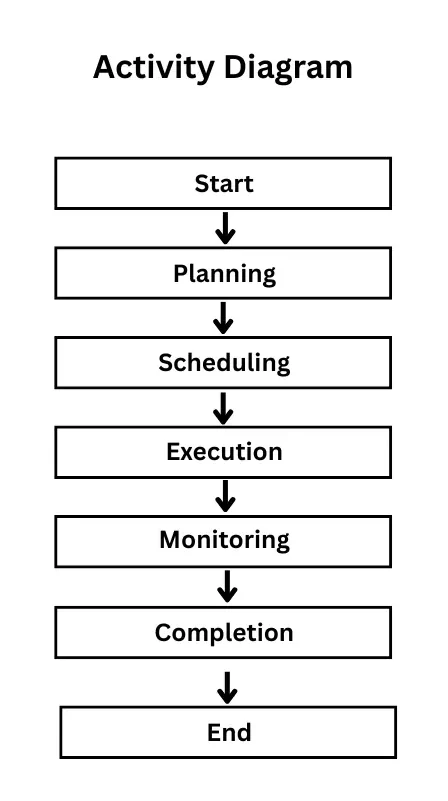
Figure: Activity Lifecycle diagram
Following are the explanation of activity Lifecycle diagram:-
1. Start
This is the beginning of the project activity. Moreover, it indicates that the project process has started. It also shows the entry point of the workflow. Therefore, all project activities begin from this stage.
2. Planning
Activity planning is the first stage where project tasks are identified and defined. Moreover, it helps in deciding what work needs to be done in the project. It also includes setting objectives and required resources. Therefore, planning ensures a clear project direction.
3. Scheduling
Activity scheduling defines the start time and end time of each activity. Moreover, it helps in setting deadlines and project timelines. It also ensures that activities are completed in proper sequence. Therefore, scheduling improves time management.
4. Execution
Activity execution is the stage where actual project work is performed. Moreover, team members complete assigned tasks and follow the project plan. It also involves coordination and teamwork. Therefore, execution turns planning into real work.
5. Monitoring
Activity monitoring checks the progress of project tasks regularly. Moreover, it helps in identifying delays and errors. It also supports corrective actions and performance tracking. Therefore, monitoring ensures smooth project progress.
6. Completion
Activity completion is the final stage where tasks are finished and verified. Moreover, it ensures that work meets project requirements and quality standards. It also includes documentation and reporting. Therefore, completion marks the successful end of an activity.
7. End
This is the final stage of the activity diagram. Moreover, it shows that the project workflow is completed. It also indicates successful execution of all activities. Therefore, the project reaches its final stage.
Conclusion
An activity is an important part of project management and software engineering as it represents a specific task that helps in completing a project successfully. It provides a clear structure for planning, scheduling, and executing project work in a systematic manner. By dividing the project into smaller activities, it becomes easier to manage time, resources, and responsibilities effectively.
Overall, activities help in improving project organization, coordination, and control while ensuring timely completion of tasks. Proper planning and execution of activities lead to better productivity, reduced risks, and successful achievement of project objectives. Therefore, activities play a vital role in ensuring efficient and smooth project management.