Project management involves planning, organizing, and controlling resources to achieve specific goals within a defined time and budget. It ensures that all project activities are carried out in a structured and systematic manner. Moreover, project management helps teams coordinate their work and complete tasks efficiently. It focuses on proper scheduling, resource allocation, and risk handling. Therefore, effective project management leads to successful project completion and better organizational performance.
In addition, project management requires various activities and knowledge areas to manage a project effectively. These include scope management, time management, cost management, quality management, and resource management. Each activity plays an important role in guiding the project from start to finish. Moreover, proper knowledge of these areas helps project managers make better decisions and control risks. As a result, project management ensures smooth execution and achievement of project objectives.
For example, while developing a mobile application, the project manager plans tasks, assigns work to developers, monitors progress, and ensures timely delivery. All these activities together represent project management.
What is management or Project management?
Management is the process of planning, organizing, directing, and controlling resources to achieve organizational goals effectively and efficiently. It involves coordinating people, materials, and activities to complete tasks successfully. Moreover, management ensures proper use of time, money, and manpower. Therefore, it helps organizations achieve their objectives in a systematic manner.
Project management is the process of planning, executing, monitoring, and controlling project activities to achieve specific goals within a defined time and budget. It focuses on managing resources, risks, and quality throughout the project lifecycle. Moreover, it ensures that project objectives are completed efficiently. Therefore, project management helps in delivering successful and high-quality project outcomes.
Diagram of Project Management Activities
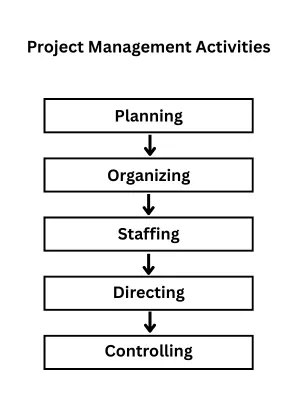
Figure: Activities in Project Management
Project Management Activities
Project management activities are the steps and processes used to plan, organize, and complete a project successfully. These activities help in managing resources, time, cost, and team coordination throughout the project lifecycle. Moreover, they provide a structured approach to achieve project goals efficiently. Each activity plays an important role in guiding the project from planning to completion. Therefore, understanding project management activities is essential for smooth execution and successful delivery of projects.
Lets see each Project Management Activities in details
1. Planning
Planning is the first and most important activity in project management. In this stage, the project manager defines project goals, scope, timeline, budget, and required resources. It helps in setting a clear direction and roadmap for the entire project. Moreover, proper planning reduces confusion and risks by identifying possible challenges in advance. It also helps in preparing schedules and strategies for successful execution. Therefore, planning ensures that the project starts with a clear vision and structured approach.
For example, a mobile app project starts with planning features and timeline. The manager decides the app design, target users, and development phases. A schedule is created for coding, testing, and deployment. As a result, the team understands the project goals and works efficiently.
2. Organizing
Organizing involves arranging resources, tasks, and team members in a proper structure. The project manager assigns responsibilities and ensures that each member knows their role. Moreover, organizing helps in managing tools, technology, and workflow effectively. It improves coordination and reduces confusion among team members. Proper organization also ensures smooth communication and task completion. Therefore, organizing makes the project more systematic and efficient.
For example, in a software development project, developers handle coding, designers work on UI, and testers check quality. The manager organizes tasks according to team skills. Work is divided into modules and deadlines are assigned. As a result, the project progresses smoothly.
3. Staffing
Staffing focuses on selecting and managing the right people for the project. It includes hiring skilled professionals, training employees, and building a strong team. Moreover, staffing ensures that the project has enough manpower to complete tasks on time. Proper staffing improves productivity and quality of work. It also helps in maintaining team motivation and performance. Therefore, staffing is essential for successful project execution.
For example, a web development project requires frontend and backend developers. The company hires experienced programmers and trains new employees. Team members are assigned tasks based on their expertise. As a result, the project gets skilled support and better output.
4. Directing (Leading)
Directing or leading involves guiding and motivating team members to achieve project goals. The project manager provides instructions, support, and leadership throughout the project. Moreover, good leadership improves teamwork and communication. It helps in solving problems and maintaining discipline in the team. Directing also ensures that employees stay focused and productive. Therefore, effective leadership leads to successful project completion.
For example, during app development, the manager guides developers and resolves technical issues. Team meetings are conducted to discuss progress and challenges. The manager motivates employees to meet deadlines and maintain quality. As a result, the team works efficiently and achieves project goals.
5. Controlling
Controlling involves monitoring project progress and comparing it with the planned schedule and budget. The project manager checks performance and identifies any deviations. Moreover, corrective actions are taken to fix delays or errors. Controlling ensures quality, cost control, and timely completion of the project. Regular monitoring helps in maintaining project stability. Therefore, controlling keeps the project on the right track.
For example, in a software project, the manager tracks development progress weekly. If coding is delayed, extra resources are assigned to complete tasks. Testing is done to ensure quality and performance. As a result, the project stays on schedule and meets its objectives.
Knowledge Areas in Project Management
Project management is divided into different knowledge areas. Each area focuses on a specific part of managing a project. Together, they help ensure that the project is completed successfully, on time, within budget, and with the desired quality. Understanding these areas helps students and professionals manage projects in a structured and efficient way.
Following are the explanation of each knowledge areas in Project Management:-
1. Scope Management
Scope management defines what work is included in the project and what is not included. It helps in setting clear project boundaries and objectives from the beginning. Moreover, it ensures that the project team focuses only on required tasks and avoids unnecessary work. Proper scope management reduces confusion and prevents scope creep during development. It also helps in planning resources and timelines effectively. Therefore, scope management ensures that the project stays aligned with its goals.
2. Time Management
Time management ensures that the project is completed within the given schedule and deadlines. It involves planning activities, setting timelines, and monitoring progress regularly. Moreover, proper time management helps in avoiding delays and improves productivity. Project managers use schedules and timelines to track progress and manage tasks. This ensures that every phase of the project is completed on time. Therefore, time management plays a key role in successful project delivery.
3. Cost Management
Cost management focuses on managing the project budget and controlling expenses effectively. It includes estimating costs, planning the budget, and monitoring financial resources. Moreover, proper cost management helps in avoiding overspending and financial losses. Project managers track expenses and make adjustments when necessary. This ensures that the project is completed within the allocated budget. Therefore, cost management is essential for financial stability in projects.
4. Quality Management
Quality management ensures that the final output meets required standards and customer expectations. It involves quality planning, quality assurance, and quality control during the project. Moreover, regular testing and monitoring help in reducing defects and improving performance. High-quality output increases user satisfaction and trust. Proper quality management also ensures reliability and efficiency. Therefore, quality management is important for delivering successful projects.
5. Resource Management
Resource management focuses on managing people, materials, and tools needed for the project. It ensures that resources are available at the right time and used efficiently. Moreover, proper resource allocation improves productivity and reduces wastage. Project managers assign tasks based on team skills and project requirements. This helps in smooth workflow and coordination. Therefore, resource management supports effective project execution.
6. Risk Management
Risk management identifies and handles risks that may affect the project. It involves analyzing possible problems and preparing solutions in advance. Moreover, proper risk management reduces uncertainties and project failures. Managers create backup plans to handle unexpected situations. This ensures project stability and smooth progress. Therefore, risk management helps in minimizing project risks.
7. Communication Management
Communication management ensures proper information flow among team members and stakeholders. It helps in sharing updates, instructions, and feedback regularly. Moreover, clear communication reduces misunderstandings and improves teamwork. Project managers conduct meetings and use communication tools to keep everyone informed. This ensures smooth coordination and problem-solving. Therefore, communication management is essential for project success.
Objectives of Management / Project Management
Project management objectives define the goals that guide a project toward successful completion. These objectives help in planning, organizing, and controlling project activities effectively. Moreover, they ensure that resources, time, and budget are used properly. Clear objectives also help project managers monitor progress and reduce risks. Therefore, understanding the objectives of project management is essential for achieving quality results and meeting organizational goals.
Following are the objectives of Project management:-
1. Achieving Project Goals
The main objective of project management is to achieve the defined project goals successfully. It ensures that all tasks are completed according to the project requirements and objectives. Proper planning and coordination help in meeting targets efficiently. Moreover, project managers guide the team to stay focused on the final outcome. Therefore, achieving project goals is the primary aim of management.
2. Effective Resource Utilization
Project management aims to use resources such as time, money, manpower, and materials efficiently. Proper allocation of resources reduces wastage and improves productivity. Moreover, it ensures that every resource is used in the best possible way. Efficient resource utilization also helps in reducing project costs. Therefore, management ensures optimal use of available resources.
3. Timely Completion of Project
Another important objective is to complete the project within the given time frame. Project management helps in planning schedules and monitoring progress regularly. Moreover, deadlines are set to ensure tasks are completed on time. Timely completion improves client satisfaction and reduces additional costs. Therefore, time management is a key objective of project management.
4. Maintaining Quality Standards
Project management ensures that the final product meets quality standards and customer expectations. Quality control and testing help in reducing errors and defects. Moreover, continuous monitoring ensures better performance and reliability. High-quality output increases user satisfaction and trust. Therefore, maintaining quality is an essential objective of management.
5. Cost Control and Budget Management
Project management aims to complete the project within the planned budget. Proper cost estimation and monitoring help in controlling expenses. Moreover, financial planning reduces unnecessary spending and losses. Budget management ensures efficient use of funds. Therefore, cost control is an important objective of project management.
6. Risk Management
Project management focuses on identifying and reducing risks that may affect project success. Proper risk analysis helps in preparing solutions in advance. Moreover, management strategies reduce uncertainties and project failures. This ensures smooth project execution. Therefore, risk management is a key objective in project management.
7. Improving Communication and Coordination
Project management aims to improve communication between team members and stakeholders. Proper coordination ensures smooth workflow and teamwork. Moreover, clear communication reduces misunderstandings and errors. It helps in solving problems quickly and efficiently. Therefore, effective communication is essential for successful project management.
Characteristics of Management / Project Management
1. Goal-Oriented Nature
Project management is always focused on achieving specific goals and objectives. Every activity and decision is planned according to the project requirements and expected outcomes. Moreover, clear goals help the team stay focused and organized throughout the project. This ensures that all efforts move in the right direction. Therefore, goal orientation is a key characteristic of project management.
2. Planning and Organization
Project management involves proper planning and organization of tasks and resources. Managers create schedules, assign responsibilities, and set deadlines to ensure smooth workflow. Moreover, organized planning helps in reducing confusion and delays. It also ensures efficient use of resources and time. Therefore, planning and organization are essential characteristics of project management.
3. Time-Bound Process
Project management works within a specific time frame and deadlines. Every project has a start date and an end date that must be followed. Moreover, timely completion ensures client satisfaction and reduces extra costs. Project managers monitor progress regularly to meet deadlines. Therefore, time-bound execution is an important characteristic of project management.
4. Resource Management
Project management focuses on the proper use of resources such as manpower, money, materials, and technology. Efficient resource management helps in reducing wastage and improving productivity. Moreover, it ensures that the project runs smoothly without interruptions. Proper allocation of resources leads to better project outcomes. Therefore, resource management is a key feature of project management.
5. Risk and Uncertainty Handling
Every project involves risks and uncertainties that may affect progress. Project management identifies possible risks and prepares solutions in advance. Moreover, risk management helps in minimizing losses and project failures. Continuous monitoring ensures better control over unexpected situations. Therefore, handling risks is an important characteristic of project management.
6. Teamwork and Coordination
Project management requires teamwork and coordination among team members. Developers, testers, managers, and stakeholders work together to achieve project goals. Moreover, proper communication improves collaboration and problem-solving. Coordination ensures smooth workflow and efficient task completion. Therefore, teamwork is a vital characteristic of project management.
7. Continuous Monitoring and Control
Project management involves regular monitoring and control of project activities. Managers track progress, check performance, and make necessary improvements. Moreover, monitoring helps in maintaining quality and meeting deadlines. It also ensures that the project stays within budget and scope. Therefore, continuous monitoring is an essential characteristic of project management.
Conclusion
Project management involves various activities and knowledge areas that help in planning, organizing, and controlling a project effectively. Activities such as scope, time, cost, quality, resource, risk, and communication management ensure smooth project execution. Moreover, these activities help in achieving project goals within the given time and budget. Proper project management improves coordination, reduces risks, and maintains quality standards. Therefore, understanding project management activities is essential for successful project completion and organizational growth.