Identifying planning objectives means defining clear goals that guide the project from start to finish. It helps the team understand what needs to be achieved. Moreover, it provides direction for planning, execution, and control. It also ensures that all activities align with project goals. Therefore, proper identification of objectives leads to successful project completion.
For example, while developing a mobile application, the team identifies objectives like timely delivery, low cost, and high quality. Then, they plan tasks according to these goals. Moreover, they monitor progress regularly to stay on track. Therefore, clear objectives guide the entire project.
Diagram for Steps to Identify Planning Objectives
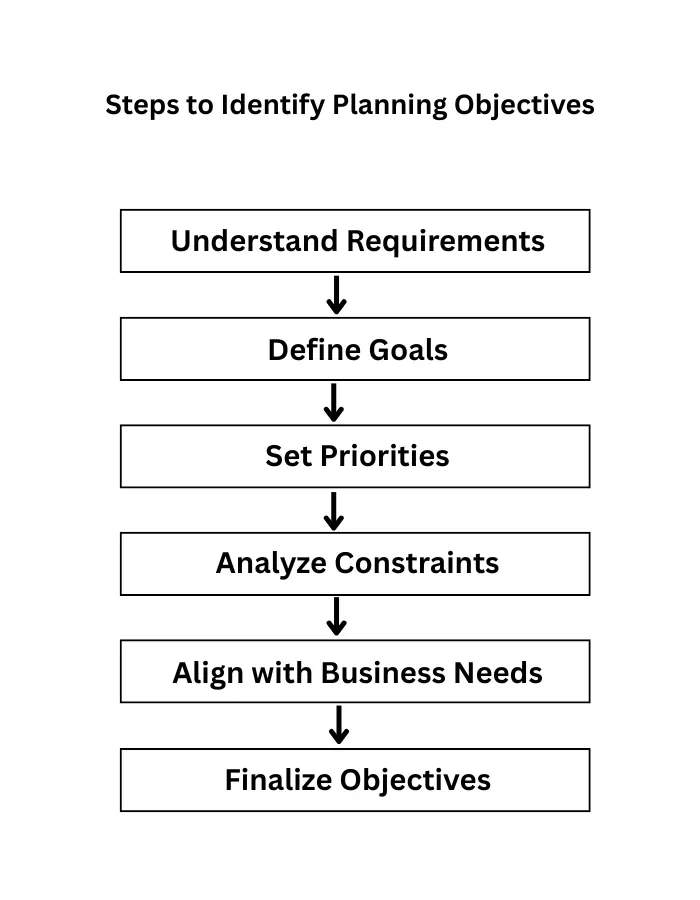
Figure: Steps to Identify Planning Objectives
Let’s see the detailed explanation for the steps to identify Planning Objectives,
1. Understand Requirements
The team first collects and studies user and business requirements. Moreover, it helps understand what the client actually needs. It also ensures that no important detail is missed. Therefore, this step provides a strong foundation for defining objectives.
For example: In an online shopping project, the team gathers requirements like product search and payment. Then, they discuss needs with stakeholders. Moreover, they document all features clearly. As a result, the project starts with a clear understanding.
2. Define Goals
The team clearly defines what the project aims to achieve. Moreover, goals should be specific and measurable. It also helps guide planning and execution. Therefore, clear goals ensure focused development.
For example: In a mobile app project, the goal is to create a fast and user-friendly app. Then, the team sets performance targets. Moreover, they focus on simple design. As a result, the app meets user expectations.
3. Set Priorities
The team decides which tasks and goals are most important. Moreover, it helps complete critical work first. It also improves time management and efficiency. Therefore, prioritization ensures better workflow.
For example: In a software project, login and security features are given priority. Then, less important features are planned later. Moreover, the team focuses on key functions first. As a result, essential features are completed early.
4. Analyze Constraints
The team identifies limitations such as time, cost, and resources. Moreover, it helps plan within available limits. It also avoids unrealistic expectations. Therefore, constraint analysis ensures practical planning.
For example: In a project, the team has a fixed budget and deadline. Then, they plan tasks accordingly. Moreover, they avoid extra features. As a result, the project stays within limits.
5. Align with Business Needs
The team ensures that objectives match business goals. Moreover, it helps deliver value to the organization. It also improves decision-making and project relevance. Therefore, alignment ensures project usefulness.
For example: In a banking system, the goal is to improve customer service. Then, the team focuses on easy transactions. Moreover, features are designed for user convenience. As a result, the system supports business growth.
6. Finalize Objectives
The team reviews and confirms all defined objectives. Moreover, it ensures that objectives are clear and achievable. It also helps communicate goals to all team members. Therefore, finalizing objectives ensures proper execution.
For example: In a project, the manager documents all objectives clearly. Then, they share them with the team. Moreover, everyone understands their role. As a result, the project moves in the right direction.
Advantages of Identifying Planning Objectives
1. Improves Project Direction
Identifying planning objectives provides a clear direction for the entire project. It helps project managers and team members understand what needs to be achieved and how the work should be carried out. Moreover, clear objectives guide the project from the beginning to the end in a structured manner. This reduces confusion and keeps the project focused on its goals. Therefore, proper planning objectives improve overall project direction and clarity.
2. Enhances Planning and Execution
Planning objectives help in organizing project activities in a systematic way. They allow managers to divide work into tasks and assign responsibilities to team members effectively. Moreover, clear objectives ensure that each stage of the project is planned and executed properly. This improves coordination and workflow in the project. Therefore, planning and execution become more efficient and structured.
3. Reduces Risks and Confusion
When planning objectives are clearly identified, it becomes easier to identify potential risks and challenges in advance. Moreover, team members understand their roles and responsibilities, which reduces confusion and misunderstandings. Proper objectives help in preparing solutions for possible problems. This improves project stability and control. Therefore, identifying planning objectives reduces risks and confusion.
4. Ensures Timely Completion
Planning objectives help in setting clear deadlines and project milestones. Moreover, they guide the team to complete tasks within a specific time frame. Proper scheduling and monitoring ensure that the project progresses smoothly. This reduces delays and improves time management. Therefore, planning objectives help in timely completion of the project.
5. Controls Cost Effectively
Identifying planning objectives helps in estimating and managing project costs properly. Moreover, it ensures that resources and budget are used efficiently. Proper objectives help avoid unnecessary expenses and financial risks. This improves cost control and budgeting. Therefore, planning objectives support effective cost management.
6. Improves Quality Output
Clear planning objectives ensure that the project meets quality standards and requirements. Moreover, they help in maintaining proper testing, monitoring, and evaluation during development. This leads to better performance and reliable software. Proper objectives ensure that the final product meets user expectations. Therefore, planning objectives improve the quality of output.
7. Supports Better Decision-Making
Planning objectives provide a clear understanding of project goals and requirements, which helps managers make better decisions. Moreover, decisions are taken based on project priorities and available resources. This improves strategic planning and project control. Proper objectives guide decision-making throughout the project. Therefore, identifying planning objectives supports effective decision-making.
Disadvantages if Objectives Are Not Identified Properly
1. Unclear Project Goals
If planning objectives are not identified properly, project goals become unclear and confusing. Team members may not understand what needs to be achieved and how to proceed. Moreover, lack of clarity leads to miscommunication and poor coordination. This affects project performance. Therefore, unclear goals create confusion in the project.
2. Poor Planning and Execution
Without proper planning objectives, project activities are not organized properly. Moreover, tasks may not be assigned correctly and deadlines may be missed. This leads to poor execution and weak project management. Proper planning becomes difficult. Therefore, poor objectives lead to weak planning and execution.
3. Increased Risks and Delays
Lack of clear objectives increases the chances of risks and unexpected problems. Moreover, project delays may occur due to improper planning and coordination. This affects project timelines and performance. Therefore, risks and delays increase.
4. Higher Project Cost
Improper planning objectives may lead to incorrect budgeting and financial planning. Moreover, unnecessary expenses and resource wastage may occur. This increases the overall project cost. Therefore, financial control becomes difficult.
5. Low Quality Output
Without clear objectives, the project may fail to meet quality standards. Moreover, testing and monitoring may not be done properly. This leads to poor software performance and user dissatisfaction. Therefore, quality output decreases.
6. Inefficient Resource Use
Lack of proper objectives leads to poor resource allocation and management. Moreover, manpower, tools, and time may be wasted. This reduces productivity and efficiency. Therefore, resources are not used effectively.
7. Reduced Project Success Rate
Improper planning objectives reduce the chances of project success. Moreover, poor planning and weak management affect overall performance. This may lead to project failure. Therefore, project success rate decreases.
Applications of Identifying Planning Objectives
1. Software Development Projects
Identifying planning objectives helps define project goals and development requirements in software projects. Moreover, it supports coding, testing, and deployment planning. This improves project organization and performance. Therefore, it is widely used in software development.
2. IT Project Management
Planning objectives are used in IT projects to ensure structured planning and execution of systems and applications. Moreover, they help manage resources and schedules effectively. This improves project control. Therefore, it supports IT project management.
3. Business Application Development
Planning objectives are applied in banking, e-commerce, and ERP systems to define business requirements clearly. Moreover, they help in achieving business goals through proper planning. This improves system performance. Therefore, it is useful in business applications.
4. Team and Resource Management
Planning objectives help assign tasks and responsibilities to team members effectively. Moreover, they improve coordination and communication within the team. This ensures efficient resource management. Therefore, it supports teamwork and productivity.
5. Risk and Quality Management
Planning objectives help identify risks and maintain quality standards in projects. Moreover, proper planning ensures safe and reliable system development. This improves project stability. Therefore, it supports risk and quality management.
6. Project Scheduling and Tracking
Planning objectives help in setting timelines and monitoring project progress. Moreover, they ensure that tasks are completed on schedule. This improves time management and control. Therefore, it supports scheduling and tracking.
7. Decision-Making Processes
Planning objectives provide clear guidelines for decision-making in projects. Moreover, managers can take informed decisions based on project goals and priorities. This improves strategic planning. Therefore, it supports effective decision-making.
Conclusion
Identifying planning objectives is an important step in software project management. It helps define clear goals and guides the entire project. Therefore, proper identification ensures successful and efficient project completion.