Management spectrum refers to the wide range of activities and responsibilities involved in managing a project or organization effectively. It shows how different management functions such as planning, organizing, staffing, directing, and controlling work together to achieve project goals. Moreover, it highlights the importance of coordination between people, processes, and technology in project management. A proper management spectrum ensures that all aspects of the project are handled in a systematic and balanced manner.
In addition, the management spectrum provides a complete view of management activities required for successful project execution. It focuses on managing resources, time, cost, quality, and risks in an organized way. Moreover, it helps project managers understand the different areas they need to control and monitor during the project. By covering all important management elements, the management spectrum improves efficiency and decision-making. Therefore, it plays an important role in effective project and software management.
For example, while developing a mobile application, the manager focuses on team members (people), app features (product), development steps (process), and timelines (project). Thus, all these elements together form the management spectrum.
What is Management Spectrum?
Management Spectrum is the comprehensive range of management activities and functions that are involved in planning, organizing, directing, and controlling resources to achieve project or organizational objectives effectively. It represents the overall framework that covers people management, process management, product management, and project management to ensure successful project execution and delivery.
Elements of Management Spectrum
The management spectrum includes four key elements: people, product, process, and project. These elements help in managing a software project effectively from start to finish. Moreover, they ensure proper coordination between team members, tasks, and goals. Each element plays an important role in successful project execution. Therefore, understanding these elements helps improve planning, development, and delivery of software.
Diagram of Elements of Management Spectrum
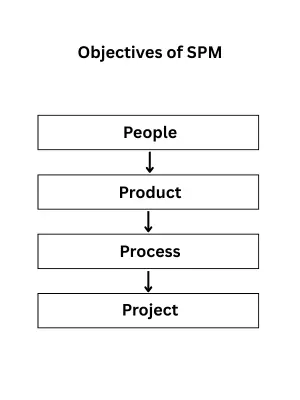
Figure: Elements of Management Spectrum
Here, explanation for the elements of management spectrum
1. People
People are the most important part of any project because they perform all tasks. They include developers, managers, testers, and stakeholders. Moreover, effective communication and teamwork improve overall performance. Therefore, managing people properly ensures smooth project execution.
For example: Assigning roles to developers, testers, and project managers in a software project.
2. Product
The product defines what the software will deliver to users. It includes features, functions, and objectives of the system. Moreover, a clear product definition helps avoid confusion during development. Therefore, it ensures that the final output meets user requirements.
For example: Defining features like login, payment, and ordering in a food delivery app.
3. Process
The process describes the steps followed to develop the software. It includes activities like planning, design, coding, and testing. Moreover, a proper process ensures smooth workflow and better quality. Therefore, it helps complete the project efficiently.
For example: Following SDLC (Software Development Lifecycle) phases while developing a web application.
4. Project
The project focuses on planning, scheduling, and controlling all activities. It ensures proper use of time, cost, and resources. Moreover, it helps track progress and manage risks. Therefore, it ensures successful completion of the project.
For example: Managing timeline, budget, and resources for a mobile app development project.
Advantages of Management Spectrum
1. Provides Holistic View of Management
Management spectrum gives a complete view of all management activities. It helps managers understand how people, processes, projects, and products are interrelated. Moreover, it reduces gaps in planning and execution. Managers can make better decisions. Therefore, it ensures smooth project and organizational operations.
2. Improves Resource Utilization
It helps in using resources like time, manpower, and tools efficiently. Managers can allocate tasks according to skills and availability. Moreover, it avoids wastage of resources and improves productivity. Proper allocation leads to better project outcomes. Therefore, it enhances efficiency.
3. Enhances Planning and Coordination
The spectrum allows managers to plan tasks and coordinate activities across teams. It ensures that all departments work in sync. Moreover, coordination reduces confusion and errors. Timelines and responsibilities become clear. Therefore, it improves overall project management.
4. Supports Risk Management
By covering all aspects of management, the spectrum helps identify potential risks early. Managers can prepare contingency plans in advance. Moreover, this reduces uncertainty and project delays. It ensures smoother execution of tasks. Therefore, it minimizes risks effectively.
5. Improves Quality of Output
Management spectrum emphasizes monitoring processes and deliverables. Regular checks ensure that quality standards are maintained. Moreover, it identifies problems early before they affect final outcomes. High-quality output increases client satisfaction. Therefore, it enhances project and product quality.
6. Facilitates Decision-Making
With a clear understanding of all management functions, managers can make informed decisions. They know the impact of their decisions on people, processes, and products. Moreover, it reduces errors in judgment. Better decisions improve project success. Therefore, it supports effective leadership.
7. Ensures Timely Completion
By monitoring all areas like resources, tasks, and risks, the spectrum ensures that projects stay on schedule. Delays are identified early, and corrective actions are taken. Moreover, it improves productivity and workflow. On-time delivery increases customer trust. Therefore, it ensures timely project completion.
Disadvantages of Management Spectrum
1. Complexity in Implementation
Covering all aspects of management can be complex. Managers need to coordinate between people, processes, and resources simultaneously. Moreover, it requires detailed planning and constant monitoring. Small projects may not need such comprehensive management. Therefore, it can be complicated to implement.
2. Time-Consuming
Managing every element of the spectrum takes time. Planning, monitoring, and reporting activities need continuous effort. Moreover, frequent checks can slow down decision-making. This may delay project execution. Therefore, it can be time-consuming for teams.
3. Requires Skilled Professionals
Management spectrum needs experienced managers to handle all functions effectively. Lack of skilled professionals can lead to poor coordination and errors. Moreover, training staff requires extra time and resources. Therefore, expertise is crucial for successful implementation.
4. High Cost of Management
Implementing a full management spectrum may increase costs. Hiring skilled personnel, tools, and software adds to the budget. Moreover, continuous monitoring and documentation require extra resources. Small organizations may find it expensive. Therefore, cost can be a disadvantage.
5. Less Flexibility
Once the management framework is set, making changes may be difficult. Adjusting processes or reallocating resources can disrupt workflow. Moreover, strict management reduces adaptability in dynamic situations. Therefore, flexibility is limited.
6. Heavy Documentation Requirement
Management spectrum involves detailed documentation for processes, resources, and tasks. Maintaining records can be time-consuming. Moreover, handling large documents may confuse team members. Therefore, heavy documentation is a challenge.
7. Continuous Monitoring Needed
All aspects of management require regular tracking. Managers must review performance, resource usage, and risks continuously. Moreover, lack of monitoring may lead to project failure. Therefore, it requires constant attention and effort.
Applications of Management Spectrum
1. Software Development Projects
Management spectrum helps in software projects by coordinating coding, testing, and deployment. It ensures resource allocation, risk management, and timely completion. Moreover, quality checks improve final output. Therefore, it is widely used in software development.
2. Construction Projects
In construction, management spectrum manages labor, materials, timelines, and safety. It improves coordination between teams and ensures cost control. Moreover, it reduces errors and delays. Therefore, it is essential for large-scale construction projects.
3. IT and Business Projects
Business and IT projects use the spectrum to manage multiple teams and tasks. It improves communication, planning, and resource utilization. Moreover, monitoring ensures project goals are achieved efficiently. Therefore, it is valuable in IT and business management.
4. Banking and Financial Projects
Banking and financial systems require careful planning, security, and monitoring. Management spectrum helps in controlling risks, costs, and timelines. Moreover, it ensures reliable and accurate outputs. Therefore, it is used in financial software and systems.
5. Government Projects
Government projects involve multiple teams, budgets, and strict deadlines. Management spectrum ensures proper coordination, monitoring, and reporting. Moreover, it reduces delays and enhances accountability. Therefore, it is widely applied in government projects.
6. Education and Research Projects
In research and educational projects, management spectrum helps plan experiments, resources, and timelines. It ensures effective teamwork and monitoring. Moreover, quality and results are improved. Therefore, it is useful in academic and research projects.
7. E-commerce and Web Projects
E-commerce and web projects use management spectrum to organize website development, payment systems, and logistics. It ensures proper planning, testing, and timely delivery. Moreover, customer satisfaction improves with efficient management. Therefore, it is essential in e-commerce platforms.
Conclusion
The management spectrum is an important concept in software project management. It helps in managing people, product, process, and project effectively. Therefore, understanding this concept ensures better planning, execution, and successful project delivery.