Project Management Life Cycle refers to the structured process that guides a project from its beginning to completion. It helps in planning, organizing, executing, and controlling project activities in a systematic way. Moreover, this life cycle ensures that all project tasks are completed within time, cost, and quality requirements. It also helps project managers monitor progress and manage risks effectively. Therefore, the project management life cycle plays an important role in successful project execution.
In addition, the project management life cycle provides a clear framework for managing different phases of a project. It helps teams understand what needs to be done at each stage of development. Moreover, it improves coordination, communication, and decision-making throughout the project. Proper use of this life cycle reduces errors and delays in project execution. Therefore, understanding the project management life cycle is essential for effective software and business project management.
For example, A company plans to develop a food delivery app. First, in initiation, the idea and goals are defined. Next, in planning, features like ordering and payment are decided. Then, in execution, developers build the app. Meanwhile, monitoring ensures progress is on track. Finally, in closure, the app is launched for users.
What is Project Management Lifecycle?
Project Management Life Cycle is the series of phases through which a project passes from initiation to completion in order to achieve specific goals within time, cost, and quality constraints. It involves planning, executing, monitoring, and closing project activities in a structured manner. Moreover, it provides a systematic approach to manage resources and risks. Therefore, the project management life cycle ensures successful project delivery.
Diagram of Project Management Lifecycle
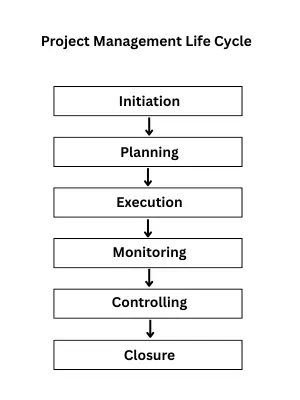
Figure: Project Management Life Cycle
Phases of Project Management Life Cycle
1. Initiation
Initiation is the first phase of the project management life cycle where the project idea is identified and evaluated. In this phase, the main goals, objectives, and purpose of the project are clearly defined. Moreover, the feasibility of the project is checked to see whether it is technically and financially possible. Stakeholders and project requirements are also identified at this stage. This phase helps in understanding the project scope and expected outcomes. Therefore, initiation sets the foundation for successful project planning and execution.
For example: Deciding to develop an online shopping website after analyzing market demand and business goals.
2. Planning
Planning is the most important phase where a detailed roadmap of the project is created. In this phase, project scope, schedule, budget, resources, and risk management plans are prepared. Moreover, project managers assign tasks and define timelines for each activity. Proper planning helps in reducing confusion and improving coordination among team members. It also ensures that the project is completed within time and cost limits. Therefore, planning provides a clear direction for project execution.
For example: Creating a development schedule, assigning developers and testers, and preparing the budget for website development.
3. Execution
Execution is the phase where actual project work begins and plans are implemented. In this stage, developers, designers, and team members perform their assigned tasks to build the product. Moreover, project managers guide and coordinate the team to ensure smooth progress. Communication and teamwork play an important role in this phase. The focus is on delivering project outputs according to the plan. Therefore, execution converts project plans into real results.
For example: Coding, designing, and developing the online shopping website features and database.
4. Monitoring and Controlling
Monitoring and controlling is the phase where project progress is continuously tracked and evaluated. In this phase, actual performance is compared with planned performance to identify delays or issues. Moreover, project managers take corrective actions to solve problems and maintain quality. Risk management and performance measurement are also done in this stage. It helps in keeping the project on schedule and within budget. Therefore, this phase ensures proper control over project activities.
For example: Checking development progress, fixing bugs, and adjusting timelines if delays occur.
5. Closure
Closure is the final phase of the project management life cycle where the project is completed and delivered to the client. In this phase, final testing, documentation, and evaluation are done. Moreover, project results are reviewed to check whether objectives are achieved or not. All project resources are released and final reports are prepared. Feedback is also collected for future improvement. Therefore, closure marks the successful completion of the project.
For example: Launching the online shopping website and handing it over to the client with complete documentation.
Characteristics of Project Management Life Cycle
1. Phase-Based Structure
Project Management Life Cycle is divided into different phases such as initiation, planning, execution, monitoring, and closure. Each phase has specific tasks and objectives to complete. Moreover, this structured approach makes project management more organized and systematic. It helps teams understand what needs to be done at each stage. Proper phase division reduces confusion and improves workflow. Therefore, phase-based structure is an important characteristic of the project management life cycle.
2. Clear Objectives and Goals
Each phase of the project management life cycle has clear objectives and goals to achieve. Project managers define targets and expected outcomes at every stage. Moreover, clear goals help in better planning and execution of project activities. Team members can work in the right direction without confusion. It also improves decision-making and project performance. Therefore, clear objectives ensure project success.
3. Sequential and Systematic Process
The project management life cycle follows a sequential and systematic process. Each phase is completed before moving to the next phase. Moreover, this step-by-step approach helps in proper planning and execution. It ensures that all project activities are performed in an organized manner. Systematic work reduces errors and delays in the project. Therefore, it provides a structured workflow.
4. Continuous Monitoring and Control
Project Management Life Cycle involves continuous monitoring and control of project activities. Project managers regularly track progress and performance. Moreover, they compare actual results with planned results to identify problems. Corrective actions are taken to maintain quality and schedule. Continuous monitoring improves project efficiency and reduces risks. Therefore, it ensures proper project control.
5. Focus on Time, Cost, and Quality
The life cycle mainly focuses on managing time, cost, and quality of the project. Proper planning ensures that the project is completed within the given schedule and budget. Moreover, quality control ensures that the final product meets required standards. This balance helps in achieving project goals effectively. It improves customer satisfaction and project success. Therefore, managing time, cost, and quality is a key characteristic.
6. Involves Team Coordination and Communication
Project Management Life Cycle requires proper coordination and communication among team members. Developers, testers, and managers work together to complete project tasks. Moreover, regular communication reduces misunderstandings and conflicts. It helps in sharing information and solving problems quickly. Good teamwork improves project performance and efficiency. Therefore, coordination and communication are essential characteristics.
7. Risk Identification and Management
The life cycle includes risk identification and management at every stage of the project. Project managers analyze possible risks and take preventive measures. Moreover, risk management helps in avoiding project failure and delays. It improves decision-making and problem-solving. Proper risk handling increases project reliability and success rate. Therefore, risk management is an important characteristic of the project management life cycle.
Objectives of Project Management Life Cycle
The objectives of the Project Management Life Cycle define the main goals that a project aims to achieve during its execution. These objectives help in managing project activities in a structured and systematic manner. Moreover, they guide project managers and team members to complete the project successfully within time, cost, and quality limits. Clear objectives improve planning, coordination, and decision-making throughout the project.
In addition, the objectives of the project management life cycle ensure proper control and monitoring of project activities. They help in reducing risks, improving teamwork, and maintaining quality standards. Moreover, well-defined objectives provide a clear direction for project execution and completion. Therefore, understanding the objectives of the project management life cycle is essential for successful project management.
Following are the objectives of Project Management Lifecycle:-
1. To Achieve Project Goals Successfully
The main objective of the project management life cycle is to achieve project goals in an organized and systematic way. It helps in defining clear targets and expected results for each phase. Moreover, proper planning and execution ensure that the project meets its requirements. Team members work according to defined objectives and guidelines. This improves project performance and productivity. Therefore, it ensures successful completion of project goals.
2. To Ensure Proper Planning and Organization
Another important objective is to ensure proper planning and organization of project activities. The life cycle helps in defining project scope, schedule, and resources clearly. Moreover, it organizes tasks in a structured way to avoid confusion. Proper planning improves workflow and coordination among team members. It also helps in managing complex projects efficiently. Therefore, it supports effective project organization.
3. To Complete the Project on Time
The project management life cycle aims to complete the project within the given timeline. It provides clear schedules and deadlines for each phase. Moreover, regular monitoring helps in identifying delays early. Corrective actions are taken to maintain project progress. Timely completion improves customer satisfaction and project success. Therefore, it ensures on-time delivery of the project.
4. To Control Cost and Resources
Controlling cost and resources is another key objective of the project management life cycle. It helps in managing budget, manpower, and materials effectively. Moreover, proper planning reduces unnecessary expenses and resource wastage. Efficient resource utilization improves project performance. It ensures that the project stays within the budget. Therefore, it helps in cost control.
5. To Maintain Quality Standards
Maintaining quality is an important objective of the project management life cycle. It ensures that the final product meets user requirements and quality standards. Moreover, testing and monitoring activities reduce errors and defects. Quality control improves system reliability and performance. It also increases customer satisfaction and trust. Therefore, it ensures high-quality project output.
6. To Improve Communication and Coordination
The life cycle helps in improving communication and coordination among project team members. It ensures proper information flow at each stage of the project. Moreover, clear communication reduces misunderstandings and conflicts. Team members can work together effectively to achieve project goals. Good coordination improves productivity and teamwork. Therefore, it supports efficient project management.
7. To Reduce Risks and Ensure Smooth Execution
Another objective is to reduce project risks and ensure smooth execution of activities. The life cycle helps in identifying potential risks at early stages. Moreover, risk management strategies reduce uncertainties and project failures. Preventive measures improve project stability and performance. It ensures smooth progress throughout the project. Therefore, it supports risk-free project execution.
Advantages of Project Management Life Cycle
1. Provides Clear Project Structure
Project Management Life Cycle provides a clear and well-defined structure for managing the project from beginning to end. It divides the project into different phases such as initiation, planning, execution, and closing. Moreover, this structured approach helps team members understand their roles and responsibilities. It also makes project activities more organized and systematic. Proper structure reduces confusion and improves workflow. Therefore, it ensures smooth project execution.
2. Improves Planning and Control
The project management life cycle helps in proper planning and control of project activities. Project managers can define goals, schedules, and resources clearly in each phase. Moreover, regular monitoring helps in controlling project progress and performance. It allows early identification of issues and corrective actions. Proper planning improves coordination and efficiency. Therefore, it ensures better control over the project.
3. Ensures Timely Completion
Project Management Life Cycle supports timely completion of projects by providing clear schedules and deadlines. Each phase has specific tasks and time limits. Moreover, regular tracking helps in identifying delays at an early stage. This allows the team to take corrective actions quickly. Timely completion improves customer satisfaction and project success. Therefore, it ensures on-time delivery of projects.
4. Reduces Risks and Errors
The life cycle helps in identifying risks and errors during early stages of the project. Risk management and testing activities reduce the chances of project failure. Moreover, continuous monitoring improves decision-making and problem-solving. Proper planning and control minimize technical and operational risks. It also improves system reliability and performance. Therefore, it reduces project risks and errors.
5. Enhances Teamwork
Project Management Life Cycle improves teamwork and coordination among team members. Each phase requires communication and collaboration between developers, testers, and managers. Moreover, clear roles and responsibilities reduce misunderstandings. Team members work together to achieve project goals. Good teamwork increases productivity and efficiency. Therefore, it enhances collaboration in the project.
6. Improves Quality of Output
The life cycle ensures that the final product meets quality standards and user requirements. Testing and quality control activities are included in different phases. Moreover, continuous monitoring improves software performance and reliability. Proper planning and execution reduce system errors and defects. Quality assurance increases customer satisfaction. Therefore, it improves the quality of project output.
7. Supports Better Decision-Making
Project Management Life Cycle provides useful information and reports for decision-making. Project managers can analyze project progress and performance easily. Moreover, proper documentation helps in making effective decisions. It improves problem-solving and risk management. Good decision-making ensures project success. Therefore, it supports better management and planning.
Disadvantages of Project Management Life Cycle
1. Time-Consuming Process
Project Management Life Cycle can be time-consuming because it involves multiple phases and detailed planning. Each phase requires proper documentation and approval before moving to the next stage. Moreover, this increases project duration and effort. Small projects may not require such detailed processes. It may slow down development speed. Therefore, it can take more time to complete projects.
2. Requires Proper Planning and Management
The life cycle needs strong planning and management to work effectively. Project managers must monitor every phase carefully. Moreover, poor planning may lead to project failure or delays. Managing all project activities requires experience and effort. Without proper management, the life cycle becomes ineffective. Therefore, strong management is necessary.
3. Less Flexibility in Strict Phases
In strict project management life cycles, it becomes difficult to make changes after planning. Once phases are defined, modifying requirements can be challenging. Moreover, frequent changes may disturb the entire project schedule. This reduces flexibility in development. It may not be suitable for dynamic projects. Therefore, strict phases limit flexibility.
4. Needs Skilled Professionals
Project Management Life Cycle requires skilled and experienced professionals to manage different phases. Project managers, developers, and testers must work efficiently. Moreover, lack of skilled team members affects project performance. Training and experience are needed for effective execution. Skilled professionals increase project quality and success. Therefore, experienced teams are necessary.
5. Can Increase Project Cost
Managing different phases and resources may increase project cost. Proper planning, monitoring, and documentation require additional resources. Moreover, hiring skilled professionals and using tools increase expenses. Large projects need more budget and management support. Cost control becomes challenging in complex projects. Therefore, it may increase overall project cost.
6. Complex for Large Projects
Project Management Life Cycle becomes complex when handling large and complicated projects. Managing multiple tasks, teams, and resources requires strong coordination. Moreover, large projects involve high risk and technical challenges. Proper monitoring and control become difficult. This increases project complexity and workload. Therefore, it can be difficult for large-scale projects.
7. Requires Continuous Monitoring
The life cycle requires continuous monitoring and tracking of project activities. Project managers must regularly check progress and performance. Moreover, frequent monitoring requires time and effort. Lack of monitoring may lead to project failure. Continuous tracking increases workload on management. Therefore, regular monitoring is necessary for project success.
Applications of Project Management Life Cycle
1. Software Development Projects
Project Management Life Cycle is widely used in software development projects. It helps in planning, designing, coding, testing, and deploying software in a structured manner. Moreover, it ensures proper scheduling and resource allocation. Teams can manage deadlines and quality standards effectively. It also reduces risks and improves coordination among developers. Therefore, it is useful in developing reliable software systems.
2. Web Development Projects
The project management life cycle is used in web development to manage website design and development processes. It helps in planning website features, user interface, and functionality. Moreover, it ensures timely completion and proper testing of websites. Project managers can monitor progress and control quality. It improves team coordination and performance. Therefore, it supports successful web project execution.
3. Mobile Application Development
Project Management Life Cycle helps in managing mobile app development projects efficiently. It ensures proper planning, coding, testing, and deployment of mobile applications. Moreover, it helps in handling user requirements and system performance. Risk management reduces technical problems during development. It improves app quality and user experience. Therefore, it is useful in mobile app development.
4. Business and IT Projects
Many business and IT projects use the project management life cycle for better management. It helps in planning business systems, managing resources, and controlling project costs. Moreover, it improves communication and coordination among stakeholders. Proper monitoring ensures project success and efficiency. It also reduces operational risks. Therefore, it is useful in business and IT project management.
5. Banking and Financial Systems
The project management life cycle is used in banking and financial software development. It helps in developing secure and reliable financial systems. Moreover, it ensures proper testing and risk management. Project managers can control cost, time, and quality effectively. It improves system performance and security. Therefore, it is important in banking and financial projects.
6. E-commerce and Online Systems
E-commerce and online platforms use the project management life cycle to manage system development. It helps in planning product features, payment systems, and user interfaces. Moreover, it ensures smooth system performance and security. Proper monitoring reduces system failures and errors. It improves customer experience and business performance. Therefore, it is useful in online and e-commerce projects.
7. Government and Large-Scale Projects
Government and large-scale projects use the project management life cycle for effective planning and execution. It helps in managing large teams, resources, and budgets. Moreover, it ensures proper monitoring and risk control. Structured phases improve project coordination and efficiency. It supports timely completion of large projects. Therefore, it is useful in government and large-scale project management.
Conclusion
Project Management Life Cycle is an important process that helps in managing projects in a structured and systematic way. It includes different phases such as planning, execution, monitoring, and closing to ensure project success. Moreover, it improves planning, teamwork, quality, and decision-making in software and business projects. Although it may require time, cost, and skilled professionals, its benefits are more valuable in managing complex projects. Proper use of the project management life cycle ensures timely completion, reduced risks, and high-quality output. Therefore, it plays a vital role in successful project management.