Software Project Management (SPM) framework provides a structured approach to plan, execute, and monitor software projects effectively. It defines how project activities, resources, and processes are managed to achieve the desired goals. Moreover, it ensures that software projects are delivered on time, within budget, and with high quality. By using a framework, organizations can standardize project management practices and reduce errors caused by mismanagement or poor planning.
In addition, the SPM framework integrates various aspects of project management such as scope, time, cost, quality, risk, and resource management. It guides project managers in decision-making and provides tools for tracking progress. Moreover, it ensures proper coordination between team members, stakeholders, and technology. Therefore, adopting a well-defined SPM framework increases project efficiency, improves communication, and reduces project risks.
For example, while developing a mobile application, the team follows a framework to plan features, assign tasks, track progress, and deliver the app on time. Thus, the framework guides the entire project.
What is the Software Projects management(SPM) framework?
Software Project Management (SPM) Framework is a structured model that outlines the processes, tools, and techniques used to plan, execute, monitor, and control software projects. It provides guidelines for managing project scope, resources, time, cost, quality, and risks systematically. The framework ensures successful delivery of software projects by standardizing practices, improving communication, and supporting informed decision-making across all stages of the project.
Objectives of Software Project Management (SPM) Framework
1. Timely Completion of Software Projects
The main objective of the SPM framework is to complete software projects within the given deadline. It focuses on proper scheduling and time management of all project activities. Moreover, it helps track progress regularly and identify delays early. This ensures corrective actions can be taken quickly. Therefore, timely delivery of software becomes possible and customer satisfaction improves.
2. Effective Cost Management
SPM aims to manage project expenses and keep the project within budget. It ensures proper allocation of financial resources and avoids unnecessary spending. Moreover, continuous monitoring helps control costs at every stage. This reduces financial risks and improves efficiency. Therefore, the project is completed economically and successfully.
3. Quality Software Development
Another important objective is to deliver high-quality software that meets user requirements. The framework includes testing, reviews, and quality assurance processes. Moreover, errors and defects are identified and corrected early. This improves software reliability and performance. Therefore, users receive a stable and efficient system.
4. Proper Resource Utilization
SPM ensures effective use of resources such as manpower, tools, and technology. It assigns tasks based on skills and experience of team members. Moreover, it avoids wastage of time and effort. Proper utilization increases productivity and efficiency. Therefore, project performance improves significantly.
5. Risk Identification and Control
The framework aims to identify possible risks at an early stage. It prepares strategies to manage technical, financial, and operational risks. Moreover, proactive risk handling prevents project failure. This ensures smooth project execution and stability. Therefore, risk management becomes an essential objective of SPM.
6. Clear Communication and Coordination
SPM promotes effective communication among team members, stakeholders, and clients. It ensures regular updates and progress reporting. Moreover, clear communication reduces misunderstandings and conflicts. This improves teamwork and collaboration. Therefore, project activities run smoothly.
7. Customer Satisfaction and Project Success
The ultimate objective of SPM is to meet customer needs and deliver useful software. It focuses on fulfilling requirements and providing reliable solutions. Moreover, timely delivery and quality output increase customer trust. This leads to successful project completion. Therefore, SPM ensures overall project success and user satisfaction.
Characteristics of Software Project Management (SPM) Framework
1. Structured and Systematic Approach
The SPM framework follows a structured and organized approach to manage software projects. It defines clear steps, processes, and guidelines for execution. Moreover, it ensures that every activity is performed in a planned manner. This reduces confusion and improves efficiency. Therefore, the project progresses in a systematic way.
2. Focus on Planning and Control
The framework emphasizes proper planning and continuous monitoring of project activities. It helps in setting goals, schedules, and resource allocation. Moreover, regular control ensures that the project stays on track. This reduces delays and errors. Therefore, planning and control are key characteristics of SPM.
3. Risk-Oriented Management
SPM focuses on identifying and managing risks at every stage of the project. It prepares strategies to handle technical and financial uncertainties. Moreover, risk management ensures smooth project execution. This reduces chances of failure. Therefore, SPM promotes a proactive approach to problem-solving.
4. Quality-Centered Framework
The framework ensures that software quality is maintained throughout the project. It includes testing, reviews, and performance evaluation. Moreover, quality checks are conducted regularly. This improves reliability and user satisfaction. Therefore, SPM ensures high-quality software development.
5. Resource Optimization
SPM ensures proper utilization of available resources like manpower, tools, and time. It assigns tasks according to skills and expertise. Moreover, it avoids wastage of resources. This increases productivity and efficiency. Therefore, optimal resource use is a major characteristic.
6. Continuous Monitoring and Evaluation
The framework requires regular monitoring of progress and performance. It compares actual results with planned outcomes. Moreover, necessary changes are made to improve performance. This ensures project success. Therefore, continuous evaluation is an important feature.
7. Stakeholder Involvement
SPM involves stakeholders such as clients, managers, and team members in decision-making. It ensures proper communication and feedback. Moreover, stakeholder participation improves project clarity. This leads to better results. Therefore, SPM promotes collaborative project management.
Diagram of SPM framework
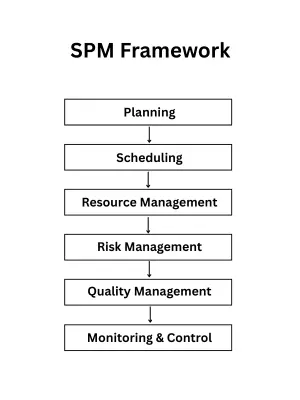
Figure: Software Project Management Framework
Let’s see the explanation of components of SPM framework
1. Planning
Planning defines project objectives, scope, and requirements. Moreover, it provides a roadmap for development. It also helps avoid confusion and delays. Therefore, planning is the foundation of the framework.
For example: Planning features of a mobile app.
2. Scheduling
Scheduling sets timelines and deadlines for each task. Moreover, it helps track progress and ensures timely completion. It also improves time management. Therefore, scheduling keeps the project on track.
For example: Creating a timeline for development and testing.
3. Resource Management
Resource management ensures proper use of people, tools, and budget. Moreover, it assigns tasks based on skills. It also improves efficiency and productivity. Therefore, it helps in effective project execution.
For example: Assigning developers and testers.
4. Risk Management
Risk management identifies potential problems in advance. Moreover, it prepares solutions to handle uncertainties. It also reduces project failures. Therefore, it ensures smooth progress.
For example: Handling delays due to technical issues.
5. Quality Management
Quality management ensures that the software meets required standards. Moreover, it includes testing and error checking. It also improves reliability and performance. Therefore, it delivers a high-quality product.
For example: Testing the application before launch.
6. Monitoring and Control
Monitoring and control track project progress and performance. Moreover, it helps compare actual work with planned work. It also allows necessary changes to improve results. Therefore, it ensures successful project completion.
For example: Reviewing progress and fixing issues regularly.
Advantages of Software Project Management (SPM) Framework
1. Clear Project Structure
A Software Project Management framework provides a structured way to manage tasks, roles, and responsibilities. It defines processes and workflows clearly for the team. This reduces confusion and ensures smooth coordination among team members. Moreover, it helps track progress systematically.
For example: A development team can follow defined roles for designers, developers, and testers in a mobile app project.
2. Better Planning and Scheduling
SPM helps managers plan every phase of the project, including tasks, timelines, and resources. Milestones and priorities are clearly set, which avoids delays. Moreover, scheduling ensures work proceeds step by step without overlapping issues.
For example: In a web development project, tasks like coding, testing, and deployment are assigned deadlines to maintain consistency.
3. Risk Identification and Management
The framework allows early detection of potential risks such as technology issues or resource shortages. Managers can plan preventive measures to reduce disruptions. Moreover, it ensures project continuity even if unexpected issues occur.
For example: Backup servers and alternative tools are prepared in a system software project to handle technical failures.
4. Cost Control
SPM frameworks help in monitoring budgets and controlling unnecessary expenses. Resource allocation is done efficiently, which avoids overspending. Moreover, continuous budget tracking prevents financial overruns.
For example: A team avoids hiring extra developers unnecessarily and uses available tools effectively to stay within a ₹5 lakh budget for an ERP system.
5. Ensures Quality
SPM includes testing, review, and evaluation processes throughout the project. Errors are detected and corrected early to ensure a high-quality product. Moreover, continuous monitoring improves software reliability.
For example: A mobile app is tested feature by feature before launch to provide a smooth user experience.
6. Enhances Communication
The framework defines communication channels for team members, stakeholders, and clients. Regular updates and progress reports reduce misunderstandings. Moreover, it ensures proper collaboration between different departments.
For example: Developers and testers in an e-commerce project hold weekly meetings to discuss progress and issues.
7. Supports Informed Decision-Making
SPM provides detailed information about progress, risks, and resource utilization. Managers can analyze data before making decisions, which reduces errors. Moreover, it ensures decisions are strategic and well-informed.
For example: In a banking software project, managers adjust tasks based on progress reports to prevent delays.
Disadvantages of Software Project Management (SPM) Framework
1. Time-Consuming Implementation
Setting up and following SPM takes significant time. Planning, documentation, and monitoring require continuous effort. Moreover, the initial stages may slow down smaller projects.
For example: Preparing workflow documents and task allocations for a mobile app can take weeks before actual development starts.
2. High Cost
Implementing SPM often needs skilled personnel, project management tools, and software licenses. Training and monitoring add extra costs. Moreover, it may be expensive for small organizations.
For example: Using professional project management software like Jira or MS Project increases costs for small teams.
3. Requires Skilled Professionals
Successful SPM depends on experienced managers and trained team members. Inexperienced personnel may struggle with complex processes. Moreover, handling multiple teams requires expertise.
For example: A poorly managed web application project may fail due to lack of trained project managers.
4. Complexity in Large Projects
Managing multiple teams, resources, and tasks in large projects is complicated. Coordinating all activities simultaneously is challenging. Moreover, tracking progress requires constant monitoring.
For example: Large ERP projects with multiple modules need careful supervision to avoid delays.
5. Less Flexibility
Once processes and plans are defined, changing them can disrupt the workflow. Adjusting schedules or reallocating resources may be difficult. Moreover, rigid frameworks may not fit rapidly changing requirements.
For example: Adding a new feature in a banking software late in the project may delay the release.
6. Heavy Documentation
SPM requires detailed documentation of tasks, risks, and progress. Managing extensive records can be time-consuming. Moreover, it may overwhelm team members.
For example: Maintaining detailed test reports and bug logs for an e-commerce platform takes considerable effort.
7. Continuous Monitoring Needed
Every phase of the project must be monitored consistently. Delays or deviations must be corrected immediately. Moreover, continuous attention is essential to prevent failure.
For example: Tracking daily progress in a mobile app project prevents missed deadlines.
Applications of Software Project Management (SPM) Framework
1. Software Development Projects
SPM is widely applied in software development, including desktop, web, and mobile apps. It manages planning, coding, testing, and deployment efficiently. Moreover, it ensures timely delivery and high-quality products.
For example: Developing a school management system using proper SPM ensures all features work correctly and on time.
2. IT and Enterprise Projects
Enterprise software like ERP or CRM systems requires SPM to manage complex workflows. It helps allocate resources, manage risks, and coordinate between departments. Moreover, it ensures smooth operations.
For example: An ERP system in a manufacturing company uses SPM to synchronize finance, HR, and inventory modules.
3. E-Commerce Projects
SPM manages the development of e-commerce websites and mobile apps, including payment systems and logistics integration. Moreover, it ensures updates, bug fixes, and smooth deployment.
For example: An online grocery platform uses SPM to track orders, inventory, and customer feedback.
4. Research and Academic Projects
In research, SPM helps plan experiments, allocate resources, and track progress. It ensures proper documentation and collaboration. Moreover, it maintains deadlines effectively.
For example: A university AI research project uses SPM to track data collection and model training phases.
5. Government Software Projects
Government IT projects like portals and online services require SPM for budget management, timelines, and stakeholder coordination. Moreover, it ensures transparency and proper execution.
For example: A city e-governance portal uses SPM to monitor development, testing, and launch.
6. Mobile App Development Projects
Mobile apps need frequent updates and bug fixes. SPM ensures scheduling, resource allocation, and monitoring of all development stages. Moreover, it improves user satisfaction.
For example: A food delivery app uses SPM to manage new feature releases and track bugs efficiently.
7. Banking and Financial Software Projects
Banking applications need secure and accurate management. SPM helps with risk handling, compliance, and timely delivery. Moreover, it ensures high reliability and user trust.
For example: A bank’s online transaction system uses SPM to maintain data integrity and service continuity.
Conclusion
Software Project Management (SPM) framework plays an important role in managing software projects in a structured and systematic manner. It helps in planning, organizing, executing, and monitoring project activities effectively. Moreover, it ensures proper use of resources, timely completion of tasks, cost control, and quality assurance. By following a well-defined framework, organizations can reduce risks and improve coordination among team members and stakeholders.
Although the SPM framework has some limitations such as high cost, complexity, and need for skilled professionals, its advantages are more significant in ensuring successful project delivery. It is widely used in software development, banking systems, government projects, and mobile applications to achieve reliable and efficient results. Therefore, the Software Project Management framework is essential for developing high-quality software and achieving project success in a competitive technological environment.