Stepwise planning activities refer to a structured approach used to plan a software project step by step. It helps managers break the project into smaller and manageable parts. Moreover, it ensures proper organization of tasks, time, and resources. It also reduces confusion and improves clarity during development. Therefore, stepwise planning helps in completing projects efficiently and successfully.
For example, while developing an online banking system, the team first defines goals such as secure transactions and user account management. Then, they break the project into tasks like design, coding, and testing, and estimate time and cost. Moreover, resources are assigned to each task and progress is monitored regularly. Thus, stepwise planning helps complete the project in an organized and efficient way.
Diagram for Stepwise Planning Activities in SPM
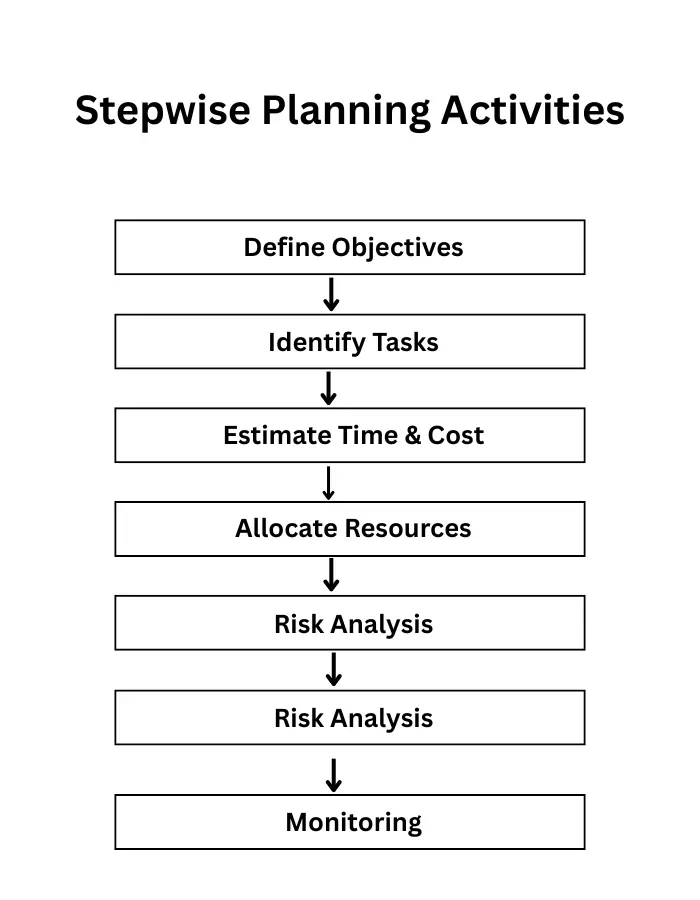
Figure: Stepwise Planning Activities in SPM
Let’s see the detailed explanation for activities in SPM,
1. Define Objectives
The team clearly defines the goals of the project. Moreover, it helps in setting direction and purpose. Therefore, clear objectives guide all activities. Objectives also help in understanding what the project aims to achieve and what results are expected. It ensures that all team members work toward a common goal and avoid confusion during execution. Clear objectives improve planning accuracy and project success.
For example: Planning to develop a food delivery app.
2. Identify Tasks
The project is divided into smaller tasks and activities. Moreover, it makes work easier to manage. Therefore, task identification improves clarity. Breaking the project into smaller modules helps in assigning responsibilities and tracking progress effectively. It also reduces complexity and improves team coordination. Proper task identification ensures smooth workflow and better control over project activities.
For example: Dividing work into design, coding, and testing.
3. Estimate Time and Cost
The team estimates how much time and budget are required. Moreover, it helps in proper planning. Therefore, estimation avoids delays and extra costs. Accurate estimation ensures that the project remains within schedule and budget limits. It also helps managers prepare financial and time-related strategies. Proper estimation reduces risks and improves decision-making during project execution.
For example: Estimating 3 months and ₹5 lakh budget.
4. Allocate Resources
Resources like people and tools are assigned to tasks. Moreover, it ensures efficient use of resources. Therefore, allocation improves productivity. Proper resource allocation helps in utilizing manpower, technology, and equipment effectively. It also ensures that no resource is overused or underutilized. Efficient allocation improves teamwork and reduces project delays.
For example: Assigning developers and testers.
5. Risk Analysis
Possible risks are identified and solutions are prepared. Moreover, it reduces uncertainty. Therefore, risk analysis ensures smooth execution. Risk analysis helps in predicting technical, financial, or operational problems. It allows the team to prepare backup plans and preventive measures. This improves project stability and reduces chances of failure.
For example: Planning backup for technical issues.
6. Scheduling
A timeline is created for completing tasks. Moreover, it helps track progress. Therefore, scheduling ensures timely completion. Scheduling defines deadlines and milestones for each project phase. It helps managers monitor progress and maintain workflow. Proper scheduling ensures coordination among team members and prevents delays.
For example: Setting deadlines for each phase.
7. Monitoring
The project progress is regularly checked and controlled. Moreover, it ensures work is on track. Therefore, monitoring helps achieve goals. Monitoring helps compare actual progress with planned progress and identify issues early. It also supports corrective actions and performance improvement. Continuous monitoring ensures project success and timely completion.
For example: Reviewing progress weekly.
Advantages of Stepwise Planning Activities
1. Clear Project Direction
Stepwise planning activities provide a clear direction for the project from the beginning. Each step defines what needs to be done and how it will be done. Moreover, it helps team members understand their responsibilities clearly. This reduces confusion and improves coordination. Therefore, the project progresses in an organized manner.
2. Better Task Management
The project is divided into smaller steps, making tasks easier to manage and execute. Moreover, it allows proper assignment of work to team members. This improves workflow and reduces complexity. Managers can track each activity effectively. Therefore, task management becomes more efficient.
3. Improved Time and Cost Estimation
Stepwise planning helps estimate time and cost accurately for each activity. Moreover, it reduces the chances of delays and budget overruns. Proper estimation supports better scheduling and financial planning. This ensures efficient project execution. Therefore, projects are completed within time and budget.
4. Effective Resource Utilization
Resources such as manpower, tools, and technology are allocated step by step. Moreover, it ensures proper use of available resources without wastage. This improves productivity and performance. Efficient resource utilization supports project success. Therefore, stepwise planning increases efficiency.
5. Risk Reduction
Stepwise planning identifies possible risks at each stage of the project. Moreover, it prepares solutions and backup plans in advance. This reduces uncertainty and prevents major problems. Risk management improves project stability. Therefore, stepwise planning ensures smooth execution.
6. Better Monitoring and Control
Each step of planning can be monitored and controlled easily. Managers can compare planned and actual progress regularly. Moreover, corrective actions can be taken when needed. This improves project performance and quality. Therefore, monitoring becomes more effective.
7. Increases Project Success Rate
By following a step-by-step approach, the project becomes well-organized and systematic. Moreover, proper planning, monitoring, and risk management improve overall performance. This increases the chances of achieving project goals. Therefore, stepwise planning leads to successful project completion.
Disadvantages of Stepwise Planning Activities
1. Time-Consuming Process
Stepwise planning requires detailed analysis and preparation of each step. Moreover, it takes time to define tasks, schedules, and resources. This may delay the start of the project. Small projects may find it unnecessary. Therefore, it can slow down initial progress.
2. Requires Skilled Management
Proper stepwise planning needs experienced project managers and planners. Moreover, incorrect planning can lead to poor execution. Skilled professionals are required to manage all steps effectively. This increases dependency on expertise. Therefore, lack of skills can reduce effectiveness.
3. Increased Documentation Work
Stepwise planning involves preparing detailed reports and plans. Moreover, documentation of each step takes time and effort. Managing large volumes of documents can be difficult. This may reduce productivity. Therefore, documentation becomes a challenge.
4. Less Flexibility
Once steps and plans are defined, making changes becomes difficult. Moreover, sudden changes in requirements may disturb the workflow. This reduces flexibility in dynamic environments. Adjusting schedules and resources becomes challenging. Therefore, stepwise planning may limit adaptability.
5. Higher Initial Cost
Planning tools, software, and professional expertise may increase initial costs. Moreover, detailed planning requires financial investment. Small organizations may find it expensive. This affects budget allocation. Therefore, stepwise planning may increase project cost.
6. Complexity in Large Projects
Managing stepwise planning in large projects can be complex. Moreover, coordination among multiple teams becomes difficult. Tracking each step requires continuous monitoring. This increases management workload. Therefore, complexity increases with project size.
7. Continuous Monitoring Required
Stepwise planning needs regular tracking and evaluation of progress. Moreover, managers must monitor each activity carefully. Lack of monitoring may lead to failure. This requires constant attention and effort. Therefore, continuous monitoring is necessary.
Applications of Stepwise Planning Activities
1. Software Development Projects
Stepwise planning is widely used in software development projects. It helps plan coding, testing, and deployment activities step by step. Moreover, it ensures timely and organized development. This improves software quality and reliability. Therefore, it is essential in software engineering.
2. IT Project Management
IT projects use stepwise planning to manage system development and maintenance. Moreover, it helps allocate resources and schedule tasks effectively. This ensures smooth IT operations. It reduces system failures and delays. Therefore, IT project management depends on stepwise planning.
3. Business Application Development
Stepwise planning is used in banking, ERP, and e-commerce systems. Moreover, it helps define requirements and timelines clearly. This improves business efficiency and reliability. Proper planning ensures secure and accurate software. Therefore, business applications benefit from stepwise planning.
4. Team and Resource Management
It helps assign tasks and manage team members efficiently. Moreover, it ensures proper use of manpower and tools. This improves teamwork and productivity. Managers can track performance easily. Therefore, stepwise planning supports resource management.
5. Risk and Quality Management
Stepwise planning helps identify risks and maintain quality at every stage. Moreover, it ensures testing and monitoring of project activities. This improves reliability and reduces errors. Proper planning ensures stable performance. Therefore, it supports risk and quality management.
6. Project Scheduling and Tracking
Stepwise planning helps create project schedules and track progress regularly. Moreover, it ensures deadlines are met and milestones are achieved. This improves project performance. Managers can control progress effectively. Therefore, scheduling becomes easier.
7. Research and Academic Projects
Research and academic projects use stepwise planning to manage experiments and documentation. Moreover, it helps allocate resources and maintain deadlines. This improves coordination among researchers. Proper planning ensures accurate results. Therefore, it is useful in academic projects.
Conclusion
Stepwise planning activities play an important role in organizing and managing software projects in a systematic and structured manner. It helps in defining objectives, identifying tasks, estimating time and cost, allocating resources, analyzing risks, scheduling activities, and monitoring progress effectively. Moreover, this step-by-step approach improves project control, reduces uncertainty, and ensures better coordination among team members. As a result, projects are completed on time with proper quality and efficient resource utilization.
Although stepwise planning may require time, skilled management, and continuous monitoring, its benefits in improving project organization and success are significant. It is widely used in software development, IT management, business applications, and research projects to ensure smooth execution and reliable outcomes. Therefore, stepwise planning activities are essential for achieving successful and well-managed software projects.