Software projects are organized efforts to create software applications that fulfill specific needs for individuals, businesses, or organizations. They involve planning, designing, coding, testing, and deployment to ensure the software works efficiently. These projects can vary widely in complexity, scale, and purpose, depending on the requirements. Choosing the right type of software project is essential to meet objectives on time and within budget. Proper classification helps developers and managers decide on tools, technologies, and strategies.
Different types of software projects serve different functions, from web and mobile applications to desktop, embedded, and enterprise solutions. Each type has unique characteristics, benefits, and limitations, influencing how it is developed and used. Understanding these types allows businesses to deliver the right solution to users and improve productivity. Moreover, clear knowledge of software project types aids in managing resources, time, and risks effectively.
For example, A company decides to develop a food delivery mobile application. First, the team plans the features such as restaurant listings, food ordering, and online payment. Next, developers design and build the application. Then testers check the app to remove errors. Finally, the company launches the app for customers to use. Thus, this becomes a software project because it has a clear goal, a planned process, and a final product.
What is Software Projects?
A software project is a planned activity in which a team develops software to solve a problem or perform a specific task. The team follows a structured process such as planning, designing, coding, testing, and deployment. In simple words, a software project focuses on creating software applications, systems, or tools within a given time and budget. For example, developing an online shopping website is a software project. A team designs the website, writes the code, tests the system, and finally launches it for users.
For example, A company decides to create an online bookstore website. First, the team plans features such as book search, product details, shopping cart, and online payment. Next, developers design and build the website. After that, testers check the system to ensure it works correctly. Finally, the website is launched for customers to buy books online. Thus, this becomes a software project because it has a clear objective, a structured development process, and a final software product.
Objectives of Software Projects
Software projects are designed to achieve specific goals that ensure the software meets user needs and business requirements. Each objective guides the project through planning, development, testing, and deployment, making the process efficient and effective. Properly defined objectives help in reducing errors, saving time, and delivering high-quality software.
Below are the main objectives:
1. Meeting User Requirements
The primary objective of any software project is to develop a product that fulfills the exact needs of its users. This includes understanding user expectations, functionality requirements, and usability preferences. Meeting user requirements ensures satisfaction and reduces the risk of project failure. It also helps in building software that solves real-world problems effectively.
2. Ensuring Quality and Reliability
Software projects aim to deliver high-quality and reliable solutions that perform consistently under different conditions. This includes minimizing bugs, errors, and crashes. Quality software improves trust among users and ensures smooth operations for businesses. Reliability also supports long-term maintenance and reduces the need for frequent fixes.
3. Efficient Resource Utilization
Another key objective is to use time, manpower, and financial resources efficiently throughout the project. Proper planning and resource management reduce wastage and help in completing the project within budget. Efficient resource use also allows teams to focus on critical tasks, improving productivity and project outcomes.
4. Timely Delivery
Delivering software on schedule is a crucial objective to meet business deadlines and market demands. Timely delivery ensures users get access to the software when it is needed. It also enhances the organization’s reputation and prevents additional costs that may arise from delays. Scheduling tools and milestone tracking help achieve this objective effectively.
5. Scalability and Flexibility
Software projects aim to develop systems that can grow with user needs and handle future updates easily. Scalability ensures the software can support more users or additional features without performance issues. Flexibility allows modifications and enhancements without major rework. This objective helps businesses adapt to changing technology and market demands.
6. Security and Data Protection
Protecting sensitive data and ensuring secure operations is a critical objective of software projects. This includes implementing authentication, encryption, and access controls. Secure software prevents unauthorized access, data breaches, and financial losses. It also builds user trust and complies with legal and industry standards.
7. Cost-effectiveness
Finally, software projects aim to deliver maximum value at minimal cost. This involves optimizing development processes, choosing the right technologies, and avoiding unnecessary expenses. Cost-effective projects ensure better return on investment and allow organizations to allocate funds to other priorities.
Different types of Software Projects
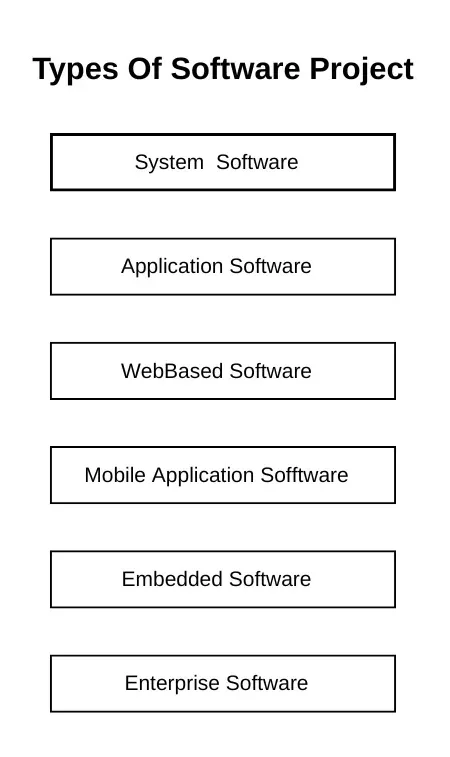
Figure: Types of software Projects
The diagram shows different categories of software projects. Each type focuses on a different purpose and area of use.
Various Types of Software Projects
Software projects are planned efforts to develop software that meets specific user or business needs. They vary in complexity, purpose, and technology used. Understanding the types of software projects helps in choosing the right approach and tools. Each type serves unique functions, from managing hardware to supporting businesses or mobile users. This knowledge ensures efficient development, better user experience, and successful project outcomes.
Following are the detailed explanation of Software Projects:-
1. System Software Projects
System software projects develop programs that control and manage computer hardware. These systems act as a bridge between hardware and user applications. They ensure that the computer works properly and efficiently. Moreover, they manage memory, processes, and devices. Without system software, other applications cannot run.
For example, an operating system like Windows or Linux helps the computer perform basic tasks, while device drivers allow hardware components like printers or keyboards to function properly.
2. Application Software Projects
Application software projects focus on creating programs that help users perform specific tasks. These applications make daily work easier and more efficient. For example, users can create documents, manage data, or perform calculations. In addition, businesses use such software to improve productivity. These projects are user-oriented and easy to interact with.
For example, Microsoft Excel allows users to perform calculations and analyze data, while a restaurant management system helps manage orders, billing, and customer information. These projects are user-oriented and provide a simple, interactive interface.
3. Web-Based Software Projects
Web-based software projects develop applications that run on web browsers. Users can access these applications from anywhere using the internet. Therefore, they do not need to install software on their devices. These projects use technologies like HTML, CSS, JavaScript, and backend tools. Moreover, they support real-time data access and updates.
For example, an online bookstore like Amazon enables users to search for books, place orders, and make payments online, providing real-time updates and easy access without installing software on devices.
4. Mobile Application Software Projects
Mobile application software projects create apps for smartphones and tablets. They provide services such as communication, shopping, entertainment, and productivity. Developers design these apps to be fast, interactive, and user-friendly, while also using device features like GPS and camera. Developers design these apps to be user-friendly and fast.
For example, a food delivery app like Swiggy allows users to order meals and track delivery in real time, making the process simple and convenient.
5. Embedded Software Projects
Embedded software projects develop programs that run inside electronic devices. These systems control the working of machines and hardware components. They are designed for specific functions and operate automatically. Moreover, they improve the efficiency and performance of devices. These projects are widely used in industries and home appliances.
For example, software in a washing machine controls washing cycles, water usage, and spinning speed, while car software systems manage engine performance, braking, and navigation, ensuring smooth and safe operation.
6. Enterprise Software Projects
Enterprise software projects build large-scale systems used by organizations to manage business operations. These projects handle large amounts of data and support multiple users simultaneously. For example, a bank management system manages accounts, transactions, and generates reports, while enterprise resource planning (ERP) software helps a company manage finance, HR, and inventory efficiently. These projects enhance decision-making and productivity.
7. Artificial Intelligence (AI) Software Projects
Artificial intelligence software projects develop systems that can learn from data and make decisions. These systems use machine learning and data analysis techniques. They improve performance over time without human intervention. Moreover, AI systems help automate complex tasks. They are widely used in modern applications and businesses.
For example, a recommendation system like Netflix suggests movies based on user interests, while AI-powered chatbots can answer customer queries automatically. These projects improve over time without constant human intervention.
Advantages of Software Projects
1. Improves Efficiency and Productivity
Software projects help organizations complete tasks faster and more accurately. They automate repetitive work, which reduces manual effort and saves time. As a result, employees can focus on more important activities. Moreover, software reduces human errors and increases work speed. This leads to better productivity and improved overall performance in organizations.
2. Better Data Management
Software projects provide structured systems to store and manage large amounts of data. They help in organizing, retrieving, and updating information easily. In addition, data can be accessed quickly whenever needed. This improves decision-making and reduces confusion. Therefore, businesses can manage customer, financial, and operational data efficiently.
3. Cost Reduction in Long Term
Although software development requires initial investment, it reduces operational costs over time. Automation decreases the need for manual labor and paperwork. Moreover, errors and delays are minimized, saving additional expenses. Organizations can manage resources more effectively with software systems. Thus, software projects become cost-effective in the long run.
4. Enhances Communication and Collaboration
Software projects improve communication between teams and departments. Many software systems provide messaging, file sharing, and real-time updates. As a result, employees can collaborate easily on tasks and projects. This reduces misunderstandings and increases teamwork. Therefore, communication becomes faster and more efficient in organizations.
5. Provides Better Security and Control
Modern software projects include security features like authentication and encryption. These features protect sensitive data from unauthorized access. In addition, software systems track user activities and maintain records. This improves transparency and accountability. As a result, organizations can maintain data safety and system control effectively.
6. Supports Business Growth and Scalability
Software projects are designed to handle increasing data and users. As businesses grow, software systems can be upgraded and expanded. Moreover, new features can be added without rebuilding the entire system. This flexibility supports long-term growth and development. Therefore, software projects help organizations adapt to changing needs.
7. Improves Decision Making
Software projects provide analytical tools and reports for better decision-making. Managers can analyze data and identify trends easily. In addition, real-time reports help in planning and strategy development. This reduces risks and improves business performance. Hence, organizations can make informed and accurate decisions.
Disadvantages of Software Projects
1. High Development Cost
Software projects require significant investment in development, tools, and skilled professionals. Small organizations may find it difficult to afford these costs. Moreover, maintenance and updates also require additional expenses. This increases the overall project budget. Therefore, cost becomes a major challenge in software projects.
2. Time-Consuming Development Process
Developing software projects takes a lot of time and planning. The process includes requirement analysis, design, coding, testing, and deployment. Each phase requires careful attention and coordination. Delays in any stage can affect the entire project timeline. As a result, software development becomes time-consuming.
3. Requires Skilled Professionals
Software projects need experienced developers, testers, and project managers. Finding skilled professionals can be difficult and expensive. In addition, training employees also requires time and money. Without proper expertise, software quality may decrease. Therefore, skilled manpower is essential for successful software projects.
4. Maintenance and Updates Required
Software projects require regular maintenance to fix bugs and improve performance. New updates are needed to match changing technology and user requirements. Moreover, security updates must be applied to prevent cyber threats. This increases workload and cost. Hence, continuous maintenance becomes necessary.
5. Risk of Security Threats
Software systems are vulnerable to hacking, malware, and data breaches. Poor security measures can lead to loss of sensitive information. In addition, cyber-attacks can damage the organization’s reputation. Strong security systems are required to reduce these risks. Therefore, security remains a major concern in software projects.
6. Complexity in Large Projects
Large software projects involve multiple modules and teams. Managing these components becomes difficult and complex. Communication gaps may create confusion and errors. Moreover, coordination between teams requires proper planning. As a result, complexity increases with project size.
7. Dependency on Technology
Software projects depend heavily on technology and systems. Hardware failure or software bugs can stop operations completely. In addition, outdated technology may reduce system performance. Organizations must continuously upgrade their systems. Therefore, dependency on technology is a major limitation.
Applications of Software Projects
1. Banking and Financial Systems
Software projects are widely used in banking and financial institutions. They help manage accounts, transactions, and customer data efficiently. In addition, online banking and digital payments are possible through software systems. This improves security and speed in financial operations. Therefore, software projects play a vital role in banking.
2. Healthcare Systems
Healthcare organizations use software projects to manage patient records and medical data. These systems help doctors diagnose diseases and track treatments. Moreover, hospital management software improves appointment scheduling and billing. This increases efficiency and patient care quality. Hence, software projects are important in healthcare.
3. Education and E-Learning Platforms
Software projects support online education and learning systems. Students can attend classes, submit assignments, and access study materials online. In addition, teachers can monitor student progress and performance. This improves learning and accessibility. Therefore, software projects enhance the education sector.
4. E-Commerce and Online Shopping
Software projects enable online shopping platforms and digital marketplaces. Customers can browse products, place orders, and make payments online. Moreover, businesses can manage inventory and sales easily. This increases convenience and global reach. Hence, software projects support e-commerce growth.
5. Industrial and Manufacturing Systems
Industries use software projects to control machines and production processes. These systems improve automation and reduce manual effort. In addition, production monitoring ensures better quality and efficiency. This leads to increased output and reduced costs. Therefore, software projects are essential in manufacturing.
6. Transportation and Logistics
Software projects help manage transportation and delivery systems. They track vehicles, routes, and delivery schedules in real time. Moreover, logistics software improves fuel efficiency and time management. This ensures smooth transportation operations. Hence, software projects are widely used in logistics.
7. Entertainment and Media Industry
Software projects support video streaming, gaming, and digital media platforms. Users can watch movies, play games, and listen to music online. In addition, content management systems help organize media files. This improves user experience and accessibility. Therefore, software projects are important in the entertainment industry.
Conclusion
Various types of software projects play an important role in modern technology and business operations. Each type, such as system software, application software, web-based, mobile, embedded, enterprise, and AI software, serves a specific purpose and solves real-world problems. These projects improve efficiency, productivity, and user experience in different fields. Moreover, understanding their advantages, disadvantages, and applications helps in selecting the right software solution. Proper planning and development ensure successful software project implementation and long-term growth.