The Spiral Model is a risk-driven software development model that combines elements of both iterative and waterfall models. It allows developers to plan, design, prototype, and test in repeated cycles called “spirals.” Each spiral represents a phase of development, helping to identify and reduce risks early. This model is especially useful for large, complex, and high-risk projects because it focuses on continuous improvement through feedback.
For example, A banking app is being developed using the Spiral Model. First, the team plans features like account management and transactions. Next, they analyze risks, such as security vulnerabilities, and create a small prototype. Then, they develop and test the app in stages. Finally, users review the app, and feedback is incorporated in the next spiral. This cycle repeats until the final app is secure, functional, and user-friendly.
What is Spiral Model?
The Spiral Model is a software development model in which the system is developed in repeated cycles with continuous risk analysis and improvement until the final product is ready.
This approach allows developers to detect problems early and make necessary changes before moving to the next cycle. As a result, the final software becomes more reliable, secure, and aligned with user requirements.
Objectives of Spiral Model
The Spiral Model is a risk-driven software development model that focuses on systematic planning, risk analysis, and continuous improvement of software. The main objective of the Spiral Model is to develop high-quality and reliable software while reducing risks at every stage of development. It follows repeated cycles of planning, development, testing, and evaluation to ensure better project control and performance.
The objectives of the Spiral Model aim to improve software quality, enhance customer involvement, manage project risks, and ensure flexible and efficient development. It helps in handling complex and large-scale projects by identifying potential problems early and making necessary improvements. Therefore, the Spiral Model ensures safe, structured, and successful software development.
Following are the various objectives of spiral model:-
1. Reduce Project Risk
The main objective of the Spiral Model is to identify and reduce risks at every stage of development. Risk analysis is performed in each spiral to detect potential problems early. This helps in preventing project failure and ensures stable software development. Therefore, it improves project safety and reliability.
2. Improve Software Quality
The Spiral Model focuses on continuous testing and evaluation in every cycle. Errors and issues are identified and corrected during development. This ensures high-quality and reliable software. Therefore, the model enhances system performance and accuracy.
3. Support Iterative Development
The model allows software to be developed in small parts through multiple spirals. Each cycle improves the system based on feedback and evaluation. This helps in gradual and controlled software development. Therefore, it ensures better system design and functionality.
4. Enhance Customer Involvement
Customers are involved in reviewing the system at each spiral. Their feedback helps in improving requirements and system features. This ensures that the final product meets user expectations. Therefore, it increases customer satisfaction.
5. Improve Project Planning and Control
Each spiral includes planning and monitoring activities that help in managing project progress. This allows better control over time, cost, and resources. Therefore, the project becomes more organized and efficient.
6. Ensure Flexible Development Process
The Spiral Model allows changes and improvements at every cycle. This flexibility helps in handling dynamic requirements and complex systems. Therefore, it adapts easily to project changes.
7. Deliver Reliable Software
Continuous testing, evaluation, and risk analysis ensure reliable software development. The model focuses on stability and performance at every stage. Therefore, it produces dependable software systems.
Characteristics of Spiral Model
1. Risk-Driven Approach
The Spiral Model is mainly focused on identifying and managing risks throughout the development process. Each spiral includes risk analysis and evaluation, which helps in reducing project uncertainty and improving system reliability.
2. Iterative and Incremental Development
Software is developed in small parts through repeated cycles. Each iteration improves the system and adds new features. This gradual development ensures better quality and flexibility.
3. Combination of Multiple Models
The Spiral Model combines features of Waterfall, Prototyping, and Iterative models. It uses structured development, user feedback, and risk management together. This makes it a flexible and powerful development approach.
4. Continuous Customer Feedback
Customer involvement is present at every spiral to review and evaluate progress. Feedback helps in improving requirements and system features. This ensures that the software meets user needs.
5. Flexible and Adaptive
The model allows changes at any stage of development. Requirements and design can be modified based on feedback and risk analysis. This makes it suitable for complex projects.
6. Strong Documentation and Planning
Each spiral includes planning and documentation activities. This ensures proper project management and clear understanding of development steps.
7. Emphasis on Testing and Evaluation
Testing is performed in every cycle to ensure quality and reliability. Continuous evaluation helps in identifying and fixing errors early.
8. Suitable for Large Projects
The Spiral Model is designed for large and complex projects that require careful planning and risk management.
Diagram of Spiral Model
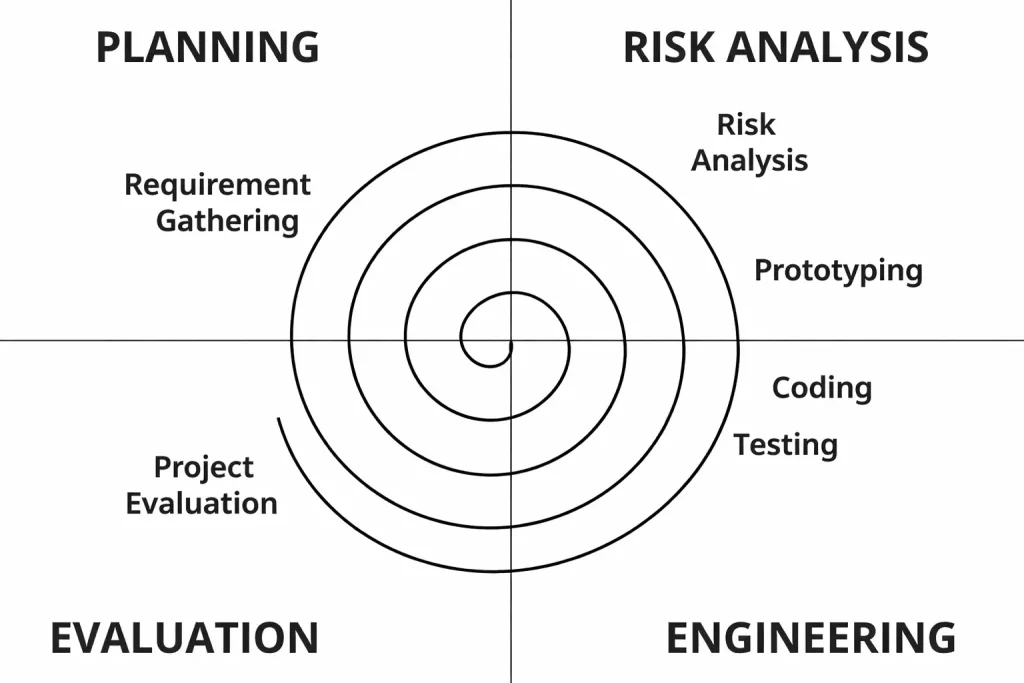
Figure: Spiral Model
Following are explanation of the phases of Spiral Model:-
1. Planning Phase (Requirement Gathering and Project Planning)
In this phase, the development team carefully studies the project requirements and defines the main objectives of the system. The team communicates with clients, users, and stakeholders to understand what they expect from the software. Moreover, project scope, cost, time, and resources are also planned in this stage. This helps developers prepare a clear roadmap before starting development.
Additionally, developers identify possible challenges and decide how the project will move forward in the next spiral cycle. The focus of this phase is to set clear goals and decide what needs to be developed in the current iteration. Therefore, proper planning reduces confusion and ensures smooth project execution.
For example, For an online banking system, developers gather requirements like account creation, fund transfer, ATM services, and secure login features. They also plan project time and budget.
2. Risk Analysis Phase (Risk Identification and Prototyping)
In this phase, developers analyze possible risks that may affect the project. Risks can be technical, financial, or operational, and each risk is studied carefully. Moreover, developers create small prototypes or test solutions to understand whether the system will work properly or not. This step helps in identifying problems early and finding suitable solutions.
Furthermore, different alternatives are tested to reduce risk and improve system quality. If any major issue is found, it is solved before moving to the next phase. Therefore, this phase makes the Spiral Model strong and reliable because it focuses on risk management in every cycle.
For example, In a banking system, developers test data security and encryption methods to prevent hacking or data loss.
3. Engineering Phase (Development and Testing)
In this phase, the actual software development begins. Developers write code, build system modules, and create different components of the software. Moreover, testing is performed to check whether the developed features are working correctly or not. This phase converts planning and design into a real working system.
Additionally, developers focus on improving system performance and fixing errors during development. Unit testing and integration testing are also performed to ensure system stability. Therefore, the software becomes more complete and functional in each spiral cycle.
For example, Developers create login systems, transaction modules, and database connections for the banking software and test them.
4. Evaluation Phase (User Review and Feedback)
In this phase, the developed system is reviewed by users and stakeholders. They test the software and provide feedback about performance, design, and functionality. Moreover, they suggest improvements and identify any missing features in the system. This helps developers understand whether the system meets user expectations.
Furthermore, the project team decides whether to move to the next spiral cycle or finalize the product. If improvements are needed, the process starts again from the planning phase. Therefore, continuous evaluation ensures high-quality and user-friendly software.
For example, Bank staff test the system and suggest adding mobile banking features and faster transaction processing.
Working of Spiral Model
- The process starts with planning.
- Then risk analysis is performed to identify problems.
- After that, engineering is done to develop and test the system.
- Finally, evaluation is performed to collect feedback.
- This cycle repeats in spiral form until the final software is ready.
When to Use Spiral Model
- Large and Complex Projects – Used when the software system is large and requires careful planning and development.
- High-Risk Projects – Suitable when project failure can cause major loss and risk analysis is necessary.
- Unclear or Changing Requirements – Used when requirements are not fully defined at the beginning and may change during development.
- Customer Feedback is Required – Used when continuous user involvement and evaluation are important.
- New Technology or Research-Based Projects – Suitable when new technologies or experimental systems are being developed.
- Safety-Critical Systems – Used in systems where safety and reliability are very important.
- Long-Term Development Projects – Suitable for projects that require continuous improvement and multiple development cycles.
Why Spiral Model is Better?
The Spiral Model is considered better than many other software development models because it focuses on risk management, flexibility, and continuous improvement throughout the development process. It combines the advantages of Waterfall, Prototyping, and Iterative models, which makes it more efficient and reliable for developing complex software systems. By following repeated cycles of planning, risk analysis, development, and testing, the Spiral Model ensures better control over the project and reduces the chances of failure.
Another reason why the Spiral Model is better is that it allows customer involvement and regular feedback at every stage of development. This helps in improving requirements, fixing errors early, and delivering high-quality software on time. It is especially suitable for large, complex, and high-risk projects, where careful planning and testing are required. Therefore, the Spiral Model provides better quality, flexibility, and project control compared to other development models.
Key Reasons Why Spiral Model is Better
- Strong Risk Management – Risks are identified and reduced at every stage of development.
- High Software Quality – Continuous testing ensures reliable and efficient software.
- Flexible Development – Changes can be made at any stage easily.
- Customer Involvement – Regular feedback improves system design and functionality.
- Early Error Detection – Problems are identified and fixed early.
- Better Project Control – Planning and monitoring improve management.
- Suitable for Complex Projects – Works well for large and high-risk systems.
- Combination of Multiple Models – Uses features of Waterfall and Prototyping together.
Advantages of Spiral Model
1. Effective Risk Management
The Spiral Model focuses strongly on identifying and analyzing risks at every stage of development. Each spiral includes a risk assessment phase that helps in detecting potential problems early. This reduces the chances of project failure and ensures safe development. Therefore, it is highly suitable for complex and high-risk projects.
2. High-Quality Software Development
Continuous testing and evaluation in every spiral improve the overall quality of the software. Errors are identified and corrected early, which reduces defects in the final product. Regular improvements ensure reliable and efficient software. Therefore, the model helps in delivering high-quality systems.
3. Flexible and Adaptive Model
The Spiral Model allows changes in requirements at any stage of development. This flexibility helps in handling dynamic and evolving project requirements. Developers can modify the system based on feedback and risk analysis. Therefore, it supports adaptive and flexible development.
4. Continuous Customer Involvement
Customers and users are involved in reviewing the system at every spiral cycle. Their feedback helps in improving requirements and system design. This ensures that the final product meets user expectations. Therefore, customer satisfaction is increased.
5. Early Detection of Errors and Issues
Since testing is done in every spiral, errors are detected and fixed early in the development process. This reduces the cost and effort required in later stages. Early problem detection improves system stability. Therefore, development becomes more efficient.
6. Suitable for Large and Complex Projects
The Spiral Model is designed for large-scale and complex software systems that require careful planning and risk control. It helps in managing multiple modules and complex requirements effectively. Therefore, it is ideal for enterprise and critical systems.
7. Better Project Control and Monitoring
Each spiral includes planning and monitoring activities that help managers track project progress. This ensures proper control over cost, time, and resources. Therefore, project management becomes easier and more organized.
8. Combines Multiple Development Approaches
The Spiral Model combines features of Waterfall, Prototyping, and Iterative models. This provides structured development along with flexibility and risk management. Therefore, it becomes a powerful and balanced development model.
Disadvantages of Spiral Model
1. High Development Cost
The Spiral Model requires repeated risk analysis, testing, and planning in every cycle, which increases overall development cost. More resources and time are required to complete the project. Therefore, it becomes expensive compared to other models.
2. Complex Process Management
Managing multiple spirals and risk analysis phases makes the model complicated. It requires proper planning and monitoring to control development activities. Therefore, project management becomes difficult.
3. Time-Consuming Model
Repeated development cycles and continuous evaluation increase project duration. Each spiral requires planning, development, testing, and review, which takes more time. Therefore, it is not suitable for quick development projects.
4. Requires Skilled Professionals
The Spiral Model requires experienced developers and project managers to perform risk analysis and planning. Without skilled experts, the project may fail. Therefore, it is difficult for small or inexperienced teams.
5. Not Suitable for Small Projects
Small projects do not require complex risk management and repeated cycles. Using the Spiral Model for small projects increases cost and effort unnecessarily. Therefore, it is not recommended for simple systems.
6. Difficult Risk Analysis
Accurate risk analysis is very important in the Spiral Model. If risks are not identified properly, the project may face serious problems. Therefore, incorrect risk evaluation can affect development.
7. Heavy Documentation and Planning
Each spiral requires proper documentation and planning, which increases workload and effort. This makes the process complex and time-consuming.
Applications of Spiral Model
1. Large-Scale Software Development
The Spiral Model is widely used in large and complex software projects that require proper risk management and continuous improvement. It helps in handling complex requirements and structured development.
2. Banking and Financial Systems
Banking and financial software require high security and reliability. The Spiral Model ensures risk analysis and testing, which makes it suitable for financial applications.
3. Defense and Military Systems
Defense and military projects involve high risks and safety requirements. The Spiral Model helps in managing risks and developing secure and reliable systems.
4. Aerospace and Aviation Systems
Aerospace and aviation software require high precision and safety. The Spiral Model ensures continuous testing and risk evaluation, making it suitable for such systems.
5. Research and Development Projects
Research-based projects involve uncertainty and frequent changes. The Spiral Model allows flexibility and continuous improvement, making it ideal for R&D projects.
6. Enterprise Software Development
Large enterprise systems require careful planning and risk control. The Spiral Model supports structured and flexible development for enterprise applications.
7. Risk-Sensitive and Safety-Critical Systems
The Spiral Model is used in projects where system failure can cause major problems. Continuous risk analysis ensures safe and reliable software development.
Conclusion
In conclusion, the Spiral Model is a powerful and flexible software development approach. It focuses on risk analysis, continuous improvement, and customer involvement. Although it is costly and complex, it works best for large and high-risk projects. Therefore, it is widely used in modern software development for building reliable and high-quality systems.