In software engineering and project management, both project life cycle and product life cycle are important concepts used to understand the stages involved in developing and managing a software system. These life cycles help in organizing the work into different phases so that the project and product can be planned, executed, monitored, and completed in a systematic manner. Understanding these life cycles helps project managers and developers control time, cost, quality, and resources effectively.
The project life cycle focuses on the stages of managing and completing a project, while the product life cycle focuses on the stages a product goes through from development to decline. Both life cycles provide a structured approach to development and maintenance, ensuring smooth execution and successful delivery of the software product. Suitable diagrams are often used to represent these life cycles for better understanding of each phase.
What is Project Life Cycle?
The project life cycle is a series of phases that a project goes through from its initiation to completion. It defines the stages involved in planning, executing, monitoring, and closing a project in a systematic manner. The project life cycle helps in managing time, cost, resources, and quality effectively to achieve project objectives successfully.
For example, in a software development project, a company decides to develop an online shopping application. In the initiation phase, the project idea and objectives are identified, such as creating an e-commerce platform for customers. In the planning phase, requirements, budget, timeline, and resources are defined. In the execution phase, developers design, code, and test the application. During the monitoring and control phase, project progress is tracked and necessary changes are made. Finally, in the closure phase, the completed software is delivered to the client and the project is officially finished.
Diagram of Project Life Cycle
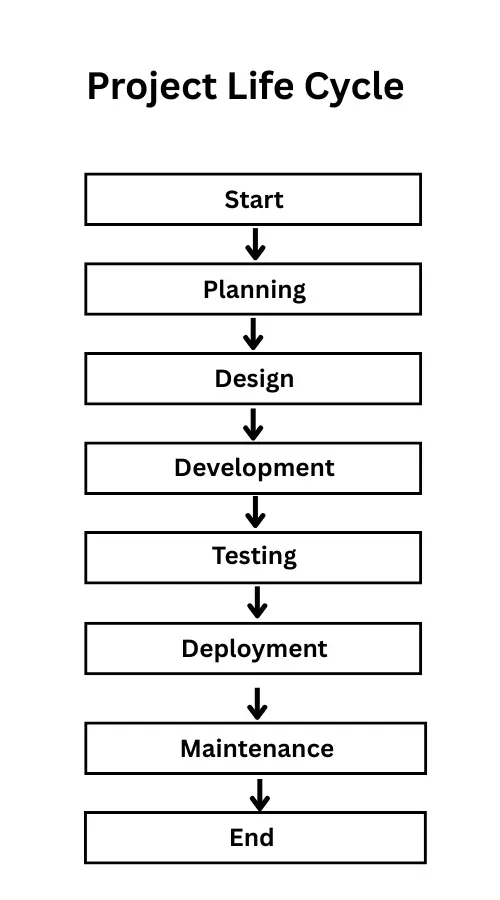
Figure: Project Lifecycle Process
Let’s see the explanation for the processes of Lifecycle,
1. Start
Start is the beginning of the project life cycle. Moreover, it defines the project idea and basic requirements. It also includes feasibility study and project approval. Therefore, the start stage gives a clear direction to begin the project.
2. Planning
Planning defines project goals, requirements, and resources. Moreover, it helps in setting project objectives and timelines. It also includes feasibility study and project scheduling. Therefore, planning provides a clear project direction.
3. Design
Design creates system structure and architecture. Moreover, it defines database and user interface. It also prepares technical documentation. Therefore, design improves system structure and development process.
4. Development
Development includes coding and implementation of software. Moreover, developers create system modules and features. It also converts design into working software. Therefore, development builds the complete system.
5. Testing
Testing checks software for errors and bugs. Moreover, it improves software quality and performance. It also ensures reliability and security. Therefore, testing ensures error-free and stable software.
6. Deployment
Deployment installs software in real environment. Moreover, it makes the system available to users. It also includes training and technical support. Therefore, deployment completes project delivery.
7. Maintenance
Maintenance fixes errors and updates software after deployment. Moreover, it improves system performance and security. It also supports new features and changes. Therefore, maintenance ensures long-term usability.
8. End
End is the final stage of the project life cycle. Moreover, it confirms project completion and client approval. It also includes documentation and project closure. Therefore, the end stage ensures successful project completion.
Objectives of Project Life Cycle
The project life cycle provides a structured framework that guides a project from its beginning to completion. It helps in organizing project activities into different phases so that planning, execution, and control can be carried out effectively. The objectives and characteristics of the project life cycle explain the purpose, features, and importance of managing a project in a systematic and organized manner.
Understanding the objectives and characteristics of the project life cycle helps project managers ensure proper planning, efficient use of resources, timely completion, and quality delivery of the project. It also improves coordination among team members and helps in monitoring progress at each stage of the project.
There are various objectives of Project Lifecycle:-
1. Ensure Systematic Project Management
The main objective of the project life cycle is to manage the project in a systematic and organized manner. It divides the project into different phases for better control and planning. This helps in smooth project execution and reduces confusion during development.
2. Achieve Project Goals
The project life cycle helps in achieving project objectives by providing a clear roadmap. Each phase contributes to the successful completion of the project. This ensures that the final output meets the required goals and expectations.
3. Improve Planning and Scheduling
The project life cycle helps in proper planning and scheduling of project tasks. It ensures that activities are completed within the given time. This improves efficiency and reduces delays in project completion.
4. Control Time and Cost
It helps in managing project time and cost effectively. Proper planning and monitoring reduce unnecessary expenses and delays. This ensures that the project stays within budget and schedule.
5. Improve Resource Utilization
The project life cycle ensures proper use of resources such as manpower, tools, and materials. It helps in allocating resources at the right time and place. This improves project efficiency and productivity.
6. Support Monitoring and Control
It helps project managers track progress at each stage of the project. Problems can be identified early and corrective actions can be taken. This improves project control and quality.
7. Ensure Quality Output
The project life cycle ensures that the final product meets quality standards and requirements. Proper testing and evaluation are done at each phase. This leads to reliable and high-quality project outcomes.
Characteristics of Project Life Cycle
1. Divided into Phases
The project life cycle is divided into different phases such as initiation, planning, execution, monitoring, and closure. Each phase has specific tasks and objectives. This helps in systematic project management.
2. Sequential Process
The phases of the project life cycle follow a logical sequence. One phase is completed before moving to the next phase. This ensures smooth workflow and better coordination.
3. Clearly Defined Objectives
Each phase of the project life cycle has clear goals and objectives. This helps in proper planning and execution of tasks. Clear objectives improve project direction and control.
4. Requires Resources
The project life cycle requires resources such as manpower, time, and tools. Proper resource allocation is necessary for successful project completion. This ensures efficient project management.
5. Focus on Monitoring and Control
The project life cycle includes monitoring and control activities at each phase. This helps in tracking progress and identifying problems. It ensures that the project stays on the right track.
6. Flexible and Adaptable
The project life cycle can be adjusted according to project needs and requirements. Changes can be made during development if required. This improves project flexibility and adaptability.
7. Ends with Project Closure
The project life cycle ends with the completion and delivery of the project. Final evaluation and documentation are done in the closure phase. This ensures proper project completion and handover.
Advantages of Project Life Cycle
1. Better Project Planning
The project life cycle provides a structured approach to planning project activities and resources. It helps in organizing tasks in different phases for smooth execution. Proper planning reduces confusion and improves project efficiency. This ensures timely completion of the project.
2. Improved Control and Monitoring
The project life cycle allows project managers to monitor progress at each phase. Problems and risks can be identified early and corrected. This improves project control and decision-making. It ensures better project management.
3. Efficient Resource Utilization
The project life cycle helps in proper allocation and use of resources such as manpower, tools, and time. It reduces wastage and improves productivity. Efficient resource utilization leads to better project performance.
4. Clear Project Structure
The project life cycle divides the project into clear and manageable phases. Each phase has defined objectives and tasks. This makes the project easier to understand and manage. It improves coordination among team members.
5. Reduces Project Risks
The project life cycle helps in identifying risks at different stages of the project. Preventive actions can be taken in advance to avoid problems. This reduces uncertainty and improves project stability.
6. Ensures Quality Output
Each phase of the project life cycle includes checking and evaluation. This ensures that the project meets quality standards. Proper testing and monitoring lead to reliable project results.
7. Supports Better Decision Making
The project life cycle provides clear information about project progress and performance. This helps managers make effective decisions. Better decisions lead to successful project completion.
Disadvantages of Project Life Cycle
1. Time-Consuming Process
The project life cycle requires detailed planning and documentation at each phase. This takes time and effort from the project team. It may delay the initial stage of the project.
2. Requires Skilled Management
Proper implementation of the project life cycle requires experienced project managers. Without proper knowledge, the project may not be managed effectively. Skilled professionals are necessary for success.
3. Increased Documentation
The project life cycle involves detailed reports and documentation at every stage. This increases administrative work and paperwork. Managing documentation becomes difficult and time-consuming.
4. Limited Flexibility
The project life cycle follows a structured and sequential approach. Making changes during later stages can be difficult. This reduces flexibility in project development.
5. Higher Cost
Proper planning, monitoring, and documentation increase project cost. Additional resources and tools may be required. This makes the project expensive.
6. Complex for Large Projects
In large projects, managing multiple phases and activities becomes complicated. It requires advanced tools and coordination. This increases project complexity.
7. Risk of Delay
If one phase is delayed, the entire project may be affected. Sequential dependency of phases can slow down project progress. This may lead to project delays.
Applications of Project Life Cycle
1. Software Development Projects
The project life cycle is widely used in software development to manage planning, coding, testing, and deployment. It helps in organizing tasks and ensuring timely delivery of software.
2. Construction Projects
The project life cycle is used in construction for planning, designing, and building structures. It helps in managing resources, time, and cost effectively.
3. Business and IT Projects
Organizations use the project life cycle to manage business and IT-related projects. It helps in planning and controlling project activities for better results.
4. Product Development
The project life cycle is used in developing new products from idea to completion. It ensures proper planning and execution of product development activities.
5. Research and Development Projects
Research projects use the project life cycle to manage experiments and analysis. It helps in organizing research work and achieving accurate results.
6. Engineering Projects
Engineering projects use the project life cycle to manage design, development, and implementation. It ensures systematic project execution and quality output.
7. Government and Infrastructure Projects
Government projects use the project life cycle for planning and executing infrastructure development. It helps in managing large-scale projects efficiently.
What is Product Life Cycle?
The product life cycle is a series of stages that a product goes through from its introduction in the market to its growth, maturity, and decline. It describes the life of a product from development and launch to its withdrawal from the market. The product life cycle helps organizations plan marketing, development, and maintenance strategies effectively.
For example, a mobile application developed by a company goes through different stages of the product life cycle. In the introduction stage, the app is launched in the market and promoted to users. In the growth stage, the number of users increases and new features are added. In the maturity stage, the app becomes stable and widely used. Finally, in the decline stage, user interest decreases and the app may be replaced or removed from the market.
Diagram of Product Life Cycle
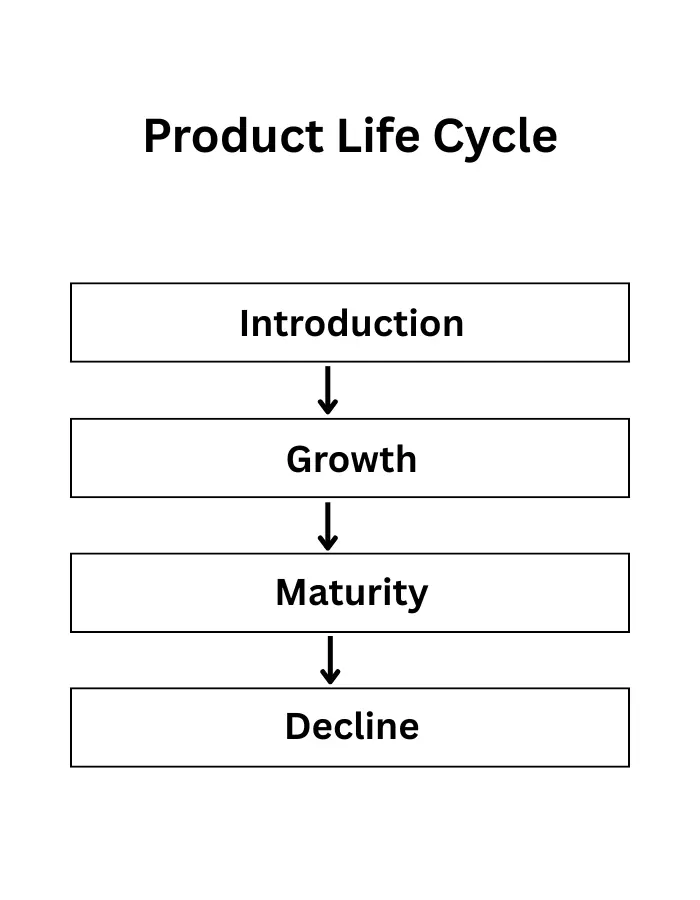
Figure: Product Lifecycle Process
Let’s see the explanation of Product Lifecycle Processes,
1. Introduction
During the introduction stage, the product is first launched in the market. Customers start using the product for the first time, and awareness needs to be created through marketing and promotions. Sales are generally low initially, and the company focuses on building a customer base while monitoring feedback to improve the product.
2. Growth
In the growth stage, the product gains popularity, and sales start increasing rapidly. Customer demand rises as more people become aware of the product’s benefits. The company may expand distribution, enhance product features, and invest in marketing to capture a larger market share and establish a competitive position.
3. Maturity
During the maturity stage, the product reaches its peak sales and market presence. Competition becomes intense, requiring the company to innovate and improve the product continually. The focus is on maintaining market share, customer loyalty, and profitability while managing costs effectively.
4. Decline
In the decline stage, demand for the product decreases, often due to new technology, changing customer preferences, or market saturation. Sales gradually reduce over time, and companies may phase out the product or replace it with an updated version. Strategic decisions are made to minimize losses and manage remaining inventory efficiently.
Objectives of Product Life Cycle
The product life cycle provides a framework to understand the progression of a product from its introduction to its decline in the market. It helps organizations plan marketing, production, and development strategies effectively for each stage of the product. Understanding the objectives and characteristics of the product life cycle ensures better decision-making, resource management, and market success.
Following are the various objectives of Product Lifecycle:-
1. Plan Marketing Strategies
The main objective is to plan marketing strategies according to the product stage. This ensures effective promotion, pricing, and distribution for maximum market impact.
2. Manage Product Development
It helps in managing the product development process by identifying when to launch new features or updates. This ensures continuous product improvement.
3. Optimize Resource Allocation
The product life cycle allows proper allocation of resources like funds, manpower, and time at different stages. Efficient resource use improves productivity and profitability.
4. Maximize Product Profitability
By analyzing each stage, organizations can implement strategies to increase sales and profitability. This includes promotions during introduction and cost control during maturity.
5. Support Decision Making
The product life cycle provides insights into product performance, helping managers make informed decisions. This reduces risks and improves business outcomes.
6. Improve Customer Satisfaction
It helps in meeting customer expectations by managing product updates and enhancements. Timely improvements increase customer loyalty and satisfaction.
7. Plan Product Replacement
The product life cycle helps in deciding when to phase out or replace the product. This ensures smooth transition to new products without market disruption.
Characteristics of Product Life Cycle
1. Stages-Based Process
The product life cycle consists of four main stages: Introduction, Growth, Maturity, and Decline. Each stage has specific objectives, challenges, and strategies.
2. Time-Bound
Each stage occurs over a certain period depending on market response, product type, and competition. Timing affects marketing and production strategies.
3. Impact on Sales and Profits
Sales and profits vary at each stage. They are usually low during introduction, peak during maturity, and decline in the final stage. This helps in planning financial strategies.
4. Requires Strategic Management
Effective management is needed at each stage for marketing, production, and resource allocation. Strategies must be adapted to the stage for success.
5. Dynamic and Changing
The product life cycle is dynamic, as market trends, customer preferences, and competition influence each stage. Flexibility is essential for sustaining the product.
6. Predictable Pattern
Despite variations, the product life cycle generally follows a predictable pattern of growth and decline. This helps in forecasting and planning.
7. Influences Business Decisions
Decisions regarding marketing, production, pricing, and product updates are influenced by the stage of the product life cycle. This ensures proper alignment with market conditions.
Advantages of Product Life Cycle
1. Better Market Planning
The product life cycle helps organizations plan marketing strategies according to different product stages. It allows companies to introduce, promote, and manage products effectively. Proper market planning improves product success and customer reach.
2. Improves Product Management
The product life cycle provides a clear understanding of product stages from introduction to decline. This helps managers take appropriate decisions at each stage. It ensures smooth product development and maintenance.
3. Helps in Resource Allocation
The product life cycle helps in allocating resources such as time, money, and manpower efficiently. Resources can be used properly at different stages of the product. This improves productivity and reduces wastage.
4. Supports Strategic Decision Making
The product life cycle provides useful information about product performance and market conditions. Managers can make better strategic decisions based on product stage. This improves overall business performance.
5. Increases Product Efficiency
Understanding product life cycle stages helps in improving product features and quality. Necessary changes can be made at the right time. This ensures better product performance and customer satisfaction.
6. Helps in Risk Management
The product life cycle helps in identifying risks at different stages of the product. Preventive actions can be taken to avoid product failure. This reduces business risks and improves stability.
7. Improves Customer Satisfaction
By managing product stages properly, companies can meet customer needs and expectations. Continuous improvement and updates increase customer satisfaction. This leads to better product acceptance in the market.
Disadvantages of Product Life Cycle
1. Difficult to Predict Product Stages
It is difficult to accurately predict how long each stage of the product life cycle will last. Market conditions and customer demand may change quickly. This makes planning challenging.
2. Requires Continuous Monitoring
The product life cycle requires regular monitoring and analysis of product performance. This increases management effort and time. Continuous monitoring is necessary for success.
3. High Cost of Product Development
Developing and maintaining products through different life cycle stages requires investment. Marketing, promotion, and upgrades increase overall cost. This may affect company budget.
4. Risk of Product Failure
If the product does not perform well in the market, it may fail in early stages. This leads to financial loss and wasted resources. Proper planning is required to avoid failure.
5. Complex Market Analysis
Understanding market trends and customer behavior is difficult. Companies need advanced analysis and research. This increases complexity in product management.
6. Short Product Life in Technology
In technology and software products, the life cycle is often short due to rapid innovation. Products become outdated quickly. This requires frequent updates and improvements.
7. Limited Flexibility
The product life cycle follows fixed stages, which may limit flexibility in decision making. Sudden market changes may require different strategies. This makes management difficult.
Applications of Product Life Cycle
1. Software Product Development
The product life cycle is used in software development to manage software from launch to maintenance and decline. It helps in planning updates and new versions of software.
2. Marketing and Sales Planning
Companies use the product life cycle to plan marketing and sales strategies. Different strategies are applied at different product stages to increase market success.
3. Business and Industrial Products
The product life cycle is used in business and industrial product management. It helps in planning production, distribution, and maintenance activities.
4. Mobile and Technology Products
Technology companies use the product life cycle to manage mobile apps, software, and electronic devices. It helps in updating and improving products regularly.
5. Consumer Goods Management
The product life cycle is used in managing consumer goods like electronics and household products. It helps in maintaining product demand in the market.
6. Product Innovation and Development
The product life cycle supports innovation by identifying the need for new products. Companies develop new products when old ones decline. This ensures business growth.
7. Business Strategy and Planning
Organizations use the product life cycle to plan long-term business strategies. It helps in forecasting product performance and market trends. This improves business decision making.
Conclusion
Project life cycle and product life cycle are important in software project management. Moreover, project life cycle focuses on development stages, while product life cycle focuses on market stages. They also help in planning, monitoring, and improving software systems. Therefore, both life cycles ensure successful project and product management.