The Incremental Life Cycle Model is a software development approach where the system is built and delivered in small parts called increments. Instead of developing the whole software at once, developers divide it into smaller modules. Each increment adds new features and improves the system step by step. As a result, users can start using the basic version early while new features are added over time. Therefore, this model is useful when requirements are partially known and need gradual development.
For example, A team develops an e-commerce website using the Incremental Model. First, they release a basic version with product listing. Next, they add a shopping cart feature in the second increment. Then, they include payment and order tracking features. After that, users give feedback, and improvements are made in future updates. As a result, the website grows step by step and becomes fully functional over time.
What is Incremental Model?
The term Incremental Model in Software Engineering comes from the word “increment,” which means adding something step by step in small parts. In this model, software is not developed all at once; instead, it is built in small, manageable units called increments. Each increment adds new features and improves the previous version of the system. Therefore, the software grows gradually until the final product is completed.
Moreover, the Incremental Model focuses on dividing a large project into smaller parts so that development becomes easier and more organized. Each part goes through requirement analysis, design, coding, and testing before moving to the next part.
Objectives of Incremental Model
The Incremental Model focuses on building software in a structured and efficient way. It aims to deliver the system in small parts while improving it continuously. As a result, development becomes flexible, manageable, and less risky.
Following are the objectives of Incremental Model:-
1. Develop Software in Small Parts
The main objective of the Incremental Model is to divide the software into smaller modules and develop them step by step. Each increment adds new functionality to the system. This makes development easier and more manageable. Therefore, it ensures systematic and gradual software development.
2. Deliver Working Software Early
The model aims to provide a working version of the software at early stages of development. Each increment delivers a functional part of the system to the user. This helps in early usage and feedback. Therefore, it improves user satisfaction and project efficiency.
3. Improve Software Quality
Testing is performed after each increment, which helps in identifying and fixing errors early. Continuous development and testing improve system reliability. Therefore, the model ensures high-quality software.
4. Reduce Development Risk
By developing software in small parts, the risk of project failure is reduced. Problems can be identified and solved in early stages. This makes the project safer and more controlled. Therefore, it improves project stability.
5. Enhance Customer Involvement
Customers can review each increment and provide feedback. This helps in improving system requirements and functionality. Therefore, it ensures that the final product meets user needs.
6. Improve Project Management
The Incremental Model allows proper planning and monitoring of each increment. Managers can control time, cost, and resources effectively. Therefore, it improves project organization and management.
7. Support Flexible Development
The model allows changes and improvements in future increments. This flexibility helps in adapting to new requirements. Therefore, it supports dynamic software development.
Characteristics of Incremental Life Cycle Model
1. Development in Small Increments
The software is divided into smaller modules, and each module is developed separately. Every increment adds new functionality to the system. This makes development easier and more manageable.
2. Early Delivery of Software
A working version of the software is delivered after each increment. Users can start using the system early and provide feedback. This improves system quality and usability.
3. Continuous Testing and Integration
Each increment is tested and integrated with the previous modules. This ensures error-free and reliable software development.
4. Customer Involvement
Customers are involved in reviewing each increment. Their feedback helps in improving the system and meeting user requirements.
5. Flexible and Adaptive Model
Changes can be made in future increments based on feedback and requirements. This makes the model flexible and adaptable.
6. Combination of Waterfall and Iterative Approach
Each increment follows the Waterfall process, while the overall system is developed iteratively. This provides both structure and flexibility.
7. Reduced Project Risk
Since development is done in parts, risks are minimized and problems are handled early.
8. Easy Project Management
Planning and monitoring of each increment make project management easier and more efficient.
Uniqueness of Incremental Life Cycle Model
1. Step-by-Step Development
The Incremental Model develops software in small parts, which makes it different from models that develop the entire system at once.
2. Early Working Software Delivery
It provides working software in early stages, unlike Waterfall Model which delivers at the end.
3. Continuous Testing and Improvement
Each increment is tested and improved, ensuring better system quality.
4. Flexible and Adaptive Approach
Future increments can be modified based on feedback and new requirements.
5. Easy Risk Management
Risks are reduced because development is done in small modules.
6. Better Customer Interaction
Customers review each increment and suggest improvements.
7. Combination of Waterfall and Iterative Approach
It combines structured development with repeated improvements, making it unique.
Diagram of Incremental Model
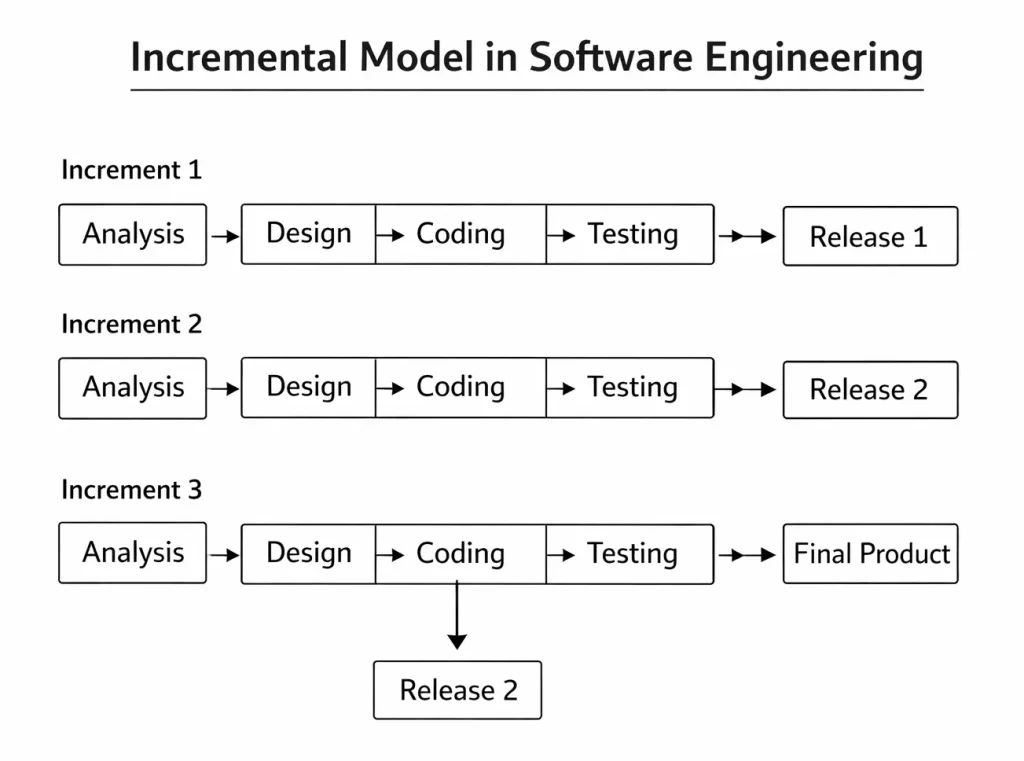
Figure: Incremental Model
Following are the explanation of Incremental Model:-
Increment 1
In the first increment, developers start with requirement analysis to understand the basic features of the system. After that, they design the system structure, write the program code, and test the developed features. Once testing is completed, the first version of the software is released to users. This version contains only the core or basic functionality of the system.
For example, In an online shopping system, the first increment may include user registration and login features, and then Release 1 is provided to users.
- First, the team performs Analysis to understand basic requirements.
- Then, they move to Design to plan the system structure.
- After that, they do Coding to build core features.
- Next, they perform Testing to ensure quality.
- Finally, Release 1 is delivered with basic functionality.
Increment 2
In the second increment, new requirements are analyzed based on user feedback and project needs. Developers again follow the same process of design, coding, and testing to add new features to the existing system. This increment improves the software by adding additional functionalities and fixing issues found in the previous release.
For example, In the shopping system, product search and product display features are added, and then Release 2 is provided.
- Next, the team starts Increment 2 with additional requirements.
- Again, they follow Analysis → Design → Coding → Testing.
- Moreover, new features are added to the existing system.
- Then, the system is tested to check integration with previous features.
- As a result, Release 2 provides improved functionality.
Increment 3
In the third increment, developers continue the same development cycle and add advanced features. The system becomes more complete and stable during this stage. After proper testing, the final version of the software is prepared and delivered as the final product. This increment ensures that all required features are included and the system works efficiently.
For example, In the shopping system, add-to-cart, payment, and order tracking features are added to create the final product.
- Finally, the Final Product is delivered with all features integrated.
- Similarly, the team begins Increment 3 to complete the system.
- They analyze remaining requirements and improve the design.
- Then, developers add advanced features during coding.
- After that, thorough testing ensures the system works properly.
Advantages of Incremental Life Cycle Model
1. Early Delivery of Working Software
The Incremental Model delivers a working version of the software after each increment. Users can start using important features early in the development process. This helps in saving time and improving productivity. Therefore, it ensures early system availability and faster delivery.
2. Improved Software Quality
Each increment is developed and tested separately, which helps in identifying and fixing errors early. Continuous testing improves system reliability and performance. This ensures high-quality software development. Therefore, the model enhances overall system quality.
3. Flexible and Easy to Modify
The Incremental Model allows changes in future increments based on user feedback and new requirements. Developers can easily update or modify the system without affecting previous modules. Therefore, it supports flexible and adaptive development.
4. Reduced Project Risk
Since development is done in small parts, risks are minimized at each stage. Problems can be identified and solved early before they affect the entire system. This reduces project failure chances. Therefore, it improves project stability and safety.
5. Better Customer Involvement
Customers can review each increment and provide feedback on system functionality. This helps in improving requirements and meeting user expectations. Therefore, customer satisfaction is increased.
6. Easy Project Management
The project is divided into smaller increments, which makes planning and monitoring easier. Managers can track progress and control resources effectively. Therefore, project management becomes more efficient.
7. Efficient Use of Resources
Resources such as time, cost, and manpower are used properly in each increment. This reduces wastage and improves efficiency. Therefore, the model supports better resource utilization.
8. Suitable for Medium and Large Projects
The Incremental Model works well for projects that require step-by-step development and gradual improvement. It is useful in systems where features can be delivered in stages.
Disadvantages of Incremental Life Cycle Model
1. Requires Proper Planning
The Incremental Model needs clear planning and system design at the beginning. If planning is not done properly, integration of increments may become difficult. Therefore, careful planning is required.
2. Integration Issues
Combining different increments into a complete system can be challenging. If modules are not properly designed, system integration problems may occur. Therefore, coordination is important.
3. Higher Initial Cost
Designing the system architecture and planning increments requires more effort and cost in the beginning. Therefore, initial investment may be high.
4. Requires Skilled Developers
Developers must have good knowledge of system design and integration. Without skilled professionals, the system may face technical problems. Therefore, experienced teams are needed.
5. Not Suitable for Small Projects
Small projects do not require multiple increments and planning. Using this model for small systems increases unnecessary effort. Therefore, it is not ideal for simple projects.
6. Continuous Customer Involvement Needed
Regular feedback from customers is required for each increment. If customer involvement is not available, development may be affected.
7. Complex System Design
The overall system architecture must be designed carefully from the start. Poor design can affect future increments and system performance.
Applications of Incremental Life Cycle Model
1. Business and Enterprise Software
Used in enterprise systems where features are added step by step and continuous improvement is required.
2. Web and Mobile Applications
Suitable for web and mobile applications where basic features are released first and new features are added later.
3. Banking and Financial Systems
Used in financial software where modules like account management, transactions, and reports are developed in increments.
4. E-Commerce Systems
Online shopping systems are developed in parts such as product catalog, payment system, and order management.
5. Educational Software
Used in learning management systems where features like courses, exams, and results are added gradually.
6. Management Information Systems
Suitable for systems that require continuous updates and module-based development.
7. Large Software Projects
Used in large projects where full system development at once is difficult.
Conclusion
The Incremental Model is a flexible and practical approach to software development. It builds the system step by step, which makes the process easier to manage and understand. Moreover, it allows early delivery of working software, so users can provide feedback at each stage. As a result, the final product becomes more accurate and user-friendly. Therefore, this model is highly suitable for large projects and systems where requirements may change over time.