A sparse matrix is a type of matrix where most elements are zero. Imagine a large grid where only a few cells contain meaningful values, while the rest remain empty. Among sparse matrices, three common structured types are lower triangular, upper triangular, and tri-diagonal matrices.
Three Types of Structured Sparse Matrices
Sparse matrices with specific patterns of non-zero elements are often categorized as:
- Lower Triangular Sparse Matrix
- Upper Triangular Sparse Matrix
- Tri-diagonal Matrix
1. Lower Triangular Matrix
In a lower triangular matrix, all elements above the main diagonal are zero. Only elements on or below the diagonal may be non-zero.
Mathematical Definition
For an element at position (i, j), if i < j then Arr[i][j] = 0.
For an n×n lower triangular matrix:
- Row 1 contains 1 non-zero element
- Row 2 contains 2 non-zero elements
- …continuing to row n with n non-zero elements
- Total non-zero elements = n(n+1)/2
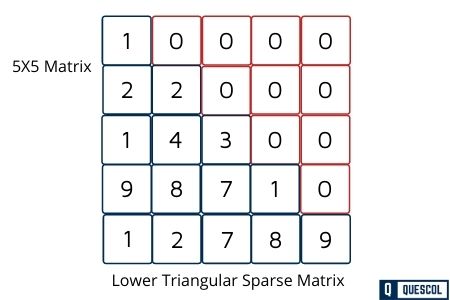
Efficient Storage: Lower triangular matrices can be stored efficiently using a one-dimensional array instead of a full n×n matrix. Two common mapping methods are:
- Row-wise mapping: Traverse rows left-to-right, top-to-bottom. For the example matrix:
{1, 2, 2, 1, 4, 3, 9, 8, 7, 1, 1, 2, 7, 8, 9} - Column-wise mapping: Traverse columns top-to-bottom, left-to-right. For the example matrix:
{1, 2, 1, 9, 1, 2, 4, 8, 2, 3, 7, 7, 1, 8, 9}
2. Upper Triangular Matrix
In an upper triangular matrix, all elements below the main diagonal are zero. Only elements on or above the diagonal may be non-zero.
Mathematical Definition
For an element at position (i, j), if i > j then Arr[i][j] = 0.
For an n×n upper triangular matrix:
- Row 1 contains n non-zero elements
- Row 2 contains n-1 non-zero elements
- …continuing to row n with 1 non-zero element
- Total non-zero elements = n(n+1)/2
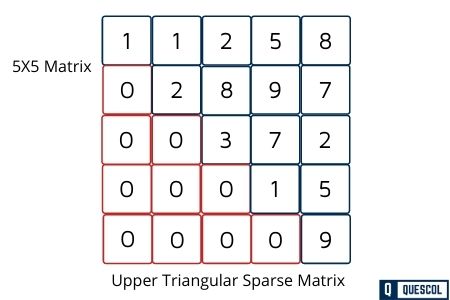
Efficient Storage: Similar to lower triangular matrices, upper triangular matrices can be stored efficiently using one-dimensional arrays:
- Row-wise mapping: For the example matrix:
{1, 1, 2, 5, 8, 2, 8, 9, 7, 3, 7, 2, 1, 5, 9} - Column-wise mapping: For the example matrix:
{1, 1, 2, 2, 8, 3, 5, 9, 7, 1, 8, 7, 2, 5, 9}
3. Tri-diagonal Matrix
A tri-diagonal matrix is a sparse matrix where non-zero elements appear only on:
- The main diagonal (i = j)
- The diagonal immediately above the main diagonal (i = j-1)
- The diagonal immediately below the main diagonal (i = j+1)
Mathematical Definition
For an element at position (i, j), if |i – j| > 1 then Arr[i][j] = 0.
For an n×n tri-diagonal matrix:
- Total non-zero elements = 3n – 2 (for n ≥ 2)
- Elements appear only in three diagonals
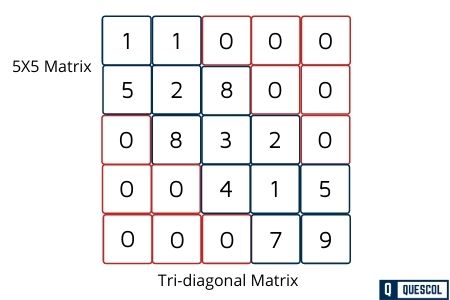
Efficient Storage: Tri-diagonal matrices can be stored using various mapping strategies:
- Row-wise mapping: Store elements row by row
- Column-wise mapping: Store elements column by column
- Diagonal-wise mapping: Store elements along each diagonal
Importance of Sparse Matrices
These structured sparse matrices are valuable because:
- Computational Efficiency: Zero elements can be skipped during operations, saving processing time
- Memory Optimization: Only non-zero elements need storage, reducing memory requirements
- Algorithmic Simplification: Specialized algorithms can leverage the known structure
Applications of Sparse Matrices
- Scientific Computing: Solving differential equations, finite element analysis
- Numerical Linear Algebra: Solving linear systems, eigenvalue problems
- Machine Learning: Handling large, sparse datasets and feature matrices
- Network Theory: Representing adjacency matrices of sparse graphs
Storage Formats for Sparse Matrices
Efficient storage is crucial for sparse matrices. Common formats include:
- Compressed Sparse Row (CSR): Stores non-zero values, column indices, and row pointers
- Compressed Sparse Column (CSC): Similar to CSR but column-oriented
- Coordinate Format (COO): Stores (row, column, value) triplets
- Specialized formats: For structured sparse matrices like triangular and tri-diagonal
Conclusion
Lower triangular, upper triangular, and tri-diagonal matrices represent important categories of structured sparse matrices. Their predictable patterns of non-zero elements enable efficient storage, faster computations, and specialized algorithms. Understanding these matrix types is essential for optimizing performance in scientific computing, data analysis, and machine learning applications where dealing with large, sparse datasets is common. By focusing computational resources only on meaningful non-zero elements, these structured sparse matrices make it possible to solve complex problems that would be impractical with dense matrix representations.