A Singly Linked List is a linear data structure where elements, called nodes, are connected in sequence. Each node consists of two components: data (which stores the value) and a next pointer (which references the following node). The list begins with a head node and ends when a node’s next pointer is NULL, indicating the list’s termination. Singly linked lists support dynamic memory allocation, efficient insertion and deletion operations, and adaptable memory usage, making them ideal for applications where data size frequently changes.
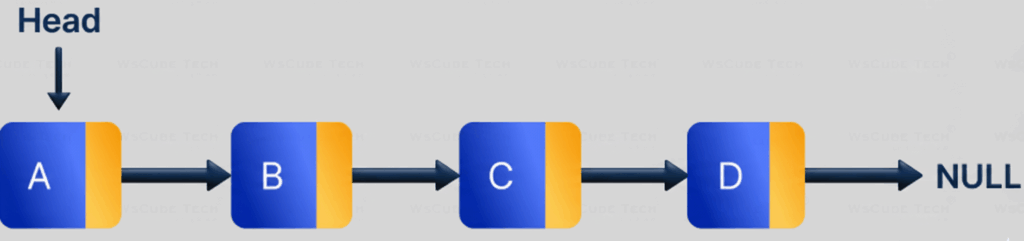
Advantages and Disadvantages of Linked Lists
Advantages:
- Dynamic Size: Linked lists can grow or shrink dynamically at runtime, providing flexibility without predefined size constraints.
- Efficient Insertions/Deletions: Adding or removing elements, especially at the beginning or middle, requires only pointer updates—no element shifting is needed, unlike arrays.
- Memory Efficiency: Memory is allocated only as needed, minimizing waste compared to arrays that may allocate unused space.
- Foundation for Complex Structures: Linked lists serve as building blocks for more advanced data structures like stacks, queues, trees, and graphs.
- No Memory Reallocation Overhead: Unlike dynamic arrays, linked lists don’t require expensive resizing operations when growing beyond capacity.
Disadvantages:
- Memory Overhead: Each node requires additional memory for the pointer/reference, increasing storage requirements compared to arrays.
- Sequential Access: Elements cannot be accessed randomly; traversal from the head is required to reach any node, resulting in O(n) access time.
- Implementation Complexity: Basic operations require careful pointer management, making implementation more error-prone than arrays.
- Poor Cache Performance: Nodes are stored non-contiguously in memory, leading to cache misses and slower performance compared to arrays.
- No Backward Traversal: Singly linked lists only allow forward traversal; doubly linked lists are needed for bidirectional movement at the cost of additional memory.
Applications of Linked Lists
- Dynamic Memory Management: Operating systems use linked lists to manage free memory blocks and allocate/deallocate memory dynamically for processes.
- Implementation of Abstract Data Types: Linked lists form the foundation for implementing stacks, queues, and associative arrays (dictionaries) in programming languages.
- Undo Functionality: Applications like text editors and graphic design software use linked lists to maintain history states for undo/redo operations.
- Hash Table Collision Resolution: Linked lists handle collisions in hash tables through chaining, where each bucket points to a linked list of entries with the same hash.
- Graph Representation: Adjacency lists, a common graph representation, use linked lists to store neighboring vertices efficiently, especially for sparse graphs.
- Polynomial Arithmetic: Mathematical software represents polynomials using linked lists, where each node stores a coefficient and exponent, facilitating operations like addition and multiplication.
- Sparse Matrix Storage: Linked lists efficiently store non-zero elements in sparse matrices, conserving memory while maintaining accessibility.
- Dynamic String Manipulation: Text editors and word processors use linked lists for efficient string operations like insertion and deletion without requiring full string reallocation.
- Image Navigation: Image viewers and slideshow applications use linked lists to enable seamless forward/backward navigation through images.
- Playlist Management: Media players implement playlists using linked lists, allowing easy track insertion, deletion, and sequential playback.
Conclusion
A singly linked list provides a flexible way to store data using dynamically allocated nodes, making insertions and deletions efficient. Although it lacks direct access and requires sequential traversal, its simplicity and low memory overhead make it suitable for many real-world applications. Overall, singly linked lists are a practical choice when dynamic resizing and frequent structural modifications are required.