In today’s digital age, a reliable, high-speed Internet connection is vital for business operations. Asymmetric Digital Subscriber Line (ADSL) is a popular choice for homes and small businesses due to its low cost and easy availability. However, ADSL provides high download speeds but very low upload speeds, making it unsuitable for large businesses that rely on data uploading, cloud computing, video conferencing, and hosting services.
While ADSL works well for light Internet use, enterprises need faster, symmetric, and more stable connections. Technologies like SDSL, VDSL, Fiber Optics, and Leased Lines offer better performance and reliability, making them ideal for large-scale business applications.
What is ADSL Technology?
ADSL (Asymmetric Digital Subscriber Line) is a type of DSL (Digital Subscriber Line) technology that enables high-speed Internet access using existing copper telephone lines. The term “asymmetric” refers to the difference between the download and upload speeds — the download bandwidth is significantly higher than the upload bandwidth.
ADSL works by dividing the telephone line into separate frequency bands for voice communication and data transmission.
- The lower frequency band (0–4 kHz) is reserved for normal voice calls.
- The higher frequency bands (above 25 kHz) are used for digital data transmission.
A splitter or microfilter separates the voice and data signals, allowing both Internet access and voice calls to occur simultaneously on the same line.
A simplified description of the data flow:
- Data from the Internet reaches the DSL Access Multiplexer (DSLAM) at the telephone exchange.
- The DSLAM connects to the user’s modem via the telephone line.
- The modem separates the data and voice signals and provides Internet access to the computer or router.
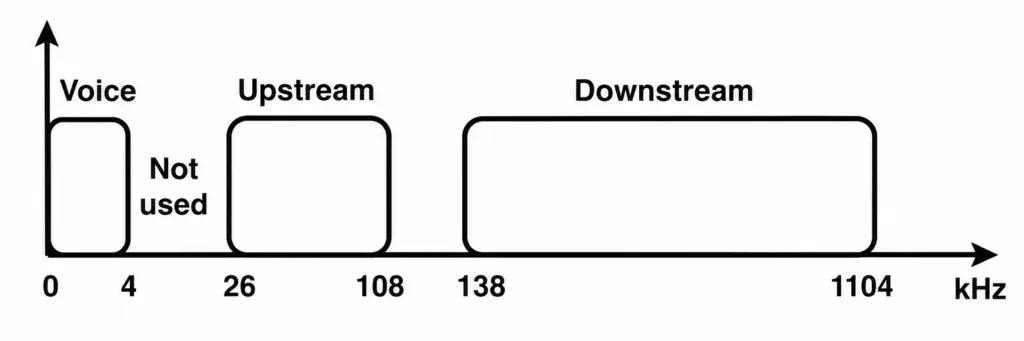
Figure: Bandwidth division in ADSL
Why ADSL is Not Suitable for Large Business Applications
Asymmetric Bandwidth Problem
The most fundamental limitation of ADSL is its asymmetric speed structure — high download but low upload speed.
Example:
A typical ADSL plan might offer 24 Mbps download and only 1 Mbps upload.
For a business hosting a website, running video conferences, or uploading large data to cloud servers, upload bandwidth is just as important as download bandwidth.
Impact:
- Slow upload leads to delays in sending large files or database backups.
- Real-time applications like VoIP, Zoom meetings, and cloud synchronization suffer from lag.
- Remote employees experience poor performance during collaborative work or file sharing.
Hence, asymmetric bandwidth makes ADSL inappropriate for businesses that rely on two-way communication or data exchange.
Limited Scalability and Bandwidth Capacity
Large businesses often have hundreds of employees and multiple departments using the same Internet connection. ADSL cannot efficiently handle such heavy simultaneous usage.
- The maximum speed of ADSL (up to 24 Mbps in ADSL2+) becomes insufficient when multiple users perform bandwidth-intensive tasks like:
- Accessing cloud-based CRMs (Salesforce, Zoho)
- Streaming meetings (Teams, Zoom)
- Uploading to company servers or backup systems
- Bandwidth contention leads to network congestion, slower performance, and reduced productivity.
Comparison with Fiber Optic:
| Technology | Max Download Speed | Max Upload Speed | Scalability |
|---|---|---|---|
| ADSL | Up to 24 Mbps | Up to 1 Mbps | Limited |
| Fiber Optic | 100 Mbps – 10 Gbps | 100 Mbps – 10 Gbps | Highly scalable |
Distance Sensitivity and Signal Degradation
The speed and reliability of ADSL are highly dependent on the distance between the business premises and the local telephone exchange (DSLAM).
- As the distance increases, the signal strength weakens.
- Beyond 4–5 kilometers, the connection speed can drop drastically, and in some cases, the connection becomes unstable.
Technical Reason:
Copper cables suffer from attenuation and noise interference, particularly at higher frequencies. Large businesses, which might be located in industrial zones or on city outskirts, often experience degraded service quality.
This makes ADSL unreliable for enterprises needing consistent high-speed Internet across multiple branches or locations.
Poor Upload Performance for Business-Critical Tasks
Businesses often require high upstream bandwidth for the following activities:
- Hosting corporate websites or servers
- Data backup to cloud storage
- Running online transactions and e-commerce portals
- Video conferencing and remote meetings
- Virtual Private Network (VPN) access for remote employees
Since ADSL upload speeds are typically limited to 512 Kbps–1 Mbps, these operations face severe bottlenecks.
Example:
Uploading a 1 GB file over a 1 Mbps connection takes approximately 2 hours 15 minutes, which is unacceptable for enterprises that deal with massive data transfers daily.
Security and Network Management Limitations
Security is paramount in large enterprises. ADSL connections are more vulnerable because:
- They are shared connections over public networks.
- Encryption and tunneling (e.g., VPNs) consume significant bandwidth, which ADSL cannot sustain.
- Limited upload speed impacts the performance of firewalls, IDS (Intrusion Detection Systems), and remote access gateways.
Furthermore, network management tools like bandwidth shaping, Quality of Service (QoS), and redundancy protocols are often not supported in standard ADSL routers, making it unsuitable for enterprise-grade IT infrastructure.
Comparison Between ADSL and Business Alternatives
| Feature | ADSL | SDSL (Symmetric DSL) | Fiber Optic (FTTH/FTTB) | Leased Line |
|---|---|---|---|---|
| Bandwidth Type | Asymmetric | Symmetric | Symmetric | Symmetric |
| Download Speed | 1.5–24 Mbps | 1–20 Mbps | 100 Mbps–10 Gbps | 10 Mbps–10 Gbps |
| Upload Speed | 128 Kbps–1 Mbps | 1–20 Mbps | 100 Mbps–10 Gbps | 10 Mbps–10 Gbps |
| Reliability | Moderate | High | Very High | Very High |
| SLA | Usually No | Yes | Yes | Yes |
| Best For | Home/Small Office | Medium Business | Large Business | Enterprise Networks |
Advantages of ADSL
- Cost-Effective Internet Access
- ADSL is relatively inexpensive compared to leased lines or fiber connections, making it an affordable broadband option.
- Uses Existing Telephone Lines
- It operates over standard copper telephone cables, so no new infrastructure or wiring is required.
- Simultaneous Voice and Data Transmission
- ADSL allows you to use the Internet and make phone calls at the same time using a splitter.
- Always-On Connectivity
- The connection is continuous; users do not need to dial in like older dial-up services.
- Easy Installation and Setup
- Setup is simple and can often be done by plugging in a modem or router without complex configurations.
- Widely Available
- Since it uses the existing PSTN (Public Switched Telephone Network), ADSL is available even in many rural or semi-urban areas.
- Good Download Speed for Home Users
- The high downstream bandwidth makes it ideal for activities like web browsing, streaming, and downloading files.
- Low Maintenance
- ADSL generally requires minimal maintenance and has fewer physical components compared to dedicated leased lines.
Disadvantages of ADSL
- Asymmetric Bandwidth
- The upload speed is much lower than the download speed, which is unsuitable for businesses requiring heavy data uploads or hosting services.
- Limited Scalability
- ADSL connections cannot handle multiple high-bandwidth users simultaneously, making it inadequate for large organizations.
- Distance Sensitivity
- The connection quality decreases as the distance from the telephone exchange increases, leading to slower speeds and possible instability.
- Low Upload Speed
- With typical upload speeds of only 512 Kbps–1 Mbps, ADSL performs poorly for tasks like video conferencing, cloud backups, or file sharing.
- No Guaranteed Bandwidth or SLA
- ADSL is a “best-effort” service without Service Level Agreements, meaning downtime or slow speeds cannot be compensated or guaranteed.
- Shared Connection and Congestion
- Since bandwidth is often shared among multiple users, performance can drop significantly during peak usage hours.
- Not Suitable for Hosting or Business-Critical Applications
- Dynamic IP addresses, lack of uptime guarantees, and low upload capacity make ADSL impractical for running servers or enterprise applications.
- Susceptible to Noise and Interference
- Copper cables are prone to electromagnetic interference, reducing connection stability and data quality.
- Security Limitations
- Shared public networks make ADSL connections more vulnerable to hacking, phishing, and unauthorized access.
- Outdated Technology
- Modern alternatives like VDSL, Fiber Optic Broadband, and Leased Lines offer higher speeds, symmetrical bandwidth, and better reliability.
Conclusion
To sum up, ADSL is a cost-effective and convenient Internet option for home users and small offices but not suitable for large business applications. Its asymmetric bandwidth, with much lower upload speed, limits performance for tasks like cloud computing, video conferencing, and data sharing. Moreover, it lacks reliability, scalability, and security features required by enterprises. Therefore, while ADSL serves well for basic Internet use, large businesses should prefer advanced solutions like fiber optics, leased lines, or SDSL that provide high-speed, symmetrical, and reliable connectivity for seamless operations.