Column-Major Order is a method for storing a multi-dimensional array in sequential computer memory. It has similar functionality as row-major order, but the sequence in which elements are placed in memory is fundamentally different, because elements are arranged column by column rather than row by row.
In Column-Major Order, elements are arranged sequentially by column. This means all elements of the first column are placed in consecutive memory locations first, followed by all elements of the second column, and so on.
Example
Consider the set of elements {1, 2, 3, 4, 5, 6, 7, 8}. If we store these in a 2×4 array using column-major order, the layout would be as follows:
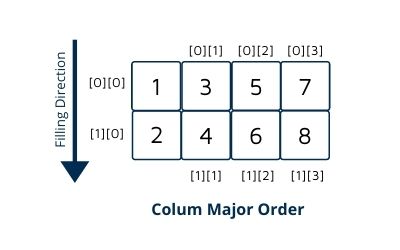
The filling sequence is first index[0][0], then index[1][0] (completing column 0), then index[0][1], then index[1][1] (completing column 1), and so on. This is the opposite of row-major order, where an entire row is filled before moving to the next.
Why Use Column-Major Order?
This storage scheme is crucial in programming and data structures because it directly impacts the performance of data access and processing.
In column-major order, elements of the same column reside in consecutive memory locations. This layout optimizes performance for algorithms that access data column-wise, which is common in scientific computing, linear algebra, and matrix operations (e.g., in languages like FORTRAN or libraries such as LAPACK).
Real-World Example
Imagine a classroom seating chart where students are listed by columns, from the front row to the back row in the first column, then the front to back of the second column, and so on. If a teacher calls on students column by column, this arrangement makes it straightforward to proceed in order.
Column-Major Order Formula
To find the memory location of an element A[i][j] in a 2D array, you can use the following formula:
LOC(A[i][j]) = base_address + w * (m * j + i)
Where:
- base_address: The memory address of the array’s first element (A[0][0]).
- w: The word size, or the number of bytes occupied by a single array element.
- m: The total number of rows in the array.
- i: The row index of the desired element (starting from 0).
- j: The column index of the desired element (starting from 0).
Note: Array indices are assumed to start from 0.
Memory Address Calculation in Column-major Order
Problem: Calculate the address of element A[1][2] in a 2×4 integer array with base address 2000 in column-major order. Assume int size is 2 bytes.
Given:
- base_address = 2000
- w = 2 bytes
- m = 2 rows
- i = 1
- j = 2
Solution:
LOC(A[1][2]) = 2000 + 2 * (2 * 2 + 1)
= 2000 + 2 * (4 + 1)
= 2000 + 2 * 5
= 2000 + 10
= 2010
Benefits of Column-major Order in Mathematics and Science
Column major order is widely used in mathematics and scientific computing because it improves performance in many numerical operations. In this memory arrangement, elements of a matrix are stored column by column. This storage pattern matches the way many mathematical algorithms process data, especially those related to linear algebra.
When a program accesses elements from the same column, it reads consecutive memory locations. This behavior works efficiently with modern CPU cache systems, resulting in faster execution and reduced memory access time. Because of this, column major order is often preferred for large scale scientific calculations.
Key Benefits of Column Major Order
- Improves performance for column based operations
- Enables faster memory access due to better cache utilization
- Reduces execution time for large matrix computations
- Works efficiently with numerical and scientific algorithms
Many important operations benefit from this storage method, including:
- Numerical simulations and scientific modeling
- Matrix multiplication
- Solving systems of linear equations
- Column wise transformations
Comparison with Row-Major Order
Row major order stores elements row by row, similar to reading text from left to right before moving to the next line. Most commonly used programming languages such as C, C++, Java, and Python use row major order by default for multidimensional arrays.
The efficiency of either approach depends on how the algorithm accesses data. If the program processes data row wise, row major order performs better. However, if the algorithm frequently accesses columns, column major order provides better performance.
When Column Major Order Works Best
- Applications using numerical libraries designed for column storage
- Algorithms that process data column wise
- Mathematical and scientific applications
- Matrix heavy computations
Choosing the Right Order
Choosing between column major and row major order depends on the data access pattern of the application. Developers should analyze whether their algorithms primarily traverse rows or columns before deciding on a storage method.
Points to Consider Before Choosing
- How the algorithm accesses data most frequently
- Size and structure of the dataset
- Performance requirements of the application
- Compatibility with existing libraries or tools
Understanding these factors helps in selecting the most efficient memory layout and ensures better performance in both mathematical and scientific applications.
Conclusion
Column-major order is a fundamental concept in computer science, essential for optimizing performance in data-intensive fields like scientific computing and numerical analysis. By aligning data storage with the pattern of data access, programmers can write faster and more efficient software. A clear understanding of both column-major and row-major ordering is a valuable tool for any developer or researcher working with multi-dimensional data structures.