Random access protocols allow many independent devices to share a single communication medium without fixed schedules. They are particularly important in wireless and satellite networks where centralized scheduling is expensive or infeasible. Among the earliest and most influential random access protocols is ALOHA, which introduced simple yet powerful ideas about how multiple users can transmit over a common channel and recover from collisions. ALOHA laid the foundation for later technologies such as Ethernet’s contention resolution and various wireless MAC protocols.
This answer explains what ALOHA is, and then discusses pure ALOHA and slotted ALOHA in depth—covering their operation, performance, advantages and disadvantages, and real-world relevance. We also provide derivations of throughput, intuitive diagrams (described textually), and step-by-step procedures that help clarify how the protocols work in practice.
What is ALOHA?
ALOHA is a family of random access protocols for shared communication channels. It was developed in the early 1970s at the University of Hawaiʻi for ALOHAnet, one of the first packet radio networks. The goal was to allow multiple users to transmit data over a common radio channel without complex coordination. The core idea is straightforward: devices transmit when they have data, listen for acknowledgments, and if a collision occurs (two or more devices transmit overlapping packets), they wait for a random time and retransmit.
ALOHA exists in two main variants:
- Pure ALOHA: Transmissions can start at any time (asynchronous).
- Slotted ALOHA: Time is divided into discrete slots, and transmissions can begin only at slot boundaries (synchronous).
Both rely on the concepts of collision detection by feedback, random backoff, and probabilistic analysis of throughput under load. They differ mainly in how they manage time to reduce collisions.
Key Concepts and Terms
- Shared Channel: A single communication medium (e.g., a radio frequency) used by multiple stations.
- Frame (or Packet): A unit of data transmitted on the channel. Frames are assumed to have a fixed length for basic analysis.
- Frame Time (Tfr): Time required to transmit one frame on the channel.
- Collision: Occurs when two or more frames overlap in time on the channel, causing corruption of all involved frames.
- Acknowledgment (ACK): A short feedback message from the receiver indicating successful frame reception. Lack of ACK implies a collision or loss.
- Offered Load (G): The average number of transmission attempts (new frames plus retransmissions) per frame time. This is a measure of traffic intensity.
- Throughput (S): The average number of successfully transmitted frames per frame time. It represents channel efficiency.
- Vulnerable Period: The time interval during which another transmission can overlap and cause a collision with a frame. Its length depends on the protocol variant.
- Random Backoff: A randomized waiting time before retransmission after a collision to reduce the chance of repeated collisions.
System Model and Assumptions
For classical ALOHA analysis, several simplifying assumptions are used:
- Frames have equal length and require a fixed frame time Tfr to send.
- Traffic is modeled as a Poisson process with rate proportional to G (attempts per frame time).
- Propagation delay is small compared to frame time (often assumed negligible for analysis).
- Stations cannot sense the channel before transmitting (no carrier sensing). They learn success/failure by receiving or not receiving an ACK.
- After a collision, each station schedules a retransmission after a random delay, independently of others.
Pure ALOHA
Pure ALOHA is the simplest variant. Stations transmit whenever they have data—without waiting for a specific time boundary. Because transmissions can start at any time, frames can overlap in many ways, which increases the probability of collision compared to slotted ALOHA.
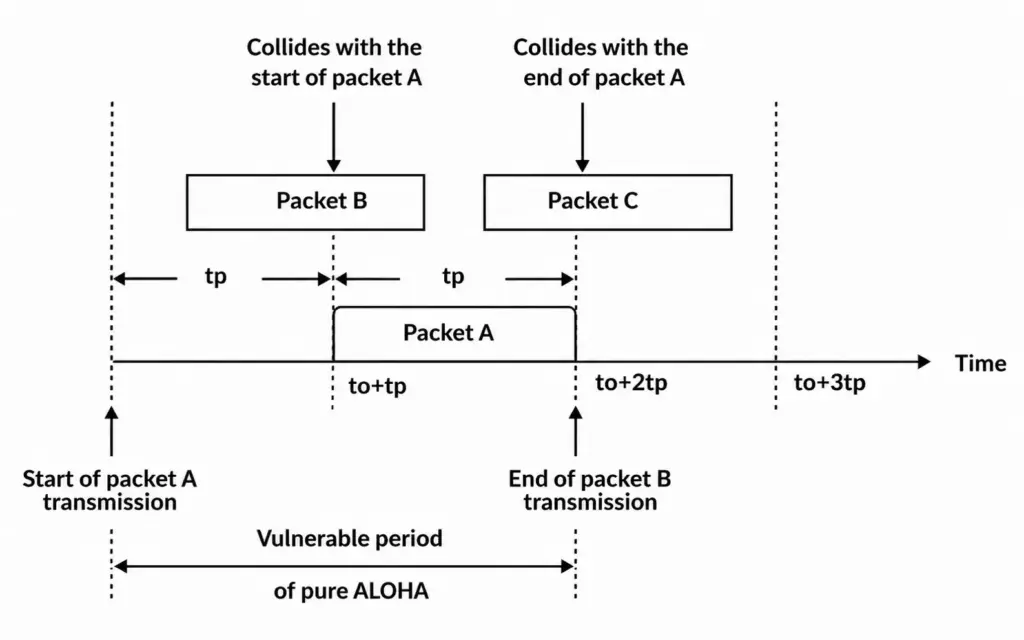
Figure: Pure ALOHA
Operation of Pure ALOHA: Step-by-Step
- Step 1: A station has a frame to send.
- Step 2: It transmits the frame immediately (no sensing, no waiting).
- Step 3: The receiving base station (or all nodes, depending on the network) broadcasts an ACK after successful reception.
- Step 4: If the sender receives an ACK within a timeout period, it concludes success.
- Step 5: If no ACK is received, the sender assumes a collision occurred. It waits a random backoff time and returns to Step 2 to retransmit.
Vulnerable Period in Pure ALOHA
Because frames can start at any time, a transmitted frame of duration Tfr is vulnerable to collision from other frames that begin up to Tfr before it starts or up to Tfr after it starts. Hence, the vulnerable period is 2Tfr.
Textual diagram: Imagine a horizontal timeline. Place the transmitting frame centered at t=0 and lasting from -Tfr/2 to +Tfr/2 for visualization. Any other frame that starts in the interval (−Tfr, +Tfr) relative to the start of this frame will overlap it. Therefore, the vulnerable window is twice the frame length.
Throughput Analysis of Pure ALOHA
We use a Poisson model for attempts. Let G be the average number of attempts per frame time. For a particular frame to succeed, no other frame attempts can occur during its vulnerable period of length 2Tfr.
- In a Poisson process, the probability of zero arrivals in time interval τ (measured in units of Tfr) is e-Gτ.
- For pure ALOHA, τ = 2 (since the vulnerable period is 2Tfr).
- Therefore, Probability of success for an arbitrary attempt = e-Gτ.
- Throughput S = G × Probability of success = Ge-Gτ frames per frame time.
Maximum throughput occurs where the derivative dS/dG = 0, which gives G = 0.5. Substituting G = 0.5, we get:
- Smax = 0.5 × e{-1} ≈ 0.184 (i.e., about 18.4% of the channel capacity).
Interpretation: Under idealized assumptions, pure ALOHA can successfully carry at most about 18% of the theoretical maximum throughput. Above G = 0.5, the system becomes increasingly unstable because collisions grow faster than successful transmissions.
Backoff and Stability in Pure ALOHA
The performance of pure ALOHA depends critically on the backoff strategy. After a collision, each station waits a random time before retrying. If this backoff is too short or poorly randomized, repeated collisions (sometimes called collision storms) can occur, reducing throughput and increasing delay.
- Simple random backoff: choose a random delay uniformly in a window, then transmit.
- Adaptive backoff: increase the backoff window after repeated collisions to reduce contention (e.g., exponential backoff). While binary exponential backoff is famous in Ethernet, ALOHA systems can also apply adaptive strategies to stabilize the channel.
- Stability: For loads well below the optimal G=0.5, throughput is modest and delay is low. As load increases toward and beyond 0.5, backlog and delay rise sharply, and the system may become unstable without proper backoff control.
Example Scenario for Pure ALOHA
Consider three sensor nodes sharing a satellite uplink. Each sends a fixed-size frame occasionally. Suppose over many frame times the total attempt rate is G = 0.4. The success probability of each attempt is e{-2 × 0.4} ≈ e{-0.8} ≈ 0.449. The throughput per frame time is S = 0.4 × 0.449 ≈ 0.18 frames/frame-time. If the designer wants higher throughput, pure ALOHA will struggle beyond these levels; improvements may require slotted ALOHA or more sophisticated contention resolution.
Advantages and Disadvantages of Pure ALOHA
- Advantages:
- Very simple: transmit immediately when needed.
- No synchronization required among stations.
- Works in decentralized and long-delay environments (e.g., satellite links).
- Disadvantages:
- Low maximum throughput (≈18%).
- High probability of collisions at moderate loads.
- Delay can become large and unstable under heavy load.
- Inefficient use of the channel because frames can overlap arbitrarily.
Slotted ALOHA
Slotted ALOHA improves on pure ALOHA by dividing time into discrete slots of duration equal to one frame time (Tfr). Stations may only begin transmission at the start of a slot. This simple change halves the vulnerable period and nearly doubles the maximum throughput.
Operation of Slotted ALOHA: Step-by-Step
- Step 1: All stations are synchronized to a global time slot clock (e.g., via beaconing or network timing signals).
- Step 2: When a station has a frame, it waits until the next slot boundary, then transmits the entire frame in that slot.
- Step 3: The receiver sends an ACK after receiving a frame successfully, typically at the end or immediately after the slot.
- Step 4: If an ACK is not received, the station infers a collision and schedules a retransmission after a random number of slots (random backoff) and repeats from Step 2.
Vulnerable Period in Slotted ALOHA
Because transmissions can begin only at slot boundaries and all frames have the same duration, the only way two frames can collide is if they start in the same slot. Hence, the vulnerable period is one slot, i.e., Tfr
Throughput Analysis of Slotted ALOHA
Using the same Poisson model, let G be the average number of attempts per slot (which equals per frame time). A transmission attempt succeeds if and only if it is the only attempt in its slot.
- Probability that exactly one attempt occurs in a slot with Poisson rate G is G e{-G} (derived from P{1} = G e{-G}).
- Equivalently, conditional on a given attempt, the probability that no other attempts occur in its slot is e{-G}, so success probability = e{-G} and throughput S = G e{-G}
Maximum throughput occurs at G = 1, giving:
- Smax = 1 × e{-1} ≈ 0.368 (i.e., about 36.8% of channel capacity).
Interpretation: Slotted ALOHA approximately doubles the best-case throughput compared to pure ALOHA. It achieves this by aligning transmissions to slots, which reduces the vulnerable period by half.
Synchronization and Practical Considerations
- Global synchronization is required so all stations agree on slot boundaries. This can be achieved with beacons from a base station, GPS timing, or periodic broadcasts.
- Propagation delay complicates slotting. If propagation times are non-negligible compared to Tfr, guards (small gaps) may be inserted to prevent partial overlaps, slightly reducing efficiency.
- Random backoff is typically measured in slots (e.g., retransmit after a random number of slots from a given range).
Example Scenario for Slotted ALOHA
Suppose a set of smart meters upload readings over a slotted ALOHA channel. The aggregate attempt rate is G = 0.8 attempts per slot. The chance that exactly one transmission occupies a slot is S = 0.8 × e{-0.8} ≈ 0.8 × 0.449 ≈ 0.359 frames per slot, close to the theoretical maximum. If the system becomes busier (G > 1), throughput begins to decrease because more slots contain multiple attempts.
Comparing Pure ALOHA and Slotted ALOHA
- Timing:
- Pure ALOHA: Asynchronous; frames start at any time.
- Slotted ALOHA: Synchronous; frames start only at slot boundaries.
- Vulnerable Period:
- Pure ALOHA: 2Tfr.
- Slotted ALOHA: Tfr.
- Maximum Throughput:
- Pure ALOHA: Smax ≈ 0.184 at G = 0.5.
- Slotted ALOHA: Smax ≈ 0.368 at G = 1.
- Complexity:
- Pure ALOHA: Simple; no synchronization overhead.
- Slotted ALOHA: Requires synchronization and possibly guard times.
- Delay and Stability:
- Pure ALOHA: More prone to instability under higher loads; higher delays.
- Slotted ALOHA: Better delay characteristics near optimal G; more stable up to higher loads.
- Implementation Environments:
- Pure ALOHA: Suited for very simple, low-duty-cycle systems and long-delay channels where synchronization is hard.
- Slotted ALOHA: Suited for systems with a coordinator (base station) that can provide timing, such as satellite random access channels and RFID anti-collision protocols.
Derivations: Why the Throughput Formulas Hold
Here is a concise step-by-step derivation for both protocols using the Poisson model.
- Assume attempts follow a Poisson process with rate G attempts per frame time.
- Property: For Poisson(λ), the probability of k arrivals in interval τ is ((λτ)k.e{-λτ}) / k! .
Pure ALOHA:
- A given attempt succeeds if there are zero other attempts in its vulnerable period of length 2Tfr.
- Number of other attempts in 2Tfr is Poisson with mean 2G (since G per Tfr).
- P(success) = P{0 in 2Tfr} = e{-2G}.
- Throughput S = G ×e{-2G} (attempts multiplied by success probability).
- Optimize S by dS/dG = 0 → (1 − 2G) e{-2G} = 0 → G = 0.5.
- Smax = 0.5 × e{-1} ≈ 0.184.
Slotted ALOHA:
- Attempts are made only at slot boundaries; the number of attempts per slot is Poisson with mean G.
- A success occurs if exactly one attempt occurs in a slot.
- P{1 in a slot} = G e{-G}. Hence S = G e{-G}.
- Optimize: dS/dG = e e{-G} (1 − G) = 0 → G = 1.
- Smax = 1 × e{-1} ≈ 0.368.
Algorithmic Pseudocode for Node Behavior
Below is a conceptual step-by-step algorithm for a node using ALOHA (applies to both variants; slot alignment step is relevant for slotted).
- When a packet arrives from upper layers:
- If slotted ALOHA: Wait until next slot boundary.
- Transmit the frame.
- Start a timer waiting for ACK (timeout covers round-trip plus processing).
- If ACK is received before timeout:
- Declare success; remove packet from queue.
- If ACK is not received (collision or loss):
- Compute a random backoff:
- Pure ALOHA: Random delay measured in frame times.
- Slotted ALOHA: Random number of slots to skip.
- Wait for the backoff interval.
- Repeat the transmission procedure.
- Compute a random backoff:
- Optionally, adapt the backoff window after repeated failures to reduce congestion.
Effects of Propagation Delay and Non-Idealities
- Propagation Delay:
- In pure ALOHA, if propagation delay is not negligible, the vulnerable period slightly exceeds 2Tfr because transmissions can begin during propagation and still overlap at receivers.
- In slotted ALOHA, guard intervals may be required to accommodate propagation and clock jitter; this effectively lengthens slots and can reduce throughput.
- Variable-Length Frames:
- ALOHA analyses assume fixed-length frames; variable lengths complicate collision probability and may call for normalization to a unit frame time or padding to fixed sizes.
- Capture Effect:
- In some radios, a strong signal can be decoded despite interference (capture). This can improve practical throughput compared to ideal analysis but may impact fairness.
- Error Channels:
- Noise-induced errors can mimic collisions when no ACK arrives. Robust acknowledgment and coding are used to differentiate and mitigate such losses.
Real-World Applications and Variants
- ALOHAnet:
- The original system connecting terminals on Oʻahu and other islands via a packet radio relay and satellite links. Demonstrated feasibility of random access in wireless networks.
- Satellite Random Access:
- Slotted ALOHA is widely used for initial access or contention-based channels in satellite systems where carrier sensing is impractical due to long delays.
- RFID Anti-Collision:
- Framed Slotted ALOHA is a common method in passive RFID systems. A reader defines a frame with multiple slots; tags randomly pick a slot to respond, reducing collisions.
- IoT and Low-Power Wide-Area Networks:
- Some LoRaWAN deployments use ALOHA-like access, particularly pure ALOHA behavior at low duty cycles. System design relies on sparse traffic to keep collision rates acceptable.
- Cellular Random Access:
- GSM and other cellular systems use slotted random access on control channels (with additional mechanisms like preambles and power ramping), conceptually similar to slotted ALOHA.
Advantages and Disadvantages: Slotted vs. Pure
- Slotted ALOHA Advantages:
- Higher maximum throughput (~36.8%).
- Simpler collision analysis and better stability under moderate load.
- Slotted ALOHA Disadvantages:
- Requires timing synchronization and slot management.
- Potential overhead for guard times and beacons.
- Pure ALOHA Advantages:
- Absolute simplicity, no synchronization.
- Appropriate where traffic is very light and sporadic or synchronization is too costly.
- Pure ALOHA Disadvantages:
- Lower efficiency and more collisions.
- Greater susceptibility to instability with increasing load.
Design Tips and Practical Trade-offs
- Choose Pure or Slotted:
- Pick pure ALOHA for extremely simple, low-cost devices with rare transmissions and no available sync source.
- Pick slotted ALOHA when a coordinator can provide timing and the system needs better throughput and predictability.
- Backoff Strategy:
- Use randomized backoff intervals; consider increasing backoff windows after collisions to avoid repeated overlaps.
- Dimensioning Load:
- Keep offered load near the throughput-optimal region (G ≈ 0.5 for pure, G ≈ 1 for slotted), but with safety margins for burstiness and non-idealities.
- Feedback and ACKs:
- Reliable and timely ACKs are crucial; timeouts should reflect channel delays. In satellite, longer timeouts are needed due to large RTTs.
- Guard Intervals and Synchronization:
- In slotted ALOHA, design slot duration to accommodate maximum propagation and clock drift, possibly adding a small guard time.
Common Misconceptions and Clarifications
- ALOHA vs. CSMA:
- Carrier Sense Multiple Access (CSMA) protocols listen to the channel before transmitting to reduce collisions. ALOHA does not sense; it simply transmits and then reacts to collisions via backoff.
- Collision Detection:
- Classic ALOHA does not perform collision detection during transmission; it infers success from ACKs. Collision detection on radio links is difficult because a transmitter’s own signal masks incoming signals.
- Throughput Limits:
- The 18.4% and 36.8% maxima assume idealized Poisson traffic, fixed frame lengths, and no capture or coding gains. Real systems may vary due to hardware, propagation, and protocol enhancements.
Worked Example: Selecting a Protocol for an IoT Deployment
Suppose you are designing a rural sensor network with 1000 soil moisture sensors reporting infrequently (once every few minutes) to a base station over a single frequency channel. The base station can broadcast beacons for synchronization. You estimate that, even at peak times, the aggregate offered load is around G = 0.6 frames per frame time if transmissions are aligned to slots.
- With pure ALOHA: S ≈ 0.6 × e{-1.2} ≈ 0.6 × 0.301 ≈ 0.181 frames/frame-time. Collisions will waste many transmissions.
- With slotted ALOHA: S ≈ 0.6 × e{-0.6} ≈ 0.6 × 0.549 ≈ 0.329 frames/frame-time. Throughput is nearly doubled and closer to theoretical best.
Given that synchronization is possible via the base station, slotted ALOHA is clearly superior here. You would also choose an adaptive backoff to cope with occasional bursts when many sensors transmit simultaneously (e.g., after a rain event).
Conclusion
ALOHA introduced the fundamental idea that users in a shared channel can transmit opportunistically and rely on feedback plus randomized retransmissions to resolve collisions. The two principal variants—pure ALOHA and slotted ALOHA—differ in how they manage time and consequently in their performance.
- Pure ALOHA:
- Asynchronous transmission; frames can start any time.
- Vulnerable period: 2Tfr; throughput S = G e{-2G}; maximum ≈ 18.4% at G = 0.5.
- Simple and unsynchronized but collision-prone and less efficient.
- Slotted ALOHA:
- Synchronized transmission; frames start only at slot boundaries.
- Vulnerable period: Tfr; throughput S = G e{-G}; maximum ≈ 36.8% at G = 1.
- Requires timing support but almost doubles maximum throughput and improves stability.
Both protocols remain relevant, especially in wireless and satellite contexts. Slotted ALOHA is favored when synchronization is available, as in satellite random access and RFID systems, while pure ALOHA can be acceptable for very low-duty-cycle or unsynchronized environments. Understanding their operation, collision dynamics, and throughput characteristics helps network designers choose proper parameters, anticipate performance, and build more efficient medium access solutions.
In sum, ALOHA’s elegance lies in its simplicity and its probabilistic approach to contention. Pure ALOHA demonstrates the feasibility of random access, while slotted ALOHA shows how modest structure—time slotting—delivers large efficiency gains. These insights continue to influence modern MAC protocols and demonstrate the enduring value of the ALOHA family in network design.