Graph traversal is a way to visit all the nodes (vertices) in a graph. It helps us determine the order in which the nodes are visited. Traversal starts from a chosen node and moves to other connected nodes without repeating unnecessarily. Graph traversal is a basic operation used in many real-life applications, such as web crawling, social network analysis, and finding the shortest path.
Unlike trees, graphs can have cycles, which means it’s possible to revisit the same node multiple times. If we don’t keep track of which nodes have already been visited, the traversal could get stuck in an infinite loop. To prevent this, we maintain a record of visited nodes. Each vertex is marked as visited once we reach it, ensuring we do not visit it again during the same traversal. This way, the traversal can safely explore all nodes in the graph without looping endlessly.
Why is Graph Traversal Important?
Graph traversal helps in:
- Visiting each node of a graph exactly once.
- Searching for a specific node or path.
- Finding connected components.
- Detecting cycles in a graph.
- Solving problems like shortest path, minimum spanning tree, etc.
Types of Graph Traversal Techniques
There are two primary graph traversal techniques:
- Breadth-first search (BFS)
- Depth-first search (DFS)
1. Breadth-first search (BFS)
BFS is a graph traversal technique where we explore all the neighboring nodes (breadth) before moving to the next level neighbors. It uses a Queue data structure as an auxiliary data structure to keep track of nodes to be explored next. The size of the queue will be the maximum total number of vertices in the graph.
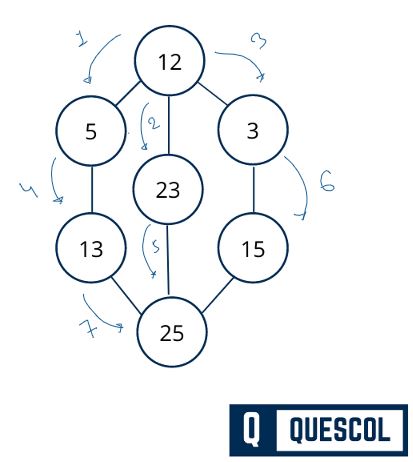
How BFS Works:
- Start from a selected node (called the source).
- Mark it as visited and add it to a queue.
- While the queue is not empty:
- Dequeue a node.
- Visit all of its unvisited adjacent nodes.
- Mark them as visited and enqueue them.
Time and Space Complexity of BFS:
- Time Complexity: O(V + E)
- Space Complexity: O(V) for queue and visited array
Read More in detail : Breadth first search graph traversal method
Depth-first search (DFS)
DFS stands for Depth First Search is a traversal technique that explores as far as possible along each branch before backtracking. It uses a Stack (either implicitly through recursion or explicitly). In DFS Traversal go as deep as possible of the graph and then backtrack once reached a vertex that has all its adjacent vertices already visited.
Depth First Search (DFS) algorithm traverses a graph in a depthward motion and uses a stack data structure to remember to get the next vertex to start a search when a dead end occurs in any iteration.
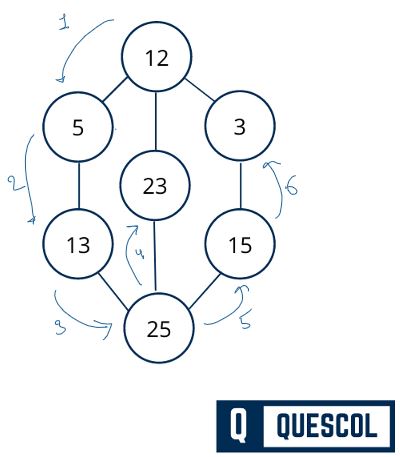
DFS traversal for tree and graph is similar but the only difference is that a graph can have a cycle but the tree does not have any cycle. So in the graph we have additional array which keeps the record of visited array to protect from infinite loop and not visit again the visited node.
How DFS Works:
- Start from a source node.
- Mark it as visited.
- Visit an unvisited neighbor recursively until all are visited.
- If a dead-end is reached, backtrack and explore other neighbors.
Read More In Detail : Depth First Search graph traversal method
BFS vs DFS: Key Differences
| Feature | BFS | DFS |
|---|---|---|
| Data Structure Used | Queue | Stack |
| Traversal Approach | Level-wise (breadth) | Depth-wise (backtracking) |
| Memory Usage | Higher for wide graphs | Higher for deep graphs |
| Shortest Path | Yes (for unweighted graphs) | No |
| Implementation | Iterative | Usually recursive |
| Used In | GPS, social networks | Puzzle games, topological sort |
Handling Cycles in Graphs
Since graphs can contain cycles, we need to track visited nodes using an array or set to avoid revisiting and infinite loops.
boolean[] visited = new boolean[numberOfVertices];Before visiting any node, we always check:
if (!visited[node]) {
    // visit node
}
Real-Life Applications of Graph Traversal
- Breadth-First Search (BFS):
- Shortest path in unweighted graphs
- Social networking sites (finding connections)
- Crawlers in search engines
- Depth-First Search (DFS):
- Solving puzzles like Sudoku
- Detecting cycles in a graph
- Topological sorting in a DAG (Directed Acyclic Graph)
Pro Tips for Exam and Interview Preparation
- Practice implementing BFS and DFS in both adjacency list and adjacency matrix formats.
- Be ready to solve problems like:
- Find connected components
- Detect cycles
- Maze solving using DFS/BFS
Conclusion
Understanding graph traversal techniques is essential for any data structures and algorithms enthusiast. BFS and DFS may appear simple but they are used in solving some of the most complex real-world problems. Whether you are preparing for coding interviews or building real-life applications, mastering these traversal methods is a must.
FAQs – Graph Traversal Techniques
Q1. What is the difference between DFS and BFS in terms of data structures?
DFS uses a Stack (or recursion), while BFS uses a Queue.
Q2. Can BFS and DFS be used in directed graphs?
Yes, both can be applied to directed and undirected graphs.
Q3. Which graph traversal is better?
It depends on the use-case. Use BFS for shortest paths and DFS for deep traversal or cycle detection.
Q4. What if the graph is disconnected?
You need to loop through all vertices and run BFS/DFS on unvisited ones to cover the entire graph.