
Currently Empty: ₹0.00

Optimality means finding the best and most efficient solution to a problem using the least time or resources, like Dijkstra’s algorithm for the shortest path. Reduction means converting one problem into another so that solving the new one helps solve the original, like reducing the traveling salesman problem to a shortest path problem.
Quescol 1-Minute Read
Optimality and Reduction are two important ideas in algorithm design. Optimality means finding the best and fastest way to solve a problem using the least time and memory. Reduction means changing one problem into another that is easier to solve. These ideas help in making algorithms better and in understanding how hard or easy a problem is.
Optimality and Reduction Of Algorithm important Points:
- They are important for solving and studying complex problems.
- Optimality finds the most efficient solution.
- Reduction changes a hard problem into an easier one.
- Both help in designing smart and faster algorithms.
Let’s Understand in Depth
What is Optimality?
In the context of algorithms, Optimality measures whether an algorithm is optimal or not for the provided problem. This is calculated in terms of time and space complexity. In another way, we can say that an algorithm for a given problem is optimal if its complexity reaches the lower bound over all the algorithms that are solving this problem.
For example,
Suppose there is an algorithm that is solving the problem “the intersection of n segments”. The solution for this problem will execute at least n2 operations in the worst case even if it does nothing but print the output. So if the problem runs for n2 times then in the worst case its complexity will be O(n2).
If we find an algorithm that solves this similar problem in less time i.e. in Omega(n)2, then we can say this one is optimal with complexity omega n2.
Optimality is categorized into two types
a. Time Optimality:
- An algorithm can be considered time-optimal if it solves a problem in the minimum possible time.
- It ensures that no other algorithm can solve this problem in lesser time.
- For example, let’s consider comparison-based sorting algorithms, such as Quicksort and Merge Sort. It’s time complexity is O(n log n), which means no other algo sort the array in lesser time and faster than Quicksort and Merge Sort. So Quicksort and Merge Sort sorting algo for this specific problem are optimal in terms of time.
b. Space Optimality:
- An algorithm is considered space-optimal if it uses the minimum possible amount of memory or space to solve a problem.
- Space optimality deals with memory size. This space could be anything like large input sizes or limited memory resources.
- For example, Suppose we have a problem to find the maximum element in an array. A space-optimal algorithm will be those that will not store the entire array. But It would keep track of the current maximum element while traversing the array, using only a constant amount of space.
What is Reduction?
Reduction is a process of converting an original problem to another problem that is known or solvable or has already solved solution. We choose this approach when the given problem is difficult to solve directly. But by reducing the complex problem into an easier solvable problem, that can be solved effectively.
Also, It can be used to prove that some problems are unsolvable if they can be reduced to a problem that has not been yet solved.
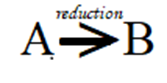
Here A is reduced to B and if B is solvable then A will also be solvable.
For Example,
As we know that a graph problem is solvable. So if any complex problem that can be transformed into a graph problem then that problem is also solvable.
A reduction is a powerful tool that allows us to utilize existing algorithms or problem-solving techniques to solve new or complex problems. With the help of this concept, we can reuse previous solutions to solve and develop of efficient algorithms.
Reduction can be performed in two directions:
a. Reduction from problem A to problem B :
- This means that an instance of problem A can be transformed into an instance of problem B.
- Here solving problem B will provide the solution to problem A.
- For Example, the Traveling Salesman Problem (TSP) can be reduced to the Hamiltonian Cycle Problem (HCP). And If we find a Hamiltonian cycle in the graph we can also find the optimal solution for the TSP.
b. Reduction from problem B to problem A:
- This means that an instance of problem B can be transformed into an instance of problem A.
- Here solving problem A will provide the solution to problem B.
- For Example, the Minimum Spanning Tree (MST) problem can be reduced to the Shortest Path Problem (SPP). Where finding the shortest path in a weighted graph implies finding the minimum spanning tree.
Real-World Use of Reduction
- Simplifies Complex Problems:
Reduction helps convert a difficult or unknown problem into another problem that is already solved or easier to handle. - Saves Time and Effort:
Instead of designing a new solution from scratch, reduction allows us to reuse existing algorithms for similar problems. - Proves Problem Complexity:
It is used to show how hard a problem is. For example, if a new problem can be reduced to a known NP-Complete problem, then it is also NP-Complete. - Helps in Algorithm Comparison:
Reduction allows us to compare two problems and understand which one is harder or if they are equally difficult. - Used in Optimization Problems:
Many optimization problems, like shortest path or scheduling, can be solved using reduction by transforming them into a standard problem type. - Foundation for Computational Theory:
Reduction forms the base of computational complexity theory, helping classify problems into groups like P, NP, NP-Complete, and NP-Hard. - Used in Machine Learning and AI:
Complex AI tasks can be reduced to simpler mathematical or optimization problems for efficient model training. - Useful in Software Development:
Developers use reduction to break big tasks into smaller, manageable problems that are easier to solve and test. - Helps in Decision-Making Problems:
In decision problems, reduction helps determine whether a solution exists by relating it to another decision problem with a known answer. - Supports Proof by Transformation:
Reduction is often used in proofs to show that solving one problem automatically provides a solution for another related problem.
Real-World Use of Optimality
- Used in Route Planning:
In navigation apps like Google Maps, optimality helps find the shortest or fastest route between locations using algorithms like Dijkstra or A*. - Applied in Resource Management:
Companies use optimal algorithms to minimize costs and maximize profit, such as deciding how to distribute products or schedule workers. - Used in Network Design:
Optimality ensures that computer networks are built with minimum cables and maximum efficiency, using algorithms like Minimum Spanning Tree. - Improves Search and Sorting:
In computer programs, optimal algorithms like QuickSort or Binary Search help sort and find data faster, saving both time and memory. - Used in Machine Learning:
Optimality is used during model training to minimize errors or loss functions, helping AI systems make better predictions. - Applied in Project Scheduling:
Tools like PERT and CPM use optimal algorithms to find the minimum time required to complete a project efficiently. - Used in Finance and Investment:
Optimization helps find the best investment strategy with maximum returns and minimum risks through mathematical modeling. - Used in Transportation Systems:
Optimal algorithms plan bus routes, flight paths, or delivery schedules to reduce fuel consumption and travel time. - Helps in Data Compression:
Algorithms like Huffman Coding achieve optimal data storage by using fewer bits to store frequent data efficiently. - Supports Decision-Making:
Optimality helps choose the best possible solution among many options, ensuring smart and balanced decisions in business, science, and technology.