The decision process refers to the systematic approach of selecting the best solution from different alternatives in a software project. It helps project managers make correct and timely decisions based on available information. Moreover, it supports planning, problem-solving, and risk management in software development. Therefore, the decision process plays an important role in successful project management.
It helps managers choose the best option for project execution and problem-solving. First, it identifies the problem and available alternatives. Next, it evaluates each option based on cost, time, and quality. Moreover, it selects the most suitable solution for the project. Therefore, it improves project performance and decision-making.
For example, a software company needs to choose between two programming languages for developing a mobile application. The project manager compares cost, development time, and performance of both languages. Moreover, the manager selects the language that meets project requirements. Therefore, the decision process helps in choosing the best option.
What is Decision Process?
The decision process is a systematic approach used to identify a problem, analyze possible alternatives, and select the best solution to achieve desired objectives in a project or organization. It helps managers and team members make logical and informed choices based on available information, resources, and project requirements. Moreover, the decision process ensures that actions are planned carefully and risks are minimized. Therefore, the decision process plays an important role in effective software project management and organizational success.
Objectives of Decision Process
The objectives of the decision process focus on selecting the best possible solution for a problem or situation in a structured and logical manner. It helps managers and team members make informed choices by analyzing available alternatives and evaluating their outcomes. Moreover, the decision process reduces uncertainty and improves the quality of decisions in software projects and organizations. Therefore, the main objective of the decision process is to support effective planning and successful project execution.
The decision process also helps in achieving organizational goals, managing resources efficiently, and solving project-related problems. It supports better coordination, risk management, and strategic planning. Moreover, it improves project performance and productivity. Therefore, the objectives of the decision process ensure proper management and decision-making in software development and business environments.
Following are the objectives of Decision Process:-
1. Problem Identification
The decision process helps in identifying problems and understanding their causes clearly. Moreover, it ensures that the correct issue is addressed. This improves the quality of decisions. Therefore, it supports effective problem-solving.
2. Selecting the Best Alternative
It helps in evaluating different alternatives and choosing the most suitable solution. Moreover, proper analysis improves decision accuracy. This leads to better project outcomes. Therefore, it ensures the best possible choice.
3. Improving Decision Quality
The decision process aims to improve the quality of decisions through logical analysis and proper planning. Moreover, it reduces errors and uncertainty. This increases project success. Therefore, it supports better decision-making.
4. Efficient Resource Utilization
It helps in using resources such as time, money, and manpower effectively. Moreover, proper decisions reduce wastage of resources. This improves productivity. Therefore, it ensures efficient resource management.
5. Risk Reduction
The decision process helps in identifying and managing risks before taking action. Moreover, it supports safe and secure project planning. This reduces project failure. Therefore, it improves risk control.
6. Achieving Organizational Goals
It supports achieving project and organizational objectives through proper planning and decision-making. Moreover, it aligns decisions with business goals. This improves overall performance. Therefore, it ensures goal achievement.
7. Supporting Project Management
The decision process helps managers plan, monitor, and control project activities effectively. Moreover, it improves coordination and communication. This leads to better project management. Therefore, it supports successful project execution.
Characteristics of Decision Process
1. Logical and Systematic
The decision process follows a logical and systematic approach to solve problems. Moreover, it involves step-by-step analysis. This improves decision accuracy. Therefore, it ensures structured decision-making.
2. Goal-Oriented
It focuses on achieving specific project or organizational goals. Moreover, decisions are taken based on objectives. This improves project performance. Therefore, it is goal-oriented.
3. Based on Information and Data
The decision process uses available data and information for analysis. Moreover, accurate information improves decision quality. This reduces uncertainty. Therefore, it is data-driven.
4. Involves Alternatives
It considers different possible solutions before selecting the best one. Moreover, analyzing alternatives improves results. This leads to better outcomes. Therefore, it involves multiple options.
5. Continuous Process
The decision process is continuous and repeated in every stage of the project. Moreover, decisions are required at different levels. This improves project control. Therefore, it is an ongoing process.
6. Involves Risk and Uncertainty
Every decision involves some level of risk and uncertainty. Moreover, proper analysis helps reduce these risks. This improves project stability. Therefore, it supports risk management.
7. Requires Managerial Judgment
The decision process depends on the experience and judgment of managers. Moreover, proper judgment improves decision quality. This leads to effective project management. Therefore, it requires skilled decision-makers.
Diagram of Key Stages in Decision Process
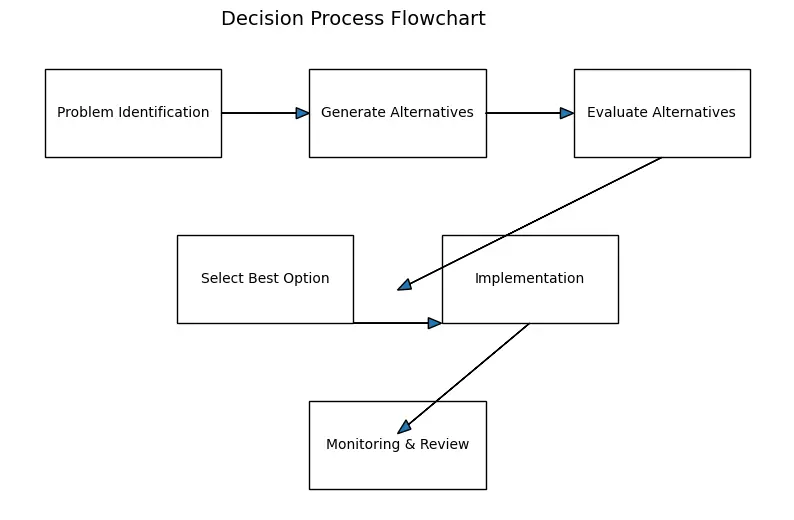
Figure: Stages in Decision Process
Following are the explanation of the key stages in Decision Process:-
1. Problem Identification
The first step is to identify the problem or situation in the project. Moreover, understanding the problem helps in finding possible solutions. It also ensures clear decision-making. Therefore, problem identification is essential in the decision process.
For example, a project is delayed due to a lack of developers. The manager identifies the shortage of team members as the main problem. Moreover, this helps in planning solutions like hiring or outsourcing. Therefore, the problem becomes clear for decision-making.
2. Generating Alternatives
The next step is to identify different possible solutions. Moreover, multiple alternatives provide better decision options. It also improves planning and flexibility. Therefore, generating alternatives helps in selecting the best solution.
For example, the manager considers hiring new developers, outsourcing work, or extending deadlines. Each option has different benefits and costs. Moreover, this helps in comparing solutions. Therefore, alternatives improve decision quality.
3. Evaluating Alternatives
In this step, all alternatives are analyzed based on cost, time, and quality. Moreover, evaluation helps in understanding advantages and risks of each option. It also supports logical decision-making. Therefore, proper evaluation leads to better project outcomes.
For example, hiring developers increases cost, outsourcing saves time, and deadline extension affects delivery. The manager compares these options carefully. Moreover, evaluation helps in selecting the best option. Therefore, the project can move forward smoothly.
4. Selecting the Best Alternative
The manager selects the most suitable solution based on evaluation. Moreover, this step ensures effective decision-making. It also improves project performance. Therefore, selecting the best alternative is the key step in the decision process.
For example, the manager chooses outsourcing to complete work on time. This reduces project delay and maintains quality. Moreover, the decision supports project completion. Therefore, the best alternative is selected.
5. Implementation of Decision
The selected decision is implemented in the project. Moreover, proper implementation ensures successful results. It also helps in achieving project objectives. Therefore, implementation is necessary.
For example, the company hires an outsourcing team and assigns project tasks. The team starts working immediately. Moreover, this helps in completing the project on time. Therefore, implementation ensures success.
6. Monitoring and Review
The final step is monitoring the decision and reviewing results. Moreover, monitoring helps in tracking project progress. It also ensures improvements if needed. Therefore, monitoring and review improve decision effectiveness.
For example, the manager checks outsourcing team performance regularly. If issues occur, corrective actions are taken. Moreover, monitoring ensures project quality and timely delivery. Therefore, the decision process becomes successful.
Advantages of Decision Process
1. Improves Decision Quality
The decision process helps in making logical and informed decisions. Moreover, proper analysis reduces errors. This improves project outcomes. Therefore, decision quality increases.
2. Reduces Risks and Uncertainty
It helps in identifying risks and planning solutions. Moreover, careful analysis reduces uncertainty. This improves project stability. Therefore, risks are minimized.
3. Supports Better Planning
The decision process helps in planning project activities effectively. Moreover, structured decisions improve management. This ensures smooth execution. Therefore, planning becomes easier.
4. Efficient Resource Utilization
It ensures proper use of time, money, and manpower. Moreover, resources are used efficiently. This improves productivity. Therefore, resource management improves.
5. Improves Coordination and Communication
The decision process encourages teamwork and discussion. Moreover, proper communication improves coordination. This leads to better project performance. Therefore, teamwork improves.
6. Enhances Project Control
It helps managers monitor project activities and performance. Moreover, control becomes easier. This improves project management. Therefore, project control increases.
7. Supports Organizational Growth
Better decisions lead to better project results and organizational success. Moreover, it improves productivity and performance. Therefore, it supports growth.
Disadvantages of Decision Process
1. Time-Consuming
The decision process involves data collection and analysis. Moreover, this takes time. This may delay project activities. Therefore, it can be time-consuming.
2. Requires Skilled Managers
Proper decision-making needs experienced and skilled professionals. Moreover, lack of expertise can affect results. This reduces decision quality. Therefore, skilled managers are required.
3. High Cost of Analysis
Collecting data and analyzing alternatives may increase project cost. Moreover, research and tools require investment. This affects budget. Therefore, it can be costly.
4. Risk of Wrong Decisions
Incorrect data or poor judgment can lead to wrong decisions. Moreover, this may affect project success. Therefore, careful analysis is needed.
5. Complex Process
The decision process involves multiple steps and analysis. Moreover, this makes it complex. Therefore, implementation becomes difficult.
6. Uncertainty in Outcomes
Even after proper analysis, results may not be guaranteed. Moreover, unexpected changes can occur. Therefore, uncertainty remains.
7. Resistance to Change
Team members may resist new decisions or changes. Moreover, this can affect implementation. Therefore, managing change becomes difficult.
Applications of Decision Process
1. Software Project Management
The decision process is used in planning, scheduling, and resource allocation in software projects. Moreover, it helps in solving project-related problems. Therefore, it supports project management.
2. Business and Organizational Management
Organizations use the decision process for strategic planning and operations. Moreover, it improves business performance. Therefore, it is widely used in management.
3. IT and System Development
The decision process helps in selecting technologies, tools, and development methods. Moreover, it supports system development planning. Therefore, it is useful in IT projects.
4. Financial and Budget Planning
It helps in making financial and investment decisions. Moreover, it supports cost control and budgeting. Therefore, it is useful in finance.
5. Risk Management
The decision process is used to identify and manage project risks. Moreover, it helps in preparing preventive measures. Therefore, it improves safety and stability.
6. Resource and Team Management
It helps in assigning tasks and managing team members effectively. Moreover, it improves coordination. Therefore, it supports resource management.
7. Strategic Planning and Policy Making
The decision process is used in planning policies and strategies. Moreover, it supports long-term planning. Therefore, it is useful in strategic management.
Conclusion
The decision process is an essential part of software project management and organizational management because it helps in selecting the best solution through a logical and systematic approach. It supports problem identification, analysis of alternatives, and effective implementation of decisions to achieve project and organizational goals. Moreover, the decision process improves planning, resource utilization, risk management, and overall project performance.
Although the decision process may be time-consuming and requires skilled professionals, its advantages in improving decision quality and reducing uncertainty make it highly valuable. It ensures better coordination, efficient management, and successful project execution. Therefore, the decision process plays a crucial role in achieving effective management and long-term organizational success.