
Currently Empty: ₹0.00

Multiprogramming OS: Definition, Advantages, and Disadvantages
Updated on August 11, 2025
Multiprogramming is a widely used idea in operating systems that allows multiple programs to stay in memory and run at the same time.
The primary objective is to make the most of CPU utilization by scheduling jobs(program) in a way that the CPU is always busy . In a single- tasking system , the CPU remains idle during times when a program is waiting for input/output(I/O) to complete But in a Multiprogramming System ,One Program can take over the CPU while the other is waiting. This not only guarantees uninterrupted processing but also enhances System efficiency .
What is Multi-Programming Operating System?
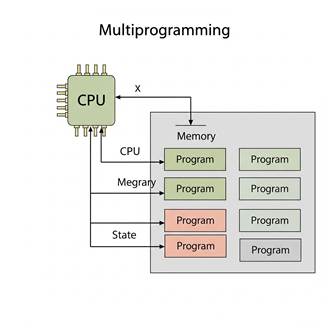
Multi-programming is a type of operating system capability where multiple programs are kept in memory at the same time, and the CPU executes them one by one based on scheduling.
Definition:
Multi-programming is a technique in which two or more programs are loaded into main memory and the operating system manages their execution by switching the CPU between them to maximize resource utilization and minimize CPU idle time.
Key Points:
- Only one program runs on the CPU at a time.
- While one program is waiting for I/O (e.g., reading from disk), the CPU is assigned to another ready program.
- Increases CPU utilization and system throughput.
- Requires memory management, CPU scheduling, and job scheduling by the OS.
Example of Multiprogramming:
Imagine 3 programs:
- Program A: waiting for disk
- Program B: doing computation
- Program C: waiting for printer
The CPU can work on Program B while A and C are waiting — this way, the CPU is never idle.
Key Features of Multiprogramming
- Concurrent Program Execution: Multiple programs are loaded into memory and executed in a sequential controlled manner one after another.
- Efficient CPU Utilization: The CPU is never left idle, as it always has a task to carry out.
- Job Scheduling: A job scheduler decides which program gets the CPU and when depending on priority or resource needs.
- Memory Management: Suitable memory allocation methods are the key to efficiently running several tasks simultaneously.
- Context Switching: The system changes between tasks in order to ensure balanced resource utilization and quick response time.
Advantages of Multiprogramming
- Increased CPU Utilization: The CPU stays busy by switching between jobs, ensuring high performance.
- Better Throughput: More jobs are completed in a specific time frame, increasing system productivity.
- Efficient Resource Use: The CPU and I/O devices are utilized efficiently, thereby minimizing the idle time.-
- Supports Multiple Users: Multiprogramming facilitates the running of multiple users or tasks concurrently, hence increasing the system’s usability.
- Reduces Waiting Time: When one task is waiting for I/O, we run another one and thus, the wait time for all the tasks is reduced.
Disadvantages of Multiprogramming
- Complex Memory Management: Managing multiple jobs in memory requires advanced techniques like segmentation or paging.
- Job Scheduling Complexity: Choosing the right job to run next is challenging and requires efficient algorithms.
- Response Time Can Suffer: If too many programs are loaded, overall performance may slow due to frequent context switching.
- Security Risks: Since multiple jobs share memory, there is a risk of data leakage or corruption.
Conclusion
Multiprogramming improves CPU efficiency by running multiple programs at the same time, which reduces idle time. While it can be complex to manage, it greatly enhances performance, multitasking, and system response. This makes it an important and essential feature in modern operating systems.